
Key takeaways
- Find the best all round zoom lens for digital cameras, with wide to telephoto range, constant aperture, stabilization, mount fit and everyday versatility.
What's inside
As an Amazon Associate I earn from qualifying purchases. This post may contain affiliate links at no extra cost to you.
The best all round zoom lens for digital cameras is the lens that stays on the camera for most of the day, from a wide street scene in the morning to a portrait in the afternoon and a detail shot in the evening. A good all-round zoom does not force a lens change every time the subject moves closer or farther away. It covers a useful range, keeps exposure predictable, focuses quickly, and stays light enough to carry for hours.


Quick answer: for most full-frame mirrorless photographers, a constant aperture 24-105mm or 24-120mm zoom is the most balanced starting point. It is wide enough for landscapes and group photographs, and long enough for portraits and travel details. If low-light performance and subject separation matter more than extra reach, a 24-70mm or 28-75mm f/2.8 lens is the stronger choice. For Sony E-mount bodies, the Sony FE 24-105mm f/4 G OSS and the Tamron 28-75mm f/2.8 Di III VXD G2 cover the two main priorities. For Canon RF cameras, the Canon RF 24-105mm f/4L IS USM is the match. For Nikon Z cameras, the Nikon NIKKOR Z 24-120mm f/4 S gives the longest reach in this group. For photographers who want the brightest standard zoom on a Sony body, the Sigma 24-70mm f/2.8 DG DN Art is the pick to compare.
Before choosing, check the mount. A lens made for Canon RF will not fit a Nikon Z camera, and a Sony E-mount lens will not fit a Canon RF camera. Every lens below is listed with its mount, focal range, aperture, stabilization, filter size, weight, and minimum focus distance.
Quick Picks
Our Short List of 3
All 5 Picks at a Glance
| Product | Specs | Action |
|---|---|---|
| 1. Canon RF 24-105mm f/4L IS USM (B07H489XDQ) | Check price on Amazon | |
| 2. Sony FE 24-105mm f/4 G OSS (B07X7KL6JM) | Check price on Amazon | |
 3. Nikon NIKKOR Z 24-120mm f/4 S (B09KHB76TP) | Check price on Amazon | |
 4. Tamron 28-75mm f/2.8 Di III VXD G2 (B09HMVJL47) | Check price on Amazon | |
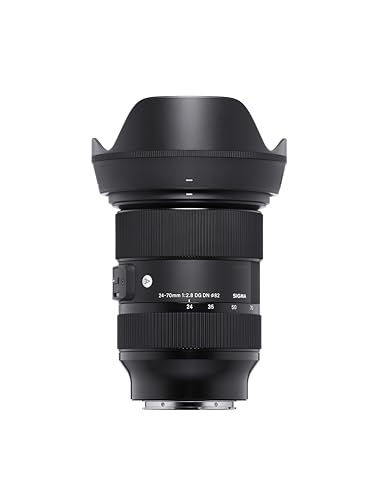 5. Sigma 24-70mm f/2.8 DG DN Art (B081L5HJBP) | Check price on Amazon |
How to Choose
Focal Range and Everyday Versatility
Focal range decides how much of a scene fits in the frame and how close a distant subject appears. A range that starts at 24mm covers wide interiors, landscapes, and group photographs. A range that ends at 105mm or 120mm reaches across a room and into a portrait distance that flatters faces. That is why 24-105mm and 24-120mm lenses are so popular as walk-around lenses. A 24-70mm lens is still versatile, but it gives up the longer end, so distant details need a step closer or a second lens. A 28-75mm lens gives up a little at the wide end as well, which matters in small rooms and tight streets.
Constant Aperture and Low-Light Performance
A constant aperture stays the same through the whole zoom range, so exposure does not change when zooming in. A variable aperture lens becomes darker at the long end. All five lenses in this guide have a constant aperture, either f/4 or f/2.8. An f/4 lens is lighter, smaller, and easier to carry all day. An f/2.8 lens gathers more light, which helps in dim rooms and at indoor events, and it creates stronger background blur. The trade is size, weight, and a shorter zoom range. Reach and lightness point toward f/4, while low light and background blur point toward f/2.8.
Mount Compatibility and Sensor Size
Mount compatibility is the first check and the easiest mistake to avoid. Canon RF lenses fit Canon RF mirrorless cameras. Nikon Z lenses fit Nikon Z mirrorless cameras. Sony E-mount lenses fit Sony E-mount full-frame and APS-C cameras, although the field of view changes on an APS-C body. On an APS-C camera, a 24-105mm lens behaves like a longer lens, roughly 36-158mm in full-frame terms, so the wide end is less wide than the numbers suggest.
Autofocus, Stabilization, and Handling
Autofocus speed and accuracy matter more in everyday use than many specification sheets suggest. A walk-around lens needs to lock focus on a moving child, a pet, or a speaker at an event without hunting back and forth. Modern ultrasonic, stepping, and linear motors are designed for quiet, fast focus, which also helps when recording video. Stabilization steadies the image when shooting handheld at slower shutter speeds, in low light, or at the long end of the zoom. Handling is the third part of this section. A lens that is too heavy or too front-heavy will stay at home, no matter how good its optics are. Check the weight, the balance on the camera body, and whether the lens extends when zooming.
Image Quality, Sharpness, and Background Blur
Sharpness across the frame, contrast, and control of flare and distortion decide whether a photograph looks clean at normal viewing sizes and in a large print. A good all-round zoom should be sharp in the center at every focal length and hold up well toward the corners when stopped down a little. Distortion at the wide end and vignetting at wide apertures are usually corrected in camera or in editing software. Background blur depends on aperture, focal length, and distance to the subject. An f/2.8 lens at 70mm or 75mm gives a softer background than an f/4 lens at the same distance. At 105mm or 120mm, an f/4 lens can still separate a subject from a busy background, especially outdoors.
Size, Weight, and Travel Friendliness
An all-round lens earns its place by being carried, not by sitting on a shelf. Weight, length, and filter size all affect how a kit feels after several hours. A lens above 800 grams is still usable, but it changes the balance and the bag. Filter size matters for anyone who already owns filters: a 67mm thread is compact, a 77mm thread is standard for many f/4 zooms, and an 82mm thread is larger and heavier. Weather sealing is another travel consideration, but sealing does not make a lens waterproof.
Close Focus, Video, and Everyday Extras
Minimum focus distance decides how close the lens can get to a small subject, a flower, or a product on a table. A shorter minimum focus distance gives more framing freedom without swapping to a macro lens. Some lenses in this guide focus very close at the wide end, which is useful for detail shots and video work. For video, quiet autofocus and minimal focus breathing matter, because a lens that jumps or changes framing while focusing will show up in footage. A lens hood, included in the box for most lenses here, reduces flare and protects the front element.
The Best All Round Zoom Lens for Digital Cameras Reviewed
1. Canon RF 24-105mm f/4L IS USM (B07H489XDQ)
The Canon RF 24-105mm f/4L IS USM is the classic Canon walk-around zoom for RF mirrorless cameras. It starts at 24mm for wide scenes and ends at 105mm for portraits and details, with a constant f/4 aperture that keeps exposure steady through the zoom. The L-series build includes weather sealing, a Nano USM autofocus motor for fast and quiet focusing, and optical stabilization for handheld shooting at slower shutter speeds. The lens weighs 700 grams, uses a 77mm filter, and focuses as close as 0.45 meters.
This lens suits Canon RF photographers who want one lens for travel, family, events, and general photography. It suits owners of Canon EOS R series bodies who want a native mount lens with full autofocus and stabilization communication.
Skip this lens if the camera is not a Canon RF mirrorless body, because the mount will not fit other systems. Skip it if low-light work and strong background blur are the main priorities, because an f/2.8 lens will serve those needs better.
2. Sony FE 24-105mm f/4 G OSS (B07X7KL6JM)
The Sony FE 24-105mm f/4 G OSS is the Sony E-mount equivalent of the Canon lens above. It covers 24mm to 105mm at a constant f/4, with Optical SteadyShot stabilization, a Direct Drive SSM autofocus motor, and a dust and moisture resistant design. The lens weighs 663 grams, uses a 77mm filter, focuses as close as 0.38 meters, and has a nine-blade aperture for smooth background blur. On an APS-C Sony body the field of view becomes narrower, so APS-C owners should remember the crop effect before buying.
This lens suits Sony photographers who want a single lens for travel, weddings, events, and everyday family photography. It suits video work as well as stills, because the autofocus is quiet and the stabilization helps handheld footage.
Skip this lens if the camera is not a Sony E-mount body, because the mount will not fit Canon, Nikon, or Fujifilm cameras. Skip it if the main work is in very dim light without flash, because an f/2.8 lens gathers more light.
3. Nikon NIKKOR Z 24-120mm f/4 S (B09KHB76TP)
The Nikon NIKKOR Z 24-120mm f/4 S gives the longest reach in this guide, and that extra 15mm at the long end is useful more often than the specification suggests. It covers 24mm to 120mm at a constant f/4, with S-line optics, a stepping motor for quiet autofocus, and a weather-sealed design for Nikon Z mirrorless cameras. The lens weighs about 630 grams, uses a 77mm filter, and focuses as close as 0.35 meters, the closest minimum focus distance in this group. On a DX format Z body the field of view becomes roughly 36-180mm, so DX owners should check whether the wide end still suits their work.
This lens suits Nikon Z photographers who want one lens for travel, landscapes, portraits, and events. It suits photographers who photograph details at a distance, because 120mm reaches farther than 105mm without a noticeable weight penalty.
Skip this lens if the camera is not a Nikon Z mirrorless body, because the mount will not fit Nikon F-mount DSLR cameras or other brands. Skip it if an f/2.8 aperture is needed for the dimmest indoor work, because this is an f/4 lens.
4. Tamron 28-75mm f/2.8 Di III VXD G2 (B09HMVJL47)
The Tamron 28-75mm f/2.8 Di III VXD G2 is the bright, light option for Sony E-mount photographers, and it trades a little range for a constant f/2.8 aperture. It covers 28mm to 75mm, with a VXD linear autofocus motor, a moisture resistant design, and a close focus distance of 0.18 meters at 28mm. The lens weighs 540 grams, uses a 67mm filter, and is noticeably lighter and more compact than the f/2.8 zooms from camera makers. Partial-fit flag: it starts at 28mm rather than 24mm, so it is less wide in tight rooms, and it ends at 75mm rather than 105mm or 120mm, so it reaches less far.
This lens suits Sony photographers who photograph portraits, events, and indoor subjects, and who want strong background blur and better low-light performance than an f/4 lens gives. It suits travel photographers who want a light kit and are willing to step back for a wider view.
Skip this lens if the camera is not a Sony E-mount body, because the mount will not fit other systems. Skip it if a true 24mm wide end is essential, because 28mm is visibly narrower. Skip it if long reach is the priority, because 75mm will feel short for distant subjects.
5. Sigma 24-70mm f/2.8 DG DN Art (B081L5HJBP)
The Sigma 24-70mm f/2.8 DG DN Art is a bright standard zoom for Sony E-mount cameras, designed for photographers who want the classic professional range at a constant f/2.8 aperture. It covers 24mm to 70mm, with a stepping motor for fast autofocus, a dust and splash resistant design, and an eleven-blade aperture for smooth background blur. The lens weighs 835 grams, uses an 82mm filter, and focuses as close as 0.25 meters. Partial-fit flag: 70mm is the shortest long end in this guide, so it is less of a walk-around telephoto than the 24-105mm and 24-120mm lenses, and it is the heaviest lens here.
This lens suits Sony photographers who work mainly between wide angle and short telephoto, including portraits, events, and studio sessions. It suits photographers who want the brightest aperture in this guide for subject separation and dim interiors.
Skip this lens if the camera is not a Sony E-mount body, because the mount will not fit other systems. Skip it if travel reach matters more than aperture, because a 24-105mm lens covers far more ground with one lens. Skip it if a light kit is the priority, because at 835 grams it is the heaviest lens in this group.
What to Check Before You Buy
Check the mount first, then the sensor size, then the range. Write down the camera model, look up its mount name in the manual or on the manufacturer site, and match it letter for letter to the lens listing. Canon RF, Nikon Z, Sony E, Fujifilm X, and Micro Four Thirds are different mounts. Next, confirm whether the camera is full frame or APS-C, because the same lens gives a narrower view on APS-C. Then check the focal range against real shooting habits: if most photographs are taken between 24mm and 70mm, a bright standard zoom may be enough, while if many are taken at 85mm to 120mm, a longer zoom will be used more often.
Check the aperture, stabilization, weight, and filter size together, because they trade against each other. An f/2.8 lens is brighter and heavier, an f/4 lens is lighter and longer. Check the minimum focus distance if close subjects matter, and check whether the lens hood, caps, and case are included in the box. Confirm that the listing is for the lens only, not a camera bundle or a renewed copy. Finally, check the lens on the camera if possible, because balance and zoom ring feel are hard to judge from a specification sheet alone.
FAQ
What is the best all round zoom lens for digital cameras?
The best all round zoom lens for digital cameras depends on the camera mount, but a constant aperture 24-105mm or 24-120mm zoom is the most balanced choice for most photographers. It covers wide scenes, normal views, and short telephoto portraits in one lens. Photographers who need more light and stronger background blur should compare a 24-70mm or 28-75mm f/2.8 zoom instead, and accept the shorter reach.
Is a 24-105mm lens good for everyday photography?
Yes, a 24-105mm lens is well suited to everyday photography, because it covers landscapes, interiors, street scenes, family photographs, and portraits without a lens change. The wide end handles tight spaces, the long end handles details and portraits, and the constant f/4 aperture keeps exposure predictable. It is less suited to very dim light than an f/2.8 lens.
Should I choose f/2.8 or f/4 for an all-round zoom?
Choose f/2.8 if low-light shooting, indoor events, and background blur are the main priorities, and the extra weight and shorter range are acceptable. Choose f/4 if a lighter lens, a longer zoom range, and all-day carrying comfort matter more. Modern cameras handle higher ISO settings well, so f/4 is enough for many outdoor and well-lit indoor situations.
Do I need a different lens for each camera brand?
Yes, in most cases a different lens is needed for each camera brand, because Canon RF, Nikon Z, Sony E, Fujifilm X, and Micro Four Thirds use different mounts. A lens must match the camera mount to fit and to communicate autofocus, aperture, and stabilization correctly.
Can one zoom lens replace several prime lenses?
One zoom lens can replace several prime lenses for general photography, travel, and events, because it covers many focal lengths in a single barrel. It will not match a prime lens for maximum aperture or background blur at the same focal length. For photographers who value flexibility over the brightest aperture, a good all-round zoom is a practical replacement for a set of primes.
Bottom Line
The best all round zoom lens for digital cameras is the one that matches the camera mount, covers the focal lengths used most often, and is light enough to carry every day. For Canon RF owners, the Canon RF 24-105mm f/4L IS USM is the balanced pick. For Sony owners, the Sony FE 24-105mm f/4 G OSS is the versatile pick, with the Tamron 28-75mm f/2.8 Di III VXD G2 as the brighter, lighter alternative and the Sigma 24-70mm f/2.8 DG DN Art as the brightest standard zoom. For Nikon Z owners, the Nikon NIKKOR Z 24-120mm f/4 S gives the most reach in this group. Check the mount first, then choose between reach and aperture.
Disclosure: As an Amazon Associate, we may earn from qualifying purchases.
Related guides
More from Amazon
Programs that pair well with the guide above. Offers and eligibility are set by Amazon and may change.
Free shipping on eligible items, Prime Video and more. Eligible new members can start with a free trial.
Start a Prime free trialAudiobooks and podcasts to listen to on the go. Eligible new members can start with a free trial.
Try Audible freeAd-free music streaming. Eligible new subscribers can start with a free trial.
Try Music Unlimited freeA free business account with business pricing and bulk-buying tools for work, shop or home office.
Create a business accountAs an Amazon Associate we earn from qualifying purchases.










Write Your Review
No reviews yet. Be the first to share your experience!