
Key takeaways
- Find the best aquarium cameras for clear through-glass monitoring and underwater tank views today, with night vision, wide-angle lenses and remote viewing.
What's inside
As an Amazon Associate I earn from qualifying purchases. This post may contain affiliate links at no extra cost to you.
The best aquarium cameras let you watch your fish clearly without standing in front of the tank all day. A good aquarium camera shows feeding, swimming, hiding, and signs of stress, and it keeps working when the room lights go out. The right choice depends on the size of your tank, the kind of fish you keep, and whether you want a live view while you are away from home or a recorded clip you can check later.


The quick answer is simple. For most home aquariums, a through-glass Wi-Fi camera with a wide-angle anti-glare lens, night vision, and motion alerts is the easiest and most practical choice. It needs no waterproof housing, it stays dry, and it can be moved from one tank to another in minutes. For a large tank, a pond, or a planted aquascape where you want a true underwater viewpoint, a wired submersible camera is the better tool, even though it needs more planning for power and cabling. The five cameras below cover both approaches, so you can match the camera to the tank instead of forcing the tank to fit the camera.
Quick Picks
Our Short List of 3
All 5 Picks at a Glance
| Product | Specs | Action |
|---|---|---|
| Amouu 2K HD Aquarium and Terrarium WiFi Pet Camera (B0FGJCSQQN) | Check price on Amazon | |
| Barlus Underwater Camera, Aquarium Live Streaming Pond 5MP Camera with 32ft Cables (B08V8B9P51) | Check price on Amazon | |
 SnapBud 3MP 2K AI Reptile and Aquarium Camera (B0G6CVYSHS) | Check price on Amazon | |
 J-SINIGIDIN Fish Tank Camera, 2K HD for Aquarium and Reptile Terrarium (B0GF1X5XNW) | Check price on Amazon | |
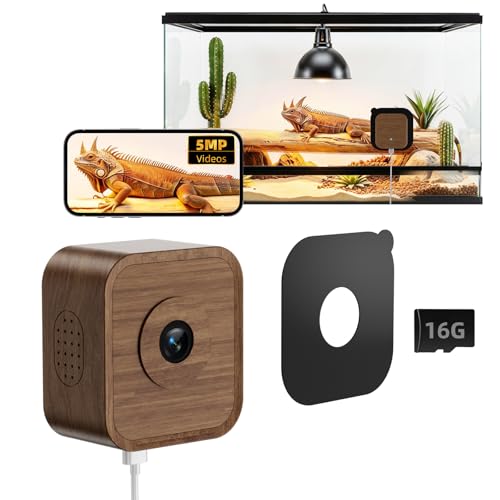 SV3C 5MP Aquarium and Terrarium Camera (B0GLFT91PT) | Check price on Amazon |
How to Choose
Through-Glass or Underwater
The first decision is where the camera will sit. Through-glass cameras mount on the outside of the tank, usually with a magnetic mount, and look through the glass at the fish. They are easy to install, easy to clean, and easy to move. Underwater cameras sit inside the tank or pond and record the view from within the water. They give a more direct angle and avoid glass reflections entirely, but they need a sealed body, a cable route out of the water, and a plan for cleaning algae from the lens.
Resolution and Lens Angle
Resolution decides how much detail you can see in fins, scales, plants, and small fish. A 2K camera with a 3MP sensor is a solid baseline for a home aquarium, and a 5MP camera gives extra detail for larger tanks or for close-up viewing. Lens angle matters just as much. A wide-angle lens of 120 to 140 degrees can cover a whole tank from a short distance, which is useful when space around the tank is tight.
Anti-Glare and Close Focus
Glass is the hardest part of filming an aquarium. Room lights, windows, and the tank light itself can all create reflections that wash out the picture. Cameras made for aquariums often use an anti-glare lens design and a mount that holds the lens close to the glass, which cuts reflections and keeps the image clear. Close focus is the other key feature. A normal camera may struggle to focus on fish that are only a few centimetres from the lens, while a close-focus lens is designed for exactly that distance.
Night Vision and Lighting
Fish do not stop moving when the tank light goes out, and problems often show up at night. Night vision lets you check the tank after dark without switching the main light on and disturbing the fish. Colour night vision can help you tell fish apart in low light, while infrared night vision works in darkness. Pay attention to how a camera handles light. Some underwater cameras have no built-in lights at all, which avoids adding heat to the water and avoids startling light-sensitive fish.
Connectivity, Recording, and Alerts
A camera is only useful if you can see what it sees when you need it. Wi-Fi cameras connect to a phone app and let you watch a live feed from another room or another town. Wired cameras connect through an Ethernet cable to a router or recorder. A wired connection can be more stable for a permanent underwater installation, but it needs a cable run and a nearby network point. Recording matters too. Some cameras record continuously to a microSD card, some record events only, and some build a daily time-lapse.
Mounting, Power, and Tank Safety
Mounting decides whether a camera stays put and whether it is easy to adjust. Magnetic mounts are common for through-glass cameras because they need no drilling and can be repositioned without tools, but they depend on the thickness of your glass. Check the mount against your tank before buying, especially for thick glass on large aquariums. Underwater cameras usually need a wired power supply and a cable long enough to reach from the tank to a socket or network point without pulling tight.
Tank Size and Fish Type
A small betta tank, a community tank, and a large cichlid or reef setup need different cameras. A small tank needs a compact camera with close focus and a wide enough angle to cover the whole tank from a short distance. A long tank may need a wider lens or a camera placed at one end to see the full length. Large fish move fast and need a camera with smooth video and a wide field of view, while small or shy fish need a camera that can focus close and work in low light without a bright light scaring them into hiding.
The Best Aquarium Cameras Reviewed
Amouu 2K HD Aquarium and Terrarium WiFi Pet Camera (B0FGJCSQQN)
The Amouu 2K HD Aquarium and Terrarium WiFi Pet Camera is the most balanced through-glass pick in this roundup. It records 2K video from a 3MP CMOS sensor, and its 140-degree wide-angle lens is designed to cover an enclosure from corner to corner. The anti-glare and anti-reflection design is aimed directly at the main problem with filming through glass, and the listing pairs it with night vision, two-way audio, AI-powered motion detection, and continuous loop recording to a microSD card of up to 256GB. A built-in 800mAh battery allows temporary cord-free placement and gives backup during short power interruptions.
This camera suits keepers who want a simple, wide view of a home aquarium without a complicated installation. It fits a community tank, a planted tank, or a terrarium setup where the camera can sit close to the glass and watch the whole scene. It is less suited to anyone who wants a true underwater angle, because this is a through-glass camera, not a submersible one. It is also less suited to very large tanks where a single wide-angle view from one side may not show the far end in enough detail.
Barlus Underwater Camera, Aquarium Live Streaming Pond 5MP Camera with 32ft Cables (B08V8B9P51)
The Barlus Underwater Camera is the only true submersible camera in this roundup, and it is built for a different job from the through-glass models. It records 5MP video at 2592 by 1944 pixels, uses a 2.0mm lens with a 110-degree angle and a default focus of 2 metres, and comes with a 32-foot cable. The body is seawater-grade stainless steel with an IP68 waterproof design, and the listing states that it can be permanently fixed underwater. It is designed for live streaming to a mobile app and for viewing through a browser or compatible recorder, and it is a wired camera that connects to a router with an Ethernet cable rather than connecting directly to Wi-Fi.
One notable design choice is the absence of built-in lights. The listing states that all underwater camera lights emit heat, and that this model is intended for keepers who are worried that lights will disturb their fish. This camera suits large tanks, ponds, and aquaculture setups where an underwater viewpoint is the point of the purchase. It does not suit someone who wants a quick magnetic mount on a small glass tank, a wireless camera, or a camera with built-in lighting for dark water. Installation needs more planning, but the underwater view is something no through-glass camera can match.
SnapBud 3MP 2K AI Reptile and Aquarium Camera (B0G6CVYSHS)
The SnapBud 3MP 2K AI Reptile and Aquarium Camera is built around close viewing through glass. It records 2K video from a 3MP sensor, and its close-focus lens is designed for fish, lizards, and other small animals viewed at short range. The angle magnetic mount lets you set the camera at an angle on the glass, which is useful for looking into a corner, a cave, or a feeding area that a straight-on camera would miss. The listing states dual-band Wi-Fi on 2.4GHz and 5GHz, continuous recording, and an anti-glare design with no reflection, plus audio and motion alerts.
This camera suits keepers of small fish, shrimp, fry, or bettas who want a sharp close view rather than a wide view of the whole room. It also suits anyone with a tank in a bright room, because the anti-glare design and close mounting help cut reflections. It is less suited to a very long tank where you need to see the full length at once, and it is not a submersible camera, so it cannot show the tank from inside the water.
J-SINIGIDIN Fish Tank Camera, 2K HD for Aquarium and Reptile Terrarium (B0GF1X5XNW)
The J-SINIGIDIN Fish Tank Camera is a through-glass 2K HD camera made for aquariums and reptile terrariums. It uses a 140-degree wide-angle lens with an anti-glare design, and it pairs that with night vision, Wi-Fi connectivity, AI motion detection, and two-way audio. The listing states continuous recording to cloud storage or a microSD card, so you can keep a record of the tank as well as watching it live. The model number is S20M, and the listing gives a 3MP photo sensor resolution with a 2K video capture resolution.
This camera suits keepers who want broad coverage of a tank from a single mounting point. The 140-degree lens helps in a small room or on a tank that sits against a wall, and the night vision and motion alerts make it useful for overnight checks. It is less suited to anyone who wants a close-up view of tiny fish, because a wide-angle lens spreads its detail across the whole tank rather than concentrating it on one small area. It is also a through-glass camera, so it will not give an underwater angle.
SV3C 5MP Aquarium and Terrarium Camera (B0GLFT91PT)
The SV3C 5MP Aquarium and Terrarium Camera stands out for its time-lapse feature. It records 5MP video, uses a 120-degree wide-angle anti-glare lens, and builds a daily time-lapse video, which is a useful way to watch plant growth, fish behaviour over a day, or changes in the tank without watching hours of footage. The listing states AI motion alerts, colour night vision, and an easy magnetic installation, and it records to a microSD card. The macro focus range is given as 20 centimetres, with autofocus, and the model number is LC6212.
This camera suits keepers who like to keep a visual record of their tank. A daily time-lapse can show how plants fill in, how fish use different parts of the tank, and whether a new decoration or layout changes behaviour. The 5MP resolution gives extra detail for that record, and the colour night vision helps keep the image usable after the main tank light goes off. It is less suited to someone who only wants a simple live view with no recording, or to a keeper who needs a true underwater camera.
What to Check Before You Buy
Before you buy, check the glass thickness of your tank against the mount, because a magnetic mount that works on a small glass tank may not hold on thick glass. Check the distance from the camera position to the nearest socket and to your Wi-Fi router, and check whether a wired camera has a cable long enough for that run. Clean the outside of the glass before you mount a through-glass camera, because dust, water marks, and algae on the glass will show in every frame.
Check the recording plan as well. Find out whether the camera records to a microSD card, whether a card is included, and how long continuous recording will keep before older footage is overwritten. Check whether motion alerts can be limited to a zone, so that filter bubbles and plant movement do not fill your phone with notifications. For an underwater camera, check the cable length, the power supply, and the way the camera connects to your network, and plan the cable route so it stays tidy and dry where it leaves the water.
FAQ
Can an aquarium camera go underwater?
Some can, and most cannot. A submersible camera such as the Barlus model in this roundup is built with a sealed stainless steel body and a waterproof cable for permanent underwater use. Through-glass cameras such as the Amouu, SnapBud, J-SINIGIDIN, and SV3C models sit outside the tank and look through the glass.
Do I need Wi-Fi for an aquarium camera?
Most through-glass cameras in this roundup use Wi-Fi to send a live view to a phone app, and they need a stable signal near the tank. Wired underwater cameras may connect through an Ethernet cable to a router instead, and then allow wireless viewing on a phone through the network. If your tank is far from the router, check the signal strength at the tank before buying, or consider a wired model for a permanent installation.
Will a camera stress my fish?
A camera itself is usually less stressful than a person standing in front of the tank, because it is small and still. Bright lights, sudden movement near the glass, and tapping on the tank are more likely to disturb fish. A camera with no built-in lights, or with infrared night vision, can be a gentler choice for shy or light-sensitive fish.
How do I stop reflections in aquarium camera footage?
Mount the lens close to the glass, clean the glass inside and out, and reduce bright lights behind the camera. An anti-glare lens design helps, and a magnetic mount that holds the camera flat against the glass helps more.
Is a 2K camera enough for a fish tank?
For most home aquariums, 2K video from a 3MP sensor is enough to see fish clearly, to tell species apart, and to spot changes in behaviour or health. A 5MP camera gives more detail for a large tank, for time-lapse recording, or for close viewing of small fish and plants.
Bottom Line
The best aquarium cameras in this roundup fall into two clear groups. If you want an easy live view of a home aquarium, choose a through-glass camera with a wide-angle anti-glare lens, night vision, and motion alerts. The Amouu 2K HD camera is the most balanced choice for most tanks, the SnapBud is the best fit for close viewing of small fish, the J-SINIGIDIN gives broad coverage from one mounting point, and the SV3C adds a daily time-lapse and 5MP detail for keepers who want a visual record. If you want a true underwater view of a large tank, a pond, or an aquaculture setup, the Barlus 5MP underwater camera is the only pick here that goes into the water, and it needs a wired connection and a planned cable run.
Start by deciding whether you need a through-glass view or an underwater view, then match the lens angle and close focus to your tank size and your fish. With the right match, an aquarium camera turns a tank you glance at into a tank you can actually watch, day and night, from anywhere.
Disclosure: As an Amazon Associate, we may earn from qualifying purchases.
Related guides
More from Amazon
Programs that pair well with the guide above. Offers and eligibility are set by Amazon and may change.
Free shipping on eligible items, Prime Video and more. Eligible new members can start with a free trial.
Start a Prime free trialAudiobooks and podcasts to listen to on the go. Eligible new members can start with a free trial.
Try Audible freeAd-free music streaming. Eligible new subscribers can start with a free trial.
Try Music Unlimited freeA free business account with business pricing and bulk-buying tools for work, shop or home office.
Create a business accountAs an Amazon Associate we earn from qualifying purchases.










Write Your Review
No reviews yet. Be the first to share your experience!