
Our Short List of 3
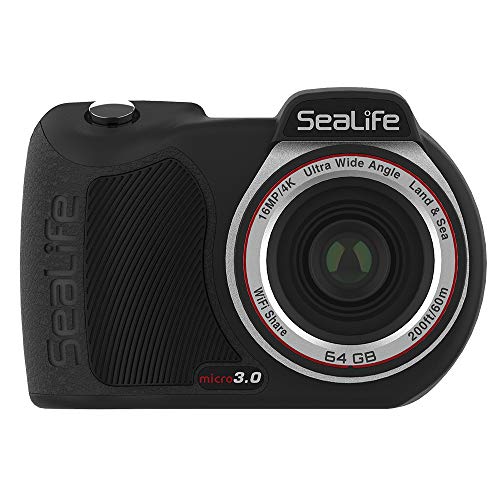
- Depth: 200 ft / 60 m, permanently sealed body, no housing required
- Sensor: 16MP Sony CMOS
- Video: 4K at 30 fps; 1080p at up to 120 fps
- Stills: 16MP with RAW capture

- Depth: 20 m camera alone (IP68); 60 m in the waterproof case (sold separately)
- Sensor: 1/1.3-inch CMOS
- Video: 4K at up to 120 fps
- Displays: dual OLED touchscreens

- Depth: 18 m camera alone; 60 m in the waterproof case (sold separately)
- Sensor: 1/1.3-inch CMOS
- Video: 4K at up to 120 fps
- Colour: 10-bit D-Log M
All 4 Picks at a Glance
| Product | Specs | Action |
|---|---|---|
| 1. SeaLife Micro 3.0 — the sealed camera built only for diving |
| Check price on Amazon |
| 3. DJI Osmo Action 5 Pro — the action camera with a diver’s instrument panel |
| Check price on Amazon |
| 4. DJI Osmo Action 4 — the previous generation, still a real dive camera |
| Check price on Amazon |
 5. Insta360 X5 — the 360 camera for reframing the dive later |
| Check price on Amazon |
Key takeaways
- Compare the best underwater cameras for diving: a sealed SeaLife rated to 200 ft, the TG-7, two DJI Osmo Action models and a 360 option, with full specs.
What's inside
- What separates a dive camera from a swim camera
- 1. SeaLife Micro 3.0 — the sealed camera built only for diving
- 2. OM System Tough TG-7 — the stills compact divers keep coming back to
- 3. DJI Osmo Action 5 Pro — the action camera with a diver’s instrument panel
- 4. DJI Osmo Action 4 — the previous generation, still a real dive camera
- 5. Insta360 X5 — the 360 camera for reframing the dive later
- Choosing between them
- Frequently Asked Questions
As an Amazon Associate I earn from qualifying purchases. This post may contain affiliate links at no extra cost to you.
Disclosure: As an Amazon Associate, we earn from qualifying purchases made through links on this page, at no extra cost to you.
A camera that survives a swim is not automatically a camera that survives a dive. Pressure builds quickly below the surface, buttons that work at the pool stop responding at depth, and a seal that holds against splashes can fail at 30 metres. The best underwater cameras for diving are the ones whose makers publish a genuine scuba depth figure, whose controls stay usable with gloves on, and whose seals are designed for repeated descents rather than a single holiday swim.
This guide compares five cameras that meet that bar in different ways. One is a permanently sealed dive camera rated to 200 feet with no housing at all. One is a tough compact that stills photographers have carried on dives for years. Two are action cameras with native depth limits of 18 and 20 metres plus maker-rated dive cases that extend them to 60 metres. The last is a 360 camera for divers who want to reframe the whole scene afterwards. Every depth figure below is quoted the way the maker publishes it, with the basis stated — camera alone, or camera inside its housing — because that distinction is the single most important line in any dive camera spec sheet.
What separates a dive camera from a swim camera
Depth limit and its basis. Recreational scuba limits run to 40 metres for advanced divers, and most guided reef dives sit between 12 and 30 metres. A camera rated to 10 metres is a snorkel camera, whatever the marketing says. Look for a published figure of at least 15 metres for the camera alone, or a housing figure in that range with the housing actually included or clearly identified as a separate purchase.
Seals and servicing. Permanently sealed cameras remove the flood risk that comes with opening a housing, but the seal cannot be serviced by the owner. Housing-based systems let the camera stay dry behind an O-ring that needs cleaning, inspection and silicone grease before every dive day. Neither approach is wrong; they suit different owners.
Controls at depth. Touchscreens stop working reliably underwater and are useless through most housings. Large physical buttons, levers that move with thick gloves, and simple menus matter more below the surface than screen size.
Light and colour. Water absorbs red light within the first few metres, so underwater colour modes, manual white balance and the option to add a dive light or red filter decide how much colour survives in the frame. Every camera here offers maker-published underwater modes or colour tools of some kind.
Stills or video first. Dedicated stills cameras bring RAW files, optical zoom and macro modes. Action cameras bring high frame rates, wide fields of view and strong stabilisation. The 360 camera records everything and lets the framing happen later. Choose by what you actually shoot.
1. SeaLife Micro 3.0 — the sealed camera built only for diving
- Depth: 200 ft / 60 m, permanently sealed body, no housing required
- Sensor: 16MP Sony CMOS
- Video: 4K at 30 fps; 1080p at up to 120 fps
- Stills: 16MP with RAW capture
The Micro 3.0 takes the most direct route to depth: there is no housing and no door to flood. SeaLife builds the camera as a permanently sealed unit rated to 200 feet (60 metres), which covers the full recreational range and beyond without any accessory. Because the body never opens, there is no O-ring routine before a dive — the trade-off is that the battery and memory are internal, so the 64GB of built-in storage and the internal battery are what you dive with.
Inside is a 16MP Sony CMOS sensor behind a wide-angle lens, recording 4K video at 30 frames per second and 1080p at up to 120 frames per second for slow motion. SeaLife’s published feature list leans into diving: large piano-key buttons sized for gloves, dedicated underwater scene modes, colour correction filters for blue water, green water and freshwater, burst shooting, time-lapse, and Wi-Fi transfer to the SeaLife app. RAW stills are part of the package, which is unusual at this size and gives stills shooters real editing room.
For a diver who wants one self-contained unit that goes from the boat straight to 40 metres with nothing to assemble, this is the cleanest answer in the guide. Divers who shoot long multi-dive days should note the sealed design: when the internal battery runs down, charging happens between dives rather than by swapping a spare.
2. OM System Tough TG-7 — the stills compact divers keep coming back to
The TG-7 is the current model in a line that has been the default recommendation for dive stills for years. The camera alone is waterproof to 15 metres (50 feet) as published by OM System, which covers shallow reef dives and freediving on its own seals. For deeper work, OM System publishes a 45 metre (147 foot) figure with the camera inside its PT-059 underwater housing, a separate accessory — so the honest way to read this pick is as a 15 metre camera that becomes a full-range dive camera when housed.
What keeps photographers with the TG series is the glass and the macro system. The 12MP back-lit CMOS sensor sits behind a bright f/2.0–4.9 lens with 4x optical zoom (25–100mm equivalent), and the Variable Macro System with microscope modes focuses far closer than action cameras can. It records 4K video at 30p, shoots RAW, and carries the full tough suite: shockproof to 2.1 metres, crushproof to 100 kgf and freezeproof to −10 °C as the maker publishes them.
Divers building a small stills rig around tray and lights get the most from this one. On its own it handles the shallows; in the housing it handles everything recreational, with macro ability nothing else in this guide matches.
Specs
- Depth: 15 m / 50 ft camera alone; 45 m / 147 ft in the PT-059 housing (sold separately)
- Sensor: 12MP back-lit CMOS
- Lens: 25–100mm equivalent, f/2.0–4.9, 4x optical zoom
- Video: 4K at 30p
- Stills: 12MP with RAW capture
- Macro: Variable Macro System with microscope modes
- Tough figures as published: shockproof 2.1 m, crushproof 100 kgf, freezeproof −10 °C
3. DJI Osmo Action 5 Pro — the action camera with a diver’s instrument panel
- Depth: 20 m camera alone (IP68); 60 m in the waterproof case (sold separately)
- Sensor: 1/1.3-inch CMOS
- Video: 4K at up to 120 fps
- Displays: dual OLED touchscreens
DJI publishes an IP68 figure of 20 metres for the Osmo Action 5 Pro with no case fitted, and 60 metres with the camera inside its waterproof case, a separate accessory. Twenty metres caseless already covers open-water certification depths, and the case figure reaches the bottom of the recreational range. Uniquely here, the camera also carries a built-in pressure sensor: DJI publishes real-time diving depth and altitude displays, so the camera shows depth data on screen while it records.
The imaging side runs on a 1/1.3-inch CMOS sensor with 4K video at up to 120 frames per second, subject tracking, dual OLED touchscreens and 47GB of built-in storage alongside the card slot. DJI publishes up to four hours of recording from the 1,950 mAh battery under its stated conditions. Stabilisation is electronic, with horizon-steady modes that hold the frame level as a diver rolls.
For video-first divers this is the most complete action option: the deepest caseless figure among the action cameras here, depth instrumentation no rival in this list offers, and a case path to 60 metres for deep wreck and wall dives.
4. DJI Osmo Action 4 — the previous generation, still a real dive camera
- Depth: 18 m camera alone; 60 m in the waterproof case (sold separately)
- Sensor: 1/1.3-inch CMOS
- Video: 4K at up to 120 fps
- Colour: 10-bit D-Log M
The Osmo Action 4 publishes an 18 metre caseless depth figure and the same 60 metre figure inside its waterproof case. Eighteen metres matches the open-water training limit exactly, which makes this a genuine dive camera as sold, and the case extends it across the full recreational range for divers who later add one.
It shares the 1/1.3-inch CMOS sensor format with its successor and records the same headline 4K at up to 120 frames per second, with a 155° field of view and 10-bit D-Log M colour for graders who like to finish footage on a computer. DJI publishes up to 160 minutes of recording time. What it gives up against the Action 5 Pro is the pressure-sensor depth display and some low-light refinement; what it keeps is the sensor size, the frame rates and the depth figures that matter.
Divers who record for themselves rather than for an audience, and who do not need on-screen depth data, get the same essential dive capability here in the earlier model.
5. Insta360 X5 — the 360 camera for reframing the dive later
- Depth: 15 m / 49 ft camera alone; 50 m in the Invisible Dive Case (sold separately)
- Sensors: dual 1/1.28-inch
- Video: 8K 360 at 30 fps; 5.7K 360 at 60 fps; 4K single-lens mode
- Stills: 72MP 360 photos
The X5 takes a different approach to the whole problem: two fisheye lenses record the full sphere, so the diver points the camera roughly at the scene and chooses the framing afterwards in the app. Insta360 publishes a 15 metre (49 foot) waterproof figure for the camera alone and a 50 metre figure with the camera in its Invisible Dive Case, a separate accessory in which the case sits outside the stitched frame.
Dual 1/1.28-inch sensors feed 8K 360 video at 30 frames per second and 5.7K 360 at 60, plus 72MP 360 stills. The lenses are user-replaceable, a practical point on a camera whose glass sits exposed on both faces and can meet rock or wreckage. FlowState stabilisation and 360 horizon lock are built in, and single-lens mode records conventional 4K footage when a flat frame is wanted.
This is the pick for divers who film encounters — a turtle pass, a shark approach, a buddy team spreading out — where the action refuses to stay in one direction. The depth basis needs the same honesty as the others: 15 metres bare covers shallow dives, and the deeper figure belongs to the case.
Choosing between them
Start with the depth you actually dive and work backwards. A diver whose logbook lives between 20 and 40 metres should anchor on the SeaLife Micro 3.0, which reaches 60 metres with nothing to add, or plan on a case for the action cameras. A photographer who shoots macro stills belongs with the TG-7 and its housing path. A videographer who wants depth data on screen belongs with the Action 5 Pro. The Action 4 covers the same video ground for divers who can skip the instruments, and the X5 suits anyone whose subjects move in every direction at once.
Whichever camera makes the list, two habits protect it. Rinse in fresh water after every salt dive, working the buttons under the tap so grit leaves the seals, and inspect any housing O-ring against a bright light before closing it — a single hair across the seal is the most common flood cause there is. Depth figures also assume the maker’s conditions: cases and housings carry their own limits, seals age, and a camera that has taken a hard drop deserves a shallow test dive before a deep one.
Frequently Asked Questions
How deep does an underwater camera need to go for scuba diving?
Match the published figure to your diving. Open-water training dives stay within 18 metres, advanced recreational limits reach 40 metres, and most guided reef dives sit in between. A camera published at 15 to 20 metres covers shallow recreational diving on its own seals; anything deeper needs a model whose bare figure or included housing figure covers the planned depth, quoted with its basis.
Is a waterproof case the same as a dive housing?
Both extend a camera’s depth figure, and makers use the terms loosely. What matters is the published depth for the combination and whether the case is in the box or sold separately. In this guide the SeaLife needs nothing added, while the DJI and Insta360 depth extensions come from cases bought separately — the figures are stated with that basis in each spec block.
Why does underwater footage lose its colour?
Water filters sunlight as depth increases, absorbing red first, then orange and yellow, which is why uncorrected footage trends blue-green. Underwater scene modes and white balance tools shift the balance back in camera, and a dive light restores the full spectrum at close range. Several cameras here publish dedicated underwater colour modes for exactly this reason.
Can these cameras be used for snorkelling and freediving too?
Yes — every camera here works at the surface and in the shallows, and their depth figures comfortably cover snorkelling and recreational freediving depths. The sealed SeaLife and the TG-7 suit long surface intervals with no setup, while the action cameras double as general travel cameras out of the water.
Related guides
More from Amazon
Programs that pair well with the guide above. Offers and eligibility are set by Amazon and may change.
Free shipping on eligible items, Prime Video and more. Eligible new members can start with a free trial.
Start a Prime free trialAudiobooks and podcasts to listen to on the go. Eligible new members can start with a free trial.
Try Audible freeAd-free music streaming. Eligible new subscribers can start with a free trial.
Try Music Unlimited freeA free business account with business pricing and bulk-buying tools for work, shop or home office.
Create a business accountAs an Amazon Associate we earn from qualifying purchases.










Write Your Review
No reviews yet. Be the first to share your experience!