
Key takeaways
- Compare five cameras for road trips by zoom range, battery life per charge, stabilisation and carry weight, from pocket compacts to superzoom models.
What's inside
- What actually matters on the road
- 1. Panasonic LUMIX ZS99 — the pocket travel zoom
- 2. Sony RX100 VII — the premium pocket camera
- 3. Panasonic LUMIX ZS300 — the big-sensor travel zoom
- 4. Panasonic LUMIX FZ80D — the long-reach bridge that stays light
- 5. Nikon COOLPIX P950 — the maximum-reach option
- Choosing between them
- Frequently asked questions
As an Amazon Associate I earn from qualifying purchases. This post may contain affiliate links at no extra cost to you.
A road trip asks a lot of a camera. It has to live in a jacket pocket or a daypack for hours, come out fast at a scenic overlook, frame everything from a wide valley to a hawk circling above it, and still have charge left when the light turns good in the evening. The five cameras in this guide cover that spread in different ways: three pocketable compacts with very different lenses, and two bridge cameras that trade pocket size for serious telephoto reach.
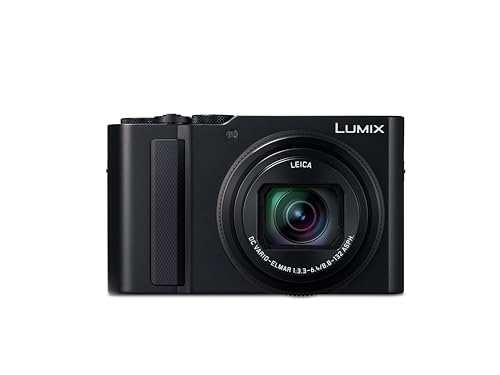

Every figure quoted below comes from the maker’s own published specifications. Battery figures are the makers’ published per-charge numbers, measured to the CIPA standard where the maker states that basis, and weights are the published figures including battery and memory card unless a section says otherwise. That keeps the comparison on documented numbers rather than impressions, which matters when the differences between two models come down to 60 shots per charge or 20 grams.
Disclosure: As an Amazon Associate, we earn from qualifying purchases made through links on this page, at no extra cost to you.
What actually matters on the road
Zoom range is the first decision, because it decides what kinds of stops the camera can handle. A 24 mm wide end covers landscapes, town squares and car interiors; reach beyond 400 mm in equivalent terms starts to pull in wildlife, distant landmarks and detail across a canyon. The pocket cameras here top out between 100 mm and 720 mm equivalent, while the two bridge models run to 1200 mm and 2000 mm. Neither end is automatically better — it depends on whether the trip is mostly towns and viewpoints or mostly open country and wildlife pull-outs.
Battery life per charge is the second decision, and it is the one most likely to shape a day. Published stills figures in this group run from about 260 shots to about 380 shots per charge, and video drains a battery far faster than stills on every model. Charging options soften the gap: four of the five cameras here can be charged over USB, which means a power bank or a car USB socket can top the camera up between stops. The remaining model charges its battery in-camera through its supplied adapter, so a spare battery matters more with it.
Weight and stabilisation finish the picture. The compacts here weigh between about 302 g and 337 g ready to shoot, light enough to forget in a coat pocket. The bridge cameras weigh about 640 g and about 1005 g, which is daypack territory rather than pocket territory. Stabilisation matters most at the long end of a zoom: each maker publishes its own system, and Nikon publishes a CIPA-measured figure for its bridge model, quoted exactly in that section below.
1. Panasonic LUMIX ZS99 — the pocket travel zoom
The ZS99 is the camera in this group that asks the least of the person carrying it. It weighs about 322 g with battery and card, slips into a jacket pocket, and still covers a 24–720 mm equivalent range through its 30x LEICA DC VARIO-ELMAR zoom. That range handles the full road trip repertoire — wide valley views at 24 mm, portraits and street scenes in the middle, and wildlife or distant detail at the long end — without a second lens or a camera bag.
Its published battery figure is the strongest among the pocket cameras here: about 380 images per charge to the CIPA standard. Panasonic also publishes USB Type-C charging for the ZS99, so the same cable and power bank that serve a phone can refill the camera during a lunch stop. The 3-inch touchscreen tilts up for low angles and selfies, 5-axis HYBRID O.I.S.+ steadies handheld shots and video, and the 4K Photo mode pulls 8-megapixel stills from short 4K bursts when a moment moves too fast for a single frame. The honest trade-off is the sensor: at 1/2.3-inch it is the smallest format in this guide alongside the bridge models, and there is no viewfinder, so bright midday sun means composing on the rear screen.
Specs
- Sensor: 1/2.3-inch High Sensitivity MOS, 20.3 megapixels effective
- Lens: LEICA DC VARIO-ELMAR 30x optical zoom, 24–720 mm equivalent, f/3.3–6.4
- Stabilisation: 5-axis HYBRID O.I.S.+
- Video: 4K (3840 × 2160) at 30p; 4K Photo mode
- Battery: Li-ion pack (7.2 V, 1025 mAh); approx. 380 images per charge (CIPA standard); USB Type-C charging
- Weight: approx. 322 g including battery and memory card
- Screen: 3.0-inch tilting touchscreen, 1,840k dots
See the Panasonic LUMIX ZS99 on Amazon
2. Sony RX100 VII — the premium pocket camera
The RX100 VII packs the largest sensor of any pocket camera in this guide into the lightest body here: about 302 g ready to shoot. Its 1.0-type stacked Exmor RS CMOS sensor and ZEISS Vario-Sonnar T* lens covering 24–200 mm equivalent give it the strongest low-light and detail performance of the three compacts, and its autofocus system — with real-time tracking and Eye AF as Sony publishes them — is built for the moving subjects a road trip keeps producing, from children at a rest stop to animals at a fence line.
Two published details suit it specifically to driving days. The pop-up OLED viewfinder gives an eye-level option when midday sun washes out a rear screen at an overlook, and Sony publishes USB charging and USB power supply for the camera, so it can sip power from the car between stops. The counterweight is stamina: Sony publishes approx. 260 shots per charge with the monitor and approx. 240 with the viewfinder, both to the CIPA standard, so a spare NP-BX1 in the glovebox is a sensible companion on long days. Optical SteadyShot handles stabilisation, and 4K video is there when a stretch of road deserves motion rather than stills.
Specs
- Sensor: 1.0-type Exmor RS CMOS (stacked), 20.1 megapixels effective
- Lens: ZEISS Vario-Sonnar T* 24–200 mm equivalent, f/2.8–4.5
- Stabilisation: Optical SteadyShot
- Video: 4K (3840 × 2160) up to 30p
- Battery: NP-BX1; approx. 260 shots per charge (monitor) or 240 shots (viewfinder), CIPA standard; USB charging published
- Weight: approx. 302 g including battery and memory card
- Viewfinder: pop-up OLED, approx. 2.36 million dots
See the Sony RX100 VII on Amazon
3. Panasonic LUMIX ZS300 — the big-sensor travel zoom
The ZS300 answers a different question from its ZS99 sibling: what if the pocket camera also had a large sensor? Its 1-type back-illuminated CMOS sensor is the same size class as the Sony’s, and Panasonic pairs it with a 15x LEICA DC VARIO-ELMAR zoom covering 24–360 mm equivalent — the longest zoom fitted to a 1-inch pocket camera, and enough to handle everything from wide valley views to a performer on a distant stage or a landmark across a harbour. It is the newest design in this guide, announced in 2026 as the successor to the long-running ZS200 line.
The road numbers are strong: Panasonic publishes approx. 360 images per charge to the CIPA standard, USB Type-C charging through the same battery family as the ZS99, and a ready-to-shoot weight of about 337 g including battery and card. The 3.0-inch touchscreen carries 1,840k dots, 5-Axis HYBRID O.I.S.+ steadies the lens, and 4K Photo mode sits alongside 4K video for fast-moving moments. The trade-offs are plainly published too: there is no viewfinder on this model, the rear screen is fixed rather than tilting, and the lens opens to f/3.3 at the wide end, a step behind the Sony’s f/2.8. Travellers choosing between the two Panasonics are really choosing between the ZS99’s smaller sensor and double the reach, and this camera’s larger sensor and moderate reach.
Specs
- Sensor: 1-type back-illuminated (BSI) CMOS, 20.1 megapixels effective
- Lens: LEICA DC VARIO-ELMAR 15x optical zoom, 24–360 mm equivalent, f/3.3–6.4
- Stabilisation: 5-Axis HYBRID O.I.S.+
- Video: 4K (3840 × 2160) at 30p; 4K Photo mode
- Battery: Li-ion pack (7.2 V, 1025 mAh); approx. 360 images per charge (CIPA standard); USB Type-C charging
- Weight: approx. 337 g including battery and memory card
- Screen: 3.0-inch touchscreen, 1,840k dots (fixed)
See the Panasonic LUMIX ZS300 on Amazon
4. Panasonic LUMIX FZ80D — the long-reach bridge that stays light
The FZ80D is the step up for travellers who keep wishing the pocket camera reached further. Its 60x zoom starts wider than anything else here, at 20 mm equivalent, and runs to 1200 mm — enough to fill a frame with a deer at a meadow’s edge or the top of a lighthouse from the car park. At about 640 g including battery and card it is twice the weight of the pocket models, but it is still a one-hand, daypack-friendly camera rather than a system to build a bag around.
Panasonic refreshed this model with road-friendly details: a 2,360k-dot electronic viewfinder for bright conditions, a sharper 1,840k-dot touchscreen, and USB Type-C battery charging, which Panasonic publishes alongside a battery figure of approx. 300 images per charge with the rear monitor or 220 images through the viewfinder, both to the CIPA standard. POWER O.I.S. stabilises the lens, and 4K Photo mode is on hand for fast moments. The 1/2.3-inch sensor is shared with the ZS99, so the FZ80D’s case rests on reach, handling and the viewfinder rather than on a bigger imaging core — an honest trade that suits daylight-heavy driving itineraries.
Specs
- Sensor: 1/2.3-inch High Sensitivity MOS, 18.1 megapixels effective
- Lens: LUMIX DC VARIO 60x optical zoom, 20–1200 mm equivalent, f/2.8–5.9
- Stabilisation: POWER O.I.S.
- Video: 4K (3840 × 2160) at 30p; 4K Photo mode
- Battery: Li-ion pack (7.2 V, 895 mAh); approx. 300 images per charge (rear monitor) or 220 images (viewfinder), CIPA standard; USB Type-C charging
- Weight: approx. 640 g including battery and memory card
- Viewfinder: 2,360k-dot electronic viewfinder; 3.0-inch touchscreen, 1,840k dots
See the Panasonic LUMIX FZ80D on Amazon
5. Nikon COOLPIX P950 — the maximum-reach option
The P950 exists for one reason: reach. Its NIKKOR lens zooms 83x, from 24 mm all the way to 2000 mm in equivalent terms, with Dynamic Fine Zoom extending the figure to 166x. That is the specification that turns a distant speck at a wildlife pull-out into a frame-filling bird, picks out a moonrise over a ridge, or reads the detail on a far shoreline. No other camera in this guide comes within 800 mm of it, and for road trips built around wildlife areas, raptor routes or big open landscapes, that gap is the whole argument.
Reach like that is only usable if the camera can hold still, and Nikon publishes the strongest stabilisation figure here: Dual Detect Optical VR with an effect equivalent to a shutter speed 5.5 stops faster, measured to the CIPA standard at approx. 350 mm equivalent. The rest of the published package supports the role — a 0.39-inch OLED viewfinder of about 2,359k dots for tracking distant subjects in bright light, a vari-angle 3.2-inch monitor, 4K UHD video at 30p, and RAW recording. The costs are size and stamina: about 1005 g including battery and card makes it the heaviest camera here by a wide margin, and Nikon publishes approx. 290 shots per charge from the EN-EL20a battery. It is a deliberate carry for travellers whose trips are planned around what lives at the far end of the zoom.
Specs
- Sensor: 1/2.3-inch back-illuminated CMOS, 16.0 megapixels effective
- Lens: NIKKOR 83x optical zoom, 24–2000 mm equivalent, f/2.8–6.5 (166x Dynamic Fine Zoom)
- Stabilisation: Dual Detect Optical VR, effect equivalent to a shutter speed 5.5 stops faster (CIPA standard, measured at approx. 350 mm equivalent)
- Video: 4K UHD (2160/30p)
- Battery: EN-EL20a; approx. 290 shots per charge (CIPA standard)
- Weight: approx. 1005 g including battery and memory card
- Viewfinder: 0.39-inch OLED, approx. 2,359k dots; vari-angle 3.2-inch monitor
See the Nikon COOLPIX P950 on Amazon
Choosing between them
The decision tree is short. If the camera has to disappear into a pocket, the choice is between the ZS99’s 720 mm reach and 380-shot stamina, the ZS300’s 1-inch sensor paired with a 360 mm zoom, and the RX100 VII’s pop-up viewfinder and fast tracking autofocus — in that order of priorities: reach, sensor size, and handling in bright sun. If wildlife and distant detail are the point of the trip, the pocket cameras stop being contenders, and the choice is between the FZ80D’s lighter 640 g carry with a 20 mm wide end and the P950’s unmatched 2000 mm reach at about a kilogram.
Whichever body goes in the car, the published battery figures argue for the same packing list: at least one spare battery or a USB power bank the maker supports, a card large enough that file management never interrupts a stop, and a small cloth for the dust and fingerprints that road life applies to lenses and screens.
Frequently asked questions
How much zoom does a road trip camera really need?
For towns, viewpoints and general scenery, a range ending between 200 mm and 720 mm equivalent covers nearly everything, which is why the three pocket cameras here span exactly that spread. Zoom beyond 1000 mm equivalent is a wildlife and distant-detail tool: it earns its weight on trips built around animal watching, birding stops and big landscapes, and is surplus on a route of towns and coast roads.
Can these cameras charge from the car?
Four of the five publish USB charging — Panasonic for the ZS99, the ZS300 and the FZ80D, all over USB Type-C, and Sony for the RX100 VII — so a car USB socket or power bank can top those cameras up between stops. The Nikon charges its battery in the camera through its supplied charging AC adapter, so a charged spare battery is the practical answer for it on long driving days.
Is a viewfinder worth having for road trip photography?
At bright overlooks, yes: a rear screen can wash out in midday sun, and an eye-level finder keeps composition reliable. The RX100 VII’s finder pops up from a pocket body, while the FZ80D and P950 build theirs in. The ZS99 and the ZS300 are screen-only designs, which is part of how they stay small and light; the ZS99’s tilting screen helps by letting you shade the display with your body at some angles, while the ZS300’s screen is fixed in place.
How many spare batteries should go in the car?
Work from the published figures. Stills stamina in this group runs from about 260 to about 380 shots per charge, and video use shortens that considerably on every model — the makers publish separate, much lower movie recording times. One spare battery covers a heavy day for the stronger performers here; the RX100 VII, with the lowest published figure, is the model most likely to want a spare by mid-afternoon.
Related guides
More from Amazon
Programs that pair well with the guide above. Offers and eligibility are set by Amazon and may change.
Free shipping on eligible items, Prime Video and more. Eligible new members can start with a free trial.
Start a Prime free trialAudiobooks and podcasts to listen to on the go. Eligible new members can start with a free trial.
Try Audible freeAd-free music streaming. Eligible new subscribers can start with a free trial.
Try Music Unlimited freeA free business account with business pricing and bulk-buying tools for work, shop or home office.
Create a business accountAs an Amazon Associate we earn from qualifying purchases.










Write Your Review
No reviews yet. Be the first to share your experience!