
Key takeaways
- Find the best click and shoot pocket cameras for travel, family moments and everyday photos, with simple auto modes, strong zoom and pocket-friendly designs.
What's inside
As an Amazon Associate I earn from qualifying purchases. This post may contain affiliate links at no extra cost to you.
The best click and shoot pocket cameras disappear into a jacket pocket, turn on in a second, and take a good photo without a menu marathon. In everyday language, these are point-and-shoot cameras: fixed-lens compacts built around automatic modes, a built-in flash, and a screen that shows exactly what the lens sees. The phrase click and shoot describes the experience, while point-and-shoot is the camera category.

The quick answer is simple. For most people, the Canon PowerShot G7 X Mark III is the strongest all-round pick because it pairs a large 1-inch sensor with a bright lens, a tilt screen, and 4K video in a genuinely pocketable body. If simplicity matters most, the KODAK PIXPRO FZ55 is the easiest camera here to pick up and use. Travellers who want more reach should look at the Sony RX100 VII for its long 24-200mm zoom and fast autofocus, or the Canon PowerShot SX740 HS for its remarkable 40x zoom. Each camera below is a fixed-lens compact, so none of them needs a separate lens or a lens change.
A pocket camera still earns its place beside capable phones. A dedicated camera gives you a real optical zoom, a physical shutter button, and a grip shaped for one-handed shooting. It also keeps photography separate from notifications and phone battery drain. For holidays and family gatherings, a small camera ready in a moment often captures the shot a phone left buried in a pocket or a bag.
This guide focuses on cameras that are simple first and capable second. Every model here has automatic modes and a built-in lens that retracts into the body. The differences are in sensor size, zoom range, screen design, and video ability.
Quick Picks
Our Short List of 3
All 3 Picks at a Glance
| Product | Specs | Action |
|---|---|---|
| Canon PowerShot G7 X Mark III (B07TKNCQZL) | Check price on Amazon | |
| KODAK PIXPRO FZ55 (B09ZRN1N3Z) | Check price on Amazon | |
 Canon PowerShot SX740 HS (B07FXPY6SF) | Check price on Amazon |
How to Choose
Sensor Size and Image Quality
Sensor size most influences image quality in a pocket camera, especially indoors and in low light. A 1-inch sensor, found in the Canon G7 X Mark III and the Sony RX100 VII, gathers more light than the smaller sensors in basic compacts, which helps keep indoor photos cleaner and backgrounds softer in portraits. A smaller sensor, such as the one in the KODAK PIXPRO FZ55, is still fine for bright daylight, but it will show more grain when the light drops. Choose a 1-inch sensor when dim rooms are a regular part of the plan.
Zoom Range and Wide-Angle Coverage
Zoom range decides how close a camera can get without moving. A 5x zoom, such as the one on the KODAK FZ55, covers group photos and nearby subjects. A 4.2x zoom with a bright lens, such as the Canon G7 X Mark III, is better for portraits and indoor shots. An 8.3x zoom, such as the Sony RX100 VII, stretches from wide landscapes to distant details. A 40x zoom, such as the Canon SX740 HS, reaches wildlife, landmarks, and stage performers that other pocket cameras cannot touch. Also check the wide end: a 24mm or 28mm wide angle fits more of a room or a landscape into the frame.
Pocket Size, Weight, and Handling
A pocket camera only works when actually carried, so size and handling matter as much as specifications. The best designs here slide into a jacket pocket with the lens retracted, then extend the lens only when switched on. Look for a grip that keeps the camera steady in one hand and a shutter button that falls naturally under a finger. A camera that feels awkward will stay at home, while a camera that feels natural will be in hand when a moment appears. Check the depth of the body too, because a long zoom lens can make a camera thicker than it looks in a photo.
Automatic Modes and Ease of Use
True click and shoot cameras should work well in full automatic mode, with reliable autofocus, automatic exposure, and a flash that fires only when needed. Scene modes for portraits, landscapes, and night scenes can help, and face detection keeps people in focus without extra steps. The KODAK FZ55 is the most direct example here, with a simple layout aimed at beginners. The Canon and Sony models add more manual controls behind the automatic modes, which is useful later, but they still work well when left in automatic mode. If a camera needs constant menu changes to take a normal photo, it is not a good click and shoot camera.
Screen, Viewfinder, and Selfies
The rear screen is the main way to compose a photo, so its size, brightness, and movement matter. A tilt screen that flips upward, found on the Canon G7 X Mark III, the Sony RX100 VII, and the Canon SX740 HS, makes selfies and low-angle shots far easier than a fixed screen. A touch screen adds tap-to-focus, which tells the camera exactly which face or subject matters. The Sony RX100 VII also has a small pop-up electronic viewfinder, which helps in bright sunlight. The KODAK FZ55 has a fixed screen, which keeps the camera simpler and slimmer.
Video, Stabilisation, and Sharing
Most buyers also want short video clips, so check video resolution, stabilisation, and sharing before choosing. All four cameras here record Full HD video, and three record 4K video as well. Optical image stabilisation helps keep handheld video steady, especially at longer zoom settings, and it also helps still photos in low light. Wi-Fi and Bluetooth, found on the Canon and Sony models, make it easier to move photos to a phone, while a microphone input on the Canon G7 X Mark III and the Sony RX100 VII is useful for spoken video. Battery life is modest on every pocket camera, so a spare battery is worth planning for a full day out.
The Best Click And Shoot Pocket Cameras Reviewed
Canon PowerShot G7 X Mark III (B07TKNCQZL)
The Canon PowerShot G7 X Mark III is the best all-round pocket camera in this guide, and the one to choose when only one camera will cover travel, family photos, portraits, and video. Its 20.1 megapixel 1-inch stacked CMOS sensor and DIGIC 8 processor give it a clear image quality advantage over basic compacts, especially indoors and at dusk. The 24-100mm lens opens to f/1.8 at the wide end and f/2.8 at the long end, which is bright for a pocket camera and helps keep shutter speeds fast and backgrounds soft in portraits.
The camera records 4K video at 30 frames per second and Full HD video at up to 120 frames per second for smooth slow-motion clips. A 3-inch tilt touch screen flips upward for selfies and vlogging, and the camera supports live streaming, vertical video, and use as a webcam. Wi-Fi and NFC help move photos to a phone, a microphone input supports clearer spoken audio, and USB charging means the camera can be topped up from a portable charger.
In hand, the G7 X Mark III feels like a serious compact rather than a toy. The lens retracts fully into the body when switched off, the controls are well placed, and automatic mode handles exposure and focus with little fuss. Manual modes are there for later, including aperture priority, shutter priority, and full manual control, plus RAW capture for anyone who wants to edit photos in more depth.
Who it suits: travellers, parents, and creators who want one pocket camera for stills and video, with strong low-light performance.
Who should skip it: anyone who wants the longest possible zoom, because 4.2x optical zoom is modest beside the Sony and Canon superzoom models below.
KODAK PIXPRO FZ55 (B09ZRN1N3Z)
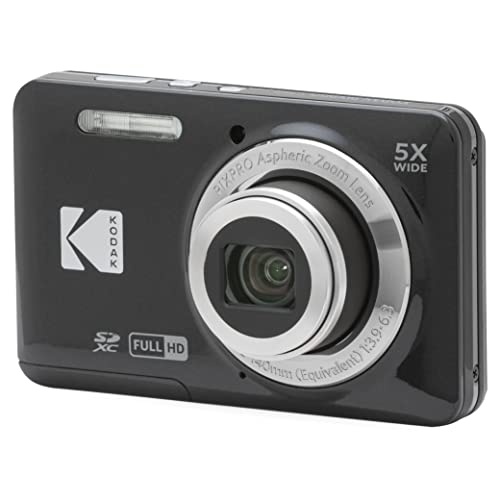
The KODAK PIXPRO FZ55 is the simplest camera in this guide, and the best choice for anyone who wants a true click and shoot experience with no learning curve. It has a 16 megapixel CMOS sensor, a 5x optical zoom lens starting at a useful 28mm wide angle, 1080p Full HD video, and a 2.7-inch LCD screen. There is no interchangeable lens, no viewfinder to learn, and no deep menu system standing between switching on and taking a photo.
That simplicity is the point. The FZ55 is light, slim, and easy to carry, and its automatic modes handle exposure and focus for everyday scenes. The 28mm wide angle is wide enough for group photos in a small room, street scenes, and landscapes, while the 5x zoom reaches across a garden or a playground. The built-in flash helps indoors, and the camera records Full HD video for short clips of birthdays and holidays.
Image quality is best in bright daylight, which is where most casual photos are taken. In low light, the smaller sensor will show more grain than the 1-inch models in this guide, and the fixed screen means composing in very bright sunlight takes a little patience. Those are fair trade-offs for a camera that is easy to carry, easy to use, and easy to hand to a friend without a tutorial first.
Who it suits: beginners, casual photographers, and families who want a light second camera for holidays and everyday photos without learning manual controls.
Who should skip it: anyone who regularly shoots indoors in dim light, wants 4K video, or needs a long zoom for wildlife or distant landmarks.
Sony RX100 VII (B07VPQV7BY)
The Sony RX100 VII is the most capable travel camera in this guide, packing a long zoom and very fast autofocus into a body that still fits a jacket pocket. Its 20.1 megapixel 1-inch stacked CMOS sensor works with a ZEISS Vario-Sonnar T 24-200mm f/2.8-4.5 lens, giving an 8.3x optical zoom that covers wide landscapes, street scenes, portraits, and distant subjects. That range is the main reason to choose it over the Canon G7 X Mark III.
Autofocus is the other reason. Real-time Eye AF for people and animals, real-time tracking, and blackout-free continuous shooting at up to 20 frames per second help keep moving subjects sharp, from children running across a park to pets and performers. The camera records 4K HDR video, has a microphone input, and includes a pop-up electronic viewfinder that helps in bright sunlight. The tilting touch screen flips upward for selfies and low-angle shots.
This is an enthusiast compact, so the controls and menus are deeper than those on the KODAK FZ55, and the small body means buttons are compact. In automatic mode, however, it still works as a click and shoot camera: switch on, point, and press the shutter, with face and eye detection doing much of the work. Battery life is modest, so a spare battery is a sensible companion for a full day of travel.
Who it suits: travellers and enthusiasts who want a long zoom, fast autofocus, and strong video in the smallest possible body.
Who should skip it: anyone who wants the simplest possible camera or a camera with a large grip and large buttons, because this is a compact enthusiast tool first.
Canon PowerShot SX740 HS (B07FXPY6SF)
The Canon PowerShot SX740 HS is the zoom champion of this guide, and the best choice when reach matters more than anything else. Its 20.3 megapixel CMOS sensor pairs with a 40x optical zoom lens, equivalent to 24-960mm, so it can frame a distant tower, a bird in a tree, or a performer on a stage. The DIGIC 8 processor, 4K UHD video, Wi-Fi, and Bluetooth round out a camera built for holidays and days out.
The flip-up screen helps with selfies and with shooting over a crowd, and the camera is still small enough for a jacket pocket when the lens is retracted. Automatic mode handles most scenes well, and the long zoom is genuinely useful for travel, where walking closer is not always possible. Image stabilisation helps at longer zoom settings, though a steady hand still helps when the lens is fully extended.
There are two points to note before choosing this model. First, a 40x zoom in a pocket body means the camera is thicker than a basic compact, and the small sensor will show more grain in low light than the 1-inch models above. Second, this is an older model and stock can be intermittent, so confirm the listing condition, the included battery and charger, and the seller details on the Amazon listing before ordering.
Who it suits: travellers, wildlife watchers, and spectators who want the longest zoom available in a pocket camera and mostly shoot in daylight.
Who should skip it: anyone who shoots mainly indoors or at night, or prefers a slimmer body and a simpler zoom range.
What to Check Before You Buy
Start with the listing itself. Confirm that the model name, colour, and included items match the camera you want, including the battery, charger, strap, and lens cap. Check whether the listing is for the camera body alone or a bundle with a memory card and case, and confirm the condition is new if that is what you expect. A memory card is essential, because pocket cameras do not include enough internal storage for a day of photos.
Next, think about power and storage for a full day out. Pocket camera batteries are small, and 4K video, Wi-Fi, and a bright screen all use power quickly. A spare battery and a habit of charging overnight will prevent a camera from going flat at the best moment of a trip. A second memory card is a useful backup, and a small pouch protects the lens and screen in a pocket or bag.
Also check the basics that are easy to forget. Make sure the camera has the screen movement you want for selfies, the video resolution you need, and the connectivity you will actually use. If video matters, check for a microphone input and for stabilisation. If travel matters, check the zoom range and the wide-angle coverage. If simplicity matters most, choose the camera with the fewest menus and the clearest automatic mode.
Finally, handle the camera before a trip, even for a few minutes at home. Learn where the shutter button, zoom control, and playback button sit, set the date and time, format the memory card in the camera, and take a few test photos in automatic mode. That short practice run means the camera will feel familiar when a real moment arrives.
FAQ
Are click and shoot cameras the same as point-and-shoot cameras?
Yes. Click and shoot is a plain-language way of describing a point-and-shoot camera: a fixed-lens compact with automatic modes, a built-in flash, and a simple shutter button.
Is a pocket camera still worth buying when a phone takes good photos?
For many people, yes, because a pocket camera adds a real optical zoom, a physical shutter button, and a grip shaped for photography. It also keeps photography separate from phone notifications and phone battery use.
Which pocket camera is best for travel?
The Sony RX100 VII is the strongest travel pick here for its 24-200mm zoom, fast autofocus, and 4K video in a jacket-pocket body. The Canon SX740 HS is the better choice when maximum zoom matters most, and the Canon G7 X Mark III is the better choice when low light and portraits matter more.
Which pocket camera is easiest for a beginner?
The KODAK PIXPRO FZ55 is the easiest camera in this guide, with a simple layout, automatic modes, and a 5x zoom that covers everyday scenes. The Canon models also work well in automatic mode, but they add manual controls that a beginner can ignore at first.
Do I need a memory card and a spare battery?
Yes, in practice. Pocket cameras need a compatible SD card for photos and video, and their small batteries run down quickly with video, Wi-Fi, and a bright screen. A spare battery and a second card are sensible companions for a full day out.
Bottom Line
The best click and shoot pocket cameras prove simple photography can still be satisfying. The Canon PowerShot G7 X Mark III is the best all-round choice for most buyers, with a large sensor, a bright lens, and strong video in a pocketable body. The KODAK PIXPRO FZ55 is the easiest choice for beginners. The Sony RX100 VII is the best travel camera for fast subjects and long zoom in a tiny body, and the Canon PowerShot SX740 HS is the best choice when a 40x zoom is the priority. Choose by zoom range, low-light needs, and ease of use, and the camera you pick will be the one in your pocket when a photo matters.
Disclosure: As an Amazon Associate, we may earn from qualifying purchases.
Related guides
More from Amazon
Programs that pair well with the guide above. Offers and eligibility are set by Amazon and may change.
Free shipping on eligible items, Prime Video and more. Eligible new members can start with a free trial.
Start a Prime free trialAudiobooks and podcasts to listen to on the go. Eligible new members can start with a free trial.
Try Audible freeAd-free music streaming. Eligible new subscribers can start with a free trial.
Try Music Unlimited freeA free business account with business pricing and bulk-buying tools for work, shop or home office.
Create a business accountAs an Amazon Associate we earn from qualifying purchases.










Write Your Review
No reviews yet. Be the first to share your experience!