
Our Short List of 3

- Best for: Cold-climate yards where the camera must survive the whole winter on one set of batteries.
- Operating temperature: -4°F to 113°F (-20°C to 45°C) per the listing’s Technical Details
- Video: 1080p HD per listing
- Battery life: two years on AA lithium batteries per listing
- Build: weather resistant per listing (no IP rating is stated in the listing)
- Best for: Google Home households that want detection-filtered alerts from a battery camera with a stated -4°F low end.
- Operating temperature: −4°F to 104°F per listing copy
- Video: 1080p HDR with night vision per listing
- Power: battery powered per the listing’s product information
- Build: weather resistant per listing

- Best for: A remote corner of the property in a moderately cold climate, where solar top-ups beat winter ladder trips.
- Operating temperature: -10°C to 55°C (14°F to 131°F) per the manufacturer’s spec sheet for this model
- Weather rating: IP65 per the same spec sheet
- Listing form: camera bundled with a solar panel
All 4 Picks at a Glance
| Product | Specs | Action |
|---|---|---|
| Blink Outdoor 4 |
| Check price on Amazon |
| Google Nest Cam (Outdoor or Indoor, Battery, 2nd Gen) |
| Check price on Amazon |
| Reolink Argus 3 Pro (with Solar Panel) |
| Check price on Amazon |
 Wyze Cam v4 |
| Check price on Amazon |
Key takeaways
- Five indoor/outdoor cameras whose listings state sub-freezing operating ranges, from -4F lows to a 14F spec-sheet figure, quoted exactly as listed.
What's inside
As an Amazon Associate I earn from qualifying purchases. This post may contain affiliate links at no extra cost to you.
A camera that quits at the first frost is a fair-weather witness, so the buying decision here is a single line in each listing: the stated operating temperature range. Only cameras whose listings state a low end below freezing, 32°F, are admitted below, and every temperature figure is printed exactly as the listing states it, with no conversion or rounding. Battery behaviour in cold air and weather sealing decide the rest.
The five cameras below span battery and wired power, chosen from the names and specifications on their Amazon product pages. Four carry their temperature range in the listing’s own technical details; one figure comes from the manufacturer’s spec sheet for the same model and is flagged as such wherever it appears. Where a listing states no weather rating number, none is printed.
Quick Picks
As an Amazon Associate we earn from qualifying purchases.
| Product | Best for | Key spec from title |
|---|---|---|
| Blink Outdoor 4 | Cold-climate yards where the camera must survive the whole winter on one set of batteries. | Operating temperature -4°F to 113°F, 1080p HD |
| Ring Stick Up Cam Battery (3rd Generation) | Homes in Ring’s ecosystem that need one battery camera specified for both deep cold and hot walls. | Operating conditions -4°F to 122°F, 1080p HD |
| Google Nest Cam (Outdoor or Indoor, Battery, 2nd Gen) | Google Home households that want detection-filtered alerts from a battery camera with a stated -4°F low end. | Operating temperature -4°F to 104°F, 1080p HDR |
| Reolink Argus 3 Pro (with Solar Panel) | A remote corner of the property in a moderately cold climate, where solar top-ups beat winter ladder trips. | Operating temperature -10°C to 55°C (14°F to 131°F) |
| Wyze Cam v4 | A porch or garage with an outlet nearby, where wired power removes the cold-battery question entirely. | Stated low end -4°F, 2.5K QHD, wired power |
How to Choose
Read the low end of the range, not the headline
Admission to this set turns on one number: the low end of the stated operating range. Four listings state -4°F; the Reolink’s spec sheet states 14°F, which is below freezing but a different class of winter. A camera in Minnesota and a camera in Tennessee both need a sub-freezing figure, but not the same one. Match the stated low end to the coldest week your property actually sees, with margin, rather than buying the most extreme figure on the page.
Battery chemistry meets cold air
Cold saps batteries, and the listings answer that problem three ways. The Blink stretches two AA lithium cells across a stated two years, minimising winter swaps. The Ring and Nest use rechargeable packs you bring indoors to charge. The Reolink bundle adds a solar panel to top up between storms, and the Wyze sidesteps the question with corded power. Your mount’s distance from a warm room decides which answer is practical, so choose the pattern whose charging routine you can actually live with through February.
A stated range is not a stated seal
Temperature survival and water survival are separate claims, and these listings do not all make both. One states weather resistance with no IP number at all; one figure here comes from a spec sheet rather than the listing; one model’s rating conflicts across captures. Where a listing prints no graded rating, this guide prints none. If the mount faces wind-driven rain or melting snow, favour the pick whose own listing states its sealing most completely.
Detection and video still decide the alerts
A camera that survives January but sends forty false alerts a day will be muted by February. The listings differ in what they state: the Nest names person, animal and vehicle detection, the Ring leans on its app ecosystem, and video runs from 1080p to the Wyze’s 2.5K QHD. Cold rating gets a camera into this set; the stated detection and resolution decide whether its footage is worth watching once it is up.
The 5 Best Options
Blink Outdoor 4
- Best for: Cold-climate yards where the camera must survive the whole winter on one set of batteries.
- Operating temperature: -4°F to 113°F (-20°C to 45°C) per the listing’s Technical Details
- Video: 1080p HD per listing
- Battery life: two years on AA lithium batteries per listing
- Build: weather resistant per listing (no IP rating is stated in the listing)
Cold-climate yards where the camera must survive the whole winter on one set of batteries.
The listing states no IP rating, so do not assume a graded seal; mount it under an eave or cover where driving rain is a routine event.
The Outdoor 4 is the endurance pick of this set. Its listing’s Technical Details state the operating temperature verbatim: -4°F to 113°F (-20°C to 45°C), a low end far below freezing. The camera records 1080p HD video and runs on AA lithium batteries with a stated two-year battery life, which matters in winter because every recharge avoided is a ladder climb in the cold that never happens. The listing calls the body weather resistant and states no IP rating number, so this guide prints none and treats the sealing as the maker’s word, not a graded figure.
Watch out for: The listing states no IP rating, so do not assume a graded seal; mount it under an eave or cover where driving rain is a routine event.
Ring Stick Up Cam Battery (3rd Generation)
The Stick Up Cam’s technical details state its operating conditions verbatim: −4°F to 122°F, weather resistant. That low end matches the Blink’s, while the top end runs higher, which suits a camera that splits the year between a sun-baked wall and a freezing one. The rest of the listing is familiar: 1080p HD with Live View, color night vision, a 130-degree diagonal field of view, two-way talk with noise cancellation and a Quick-Release Battery Pack, so a winter recharge is a swap at the door rather than a teardown.
Specs
- Operating conditions: −4°F to 122°F, weather resistant, per the listing’s technical details
- Video: 1080p HD with Live View per listing
- Night vision: color night vision per listing
- Field of view: 130 degrees diagonal per listing
- Audio: two-way talk with noise cancellation per listing
- Power: Quick-Release Battery Pack per listing
- Wi-Fi: 2.4 GHz per listing
Best for: Homes in Ring’s ecosystem that need one battery camera specified for both deep cold and hot walls.
Watch out for: Print only this code for the 3rd Generation battery model: confirm the live listing matches this generation before ordering, since a newer listing may also circulate.
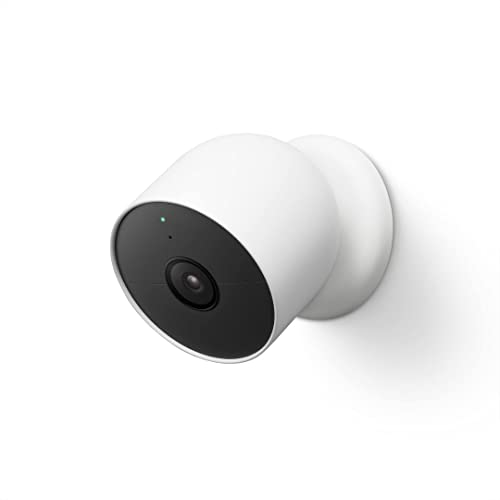
Google Nest Cam (Outdoor or Indoor, Battery, 2nd Gen)
- Best for: Google Home households that want detection-filtered alerts from a battery camera with a stated -4°F low end.
- Operating temperature: −4°F to 104°F per listing copy
- Video: 1080p HDR with night vision per listing
- Power: battery powered per the listing’s product information
- Build: weather resistant per listing
Google Home households that want detection-filtered alerts from a battery camera with a stated -4°F low end.
This ASIN is the 1-pack; the 2-pack is a different listing. Confirm the pack count on the live page before ordering.
The Nest Cam’s listing copy states its operating temperature plainly: −4°F to 104°F. The same low end as the Blink and Ring, with a lower ceiling that matters only on the hottest walls. The listing states 1080p HDR video with night vision, battery power in its product information, weather resistance, and person, animal and vehicle detection in its copy, which trims the alert stream a busy street sends. This is the 1-pack listing; the 2-pack is a separate listing with its own code, and the two should not be confused at ordering.
Watch out for: This ASIN is the 1-pack; the 2-pack is a different listing. Confirm the pack count on the live page before ordering.
Reolink Argus 3 Pro (with Solar Panel)
- Best for: A remote corner of the property in a moderately cold climate, where solar top-ups beat winter ladder trips.
- Operating temperature: -10°C to 55°C (14°F to 131°F) per the manufacturer’s spec sheet for this model
- Weather rating: IP65 per the same spec sheet
- Listing form: camera bundled with a solar panel
A remote corner of the property in a moderately cold climate, where solar top-ups beat winter ladder trips.
The temperature range and IP65 figure were captured from Reolink’s spec sheet, not the Amazon listing’s own fields; confirm both appear on the live listing before relying on them.
The Argus 3 Pro qualifies on a stated low end of 14°F, below freezing though warmer than the -4°F trio above. The figure comes from Reolink’s published spec sheet for this model, which states the operating temperature as -10°C to 55°C (14°F to 131°F), and the same sheet gives an IP65 rating. This listing is the bundle with a solar panel, which suits a camera posted far from a door in winter: the panel tops up the battery so cold-weather capacity dips need fewer manual recharges. Treat both figures as spec-sheet facts until the live listing confirms them.
Watch out for: The temperature range and IP65 figure were captured from Reolink’s spec sheet, not the Amazon listing’s own fields; confirm both appear on the live listing before relying on them.
Wyze Cam v4
- Best for: A porch or garage with an outlet nearby, where wired power removes the cold-battery question entirely.
- Operating temperature: -4°F low end per listing captures (top end unsettled; not printed)
- Video: 2.5K QHD per listing
- Use: indoor/outdoor per listing
- Power: wired (corded) per listing
A porch or garage with an outlet nearby, where wired power removes the cold-battery question entirely.
Only the -4°F low end is settled for this model; the range’s top end and the weather rating conflict across captures, so read the live listing before quoting either.
The Wyze Cam v4 is this set’s one wired camera, admitted on its temperature evidence alone: every capture of its listing agrees on a -4°F low end. The top end is not settled (captures conflict), so this guide prints the low end only and no top-end figure. The listing states 2.5K QHD video and indoor/outdoor use, and its corded power is a genuine winter argument: no battery chemistry to sag in the cold, provided an outlet is within reach of the mount. Its weather rating figures also conflict across captures, so none is asserted here.
Watch out for: Only the -4°F low end is settled for this model; the range’s top end and the weather rating conflict across captures, so read the live listing before quoting either.
Which One Fits Your Situation
A northern yard with real sub-zero weeks
Take the Blink Outdoor 4 or the Ring Stick Up Cam: both listings state a -4°F low end in their technical details, and both run on battery power that minimises winter maintenance at the mount. The Blink stretches its AA lithium cells toward a stated two years; the Ring answers with a swappable pack when a recharge cannot wait for spring.
A smart home already built on Google Home
Take the Nest Cam (Battery): its listing states the same -4°F low end as the leaders, plus person, animal and vehicle detection that filters the alert stream a busy street generates. Inside the ecosystem you already run, it is the pick with a stated sub-freezing range that asks for no new app habits or second system.
A far fence line in a milder cold climate
Take the Reolink Argus 3 Pro bundle: its spec sheet states a 14°F low end, below freezing though short of the -4°F group, and the included solar panel keeps the battery topped up at distance through short winter days. Confirm the range on the live listing, as its section flags, before relying on it.
A porch with an outlet and no patience for charging
Take the Wyze Cam v4: corded power removes battery sag from the winter equation entirely, and its listing captures agree on the -4°F low end this topic turns on. The condition is placement, since the mount must sit within cord reach of the outlet, but a porch usually offers exactly that.
Common Mistakes
- Reading a camera’s storage or operating claims from a headline and never finding the operating temperature line in the technical details, where the real winter figure lives.
- Assuming a sub-freezing rating also grades the water sealing, when one listing here states weather resistance with no IP number and another’s rating conflicts across captures.
- Printing or trusting a temperature top end that the listing captures do not agree on, as with the Wyze v4, instead of relying on the settled low end.
- Mounting a rechargeable-pack camera at height in deep cold, then facing monthly ladder trips exactly when the ground is icy, when a long-life or solar option existed.
- Confusing pack listings at ordering: the Nest 1-pack and 2-pack are different listings, and the Reolink here is the solar-panel bundle, not the bare camera.
Frequently Asked Questions
How cold can these cameras actually work in?
Four of the five state a -4°F low end in their listing details: the Blink Outdoor 4, Ring Stick Up Cam, Nest Cam and Wyze Cam v4. The Reolink Argus 3 Pro’s spec sheet states 14°F. All five are below freezing, which is the admission line for this set, but the -4°F group suits harsher winters.
Why does one camera here have no weather rating printed?
Because its listing states none. The Blink Outdoor 4 is described as weather resistant with no IP figure in the captured listing, and the Wyze Cam v4’s rating conflicts across captures. This guide prints only figures a listing states consistently, so both cameras appear without a graded rating.
Is the Reolink’s temperature figure from its Amazon listing?
No, and the article says so wherever it appears: the -10°C to 55°C (14°F to 131°F) range and the IP65 rating come from Reolink’s published spec sheet for this model. Confirm both on the live Amazon listing before relying on them.
Does wired power really help in freezing weather?
It removes one failure mode: battery capacity sag in deep cold. The Wyze Cam v4 is the set’s wired pick, so it keeps recording as long as the outlet does. The trade is placement, since the mount must sit within cord reach of power.
Related guides
More from Amazon
Programs that pair well with the guide above. Offers and eligibility are set by Amazon and may change.
Free shipping on eligible items, Prime Video and more. Eligible new members can start with a free trial.
Start a Prime free trialAudiobooks and podcasts to listen to on the go. Eligible new members can start with a free trial.
Try Audible freeAd-free music streaming. Eligible new subscribers can start with a free trial.
Try Music Unlimited freeA free business account with business pricing and bulk-buying tools for work, shop or home office.
Create a business accountAs an Amazon Associate we earn from qualifying purchases.










Write Your Review
No reviews yet. Be the first to share your experience!