
Key takeaways
- Three verified hydration bladders compared by capacity, material, valve design and cleaning access, including a filtered reservoir kit for questionable water sources.
What's inside
As an Amazon Associate I earn from qualifying purchases. This post may contain affiliate links at no extra cost to you.
Disclosure: As an Amazon Associate, we earn from qualifying purchases.
Our top pick: CamelBak Crux 3L Reservoir. Runner-up: Platypus Big Zip EVO 3-Liter.
A hydration bladder has one job: carry water inside a pack and deliver it through a tube and bite valve without leaking, tasting of plastic, or turning into a cleaning chore after every outing. The three reservoirs in this guide are all hydration bladders in the strict sense — soft reservoirs with a drink tube — and each one was checked against a real Amazon US listing with a verified ASIN. Two of them hold three litres, which is the size most hikers, trail runners with larger vests aside, and day riders reach for when water sources are far apart. The third holds two litres and adds filtration, which changes the decision entirely: it is less about carrying the most water and more about being able to refill from sources you would not drink from untreated.
That spread is deliberate. Rather than padding this guide with reservoirs whose listings could not be verified, it covers the three verified models and explains, in detail, where each one fits. If you already know you want the largest straightforward reservoir, the first pick is the obvious starting point. If you refill from taps and treated sources only, filtration adds cost and complexity you may never use. If you hate scrubbing the inside of a narrow reservoir, the wide-opening design in the runner-up spot may matter more to you than any other single feature. Read the product sections for the recorded specifications, then use the How to Choose section to match capacity, valve design and cleaning access to the way you actually carry water.
Quick Picks
- CamelBak Crux 3L Reservoir — Best all-round pick: a 3-litre TPU reservoir with the Quick Link system and Big Bite Valve, backed by the Got Your Bak lifetime guarantee.
- Platypus Big Zip EVO 3-Liter — Best for easy cleaning: a full-width SlideLock zip opening, a taste-free reservoir and a bite valve with its own shutoff.
- CamelBak Crux 2L Reservoir Kit, filtered by LifeStraw — Best for untreated refill sources: a 2-litre reservoir with two-stage filtration built into the kit.
CamelBak Crux 3L Reservoir
OUR TOP PICK
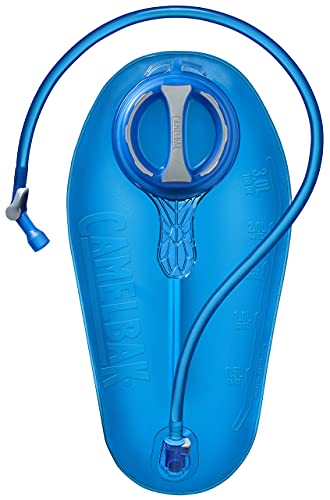
The CamelBak Crux 3L Reservoir is the straightforward large reservoir in this guide, and the one to start with if your priority is carrying plenty of water in a pack you already own. As stated on the listing, it holds 3 litres, or 100 ounces, and it is made from TPU that is BPA, BPS and BPF free. Those material details matter more than they might seem: a reservoir sits against your back for hours, warms up over the course of a day, and holds the water you will drink for that entire period, so a listing that states plainly what the reservoir is made from, and what it leaves out, is giving you the information you need rather than asking you to guess.
The connection hardware is the other half of this design. The listing records the Quick Link system, which is the connection format that lets the drink tube detach from the reservoir, and the Big Bite Valve at the end of that tube. A detachable tube sounds like a small thing until you have threaded a fixed tube through a pack, filled the reservoir at a sink, and then had to reverse the whole process to clean it. Being able to separate the tube from the reservoir body makes filling, drying and routing the tube through a pack’s hydration port noticeably simpler, and it is the kind of detail that decides whether a bladder gets used daily or left in a cupboard.
At roughly 7 ounces empty, as recorded on the listing under part number 1228401003, the Crux 3L adds little weight of its own; nearly all the carrying weight is the water itself, which is true of every reservoir here and worth remembering when you compare capacities. Three litres of water is a substantial load, and the reservoir’s job is to carry it flat and stable rather than to make it lighter. CamelBak also backs this reservoir with the Got Your Bak lifetime guarantee, as stated on the listing, which is relevant for a product whose failure mode — a leak inside a loaded pack — is the one outcome every buyer wants to avoid.
Choose the Crux 3L when you want the largest capacity in this guide without filtration, when your pack has a hydration sleeve sized for a full-size reservoir, and when you refill from taps, bottles or treated sources. It is the general-purpose answer, and for most walkers and riders it is the right one.
Specs
– Model: CamelBak Crux 3L Reservoir, part 1228401003
– Capacity: 3 L / 100 oz, as stated on the listing
– Material: TPU, BPA/BPS/BPF-free, as stated on the listing
– System: Quick Link system with Big Bite Valve, as stated on the listing
– Weight: approximately 7 oz, as stated on the listing
– Guarantee: Got Your Bak lifetime guarantee, as stated on the listing
Pros
– Full 3-litre capacity for long stretches between refill points
– Quick Link connection makes the tube detachable for filling and cleaning
– TPU construction stated as BPA, BPS and BPF free
– Backed by the Got Your Bak lifetime guarantee
Cons
– No filtration, so refill sources still need to be treated water
– A full 3-litre reservoir is a heavy load in a small pack
Platypus Big Zip EVO 3-Liter
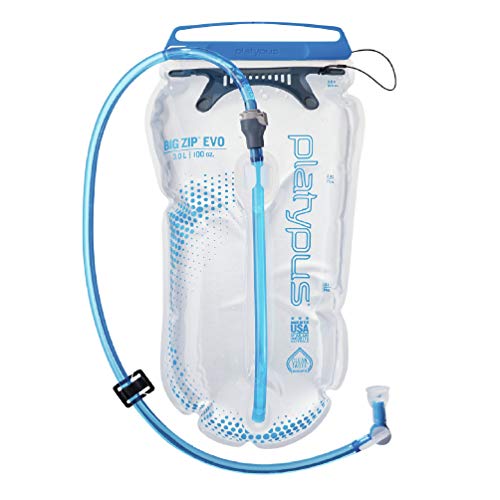
The Platypus Big Zip EVO 3-Liter matches the top pick on capacity and takes a different approach to the two things reservoir owners complain about most: taste and cleaning. The listing describes it as a taste-free reservoir, which addresses the flat, plastic note that can linger in water carried for hours. If you have ever taken a sip late in a warm day and tasted the container more than the water, that single line in the specification is aimed at you. Platypus builds the Big Zip line around that promise, and the EVO version keeps the feature that gives the range its name.
That feature is the full-width SlideLock zip opening across the top of the reservoir. Instead of a narrow screw cap that limits you to a bottle brush and hope, the Big Zip opens across its full width, so you can reach inside, scrub properly, and — just as importantly — leave it open to dry. A reservoir that never fully dries between outings is a reservoir that develops off flavours, so an opening that serves both washing and drying is a practical advantage rather than a novelty. The trade-off to keep in mind is that a zip-style closure depends on being closed fully and correctly; it rewards a careful owner and is worth a quick check before the reservoir goes into a loaded pack.
At the drinking end, the listing records a HyFLO bite valve with a shutoff, plus a quick-disconnect tube. The shutoff is a small detail with an outsized effect: it lets you close the valve so the tube cannot drip or be squeezed open accidentally in transit, which is how reservoirs usually leak — not through the body, but through a valve pressed against other gear. The quick-disconnect tube gives the same filling and cleaning convenience described for the top pick, letting the tube come away from the reservoir rather than being threaded in and out of the pack each time.
The recorded dimensions are 9 by 17.2 inches, and the weight is 6.5 ounces, slightly lighter than the CamelBak above at the same nominal capacity. That tall, flat profile suits packs with a long hydration sleeve. Choose the Big Zip EVO when cleaning access and neutral taste are your priorities, and when you are happy to trade the CamelBak’s guarantee wording for a reservoir you can open up completely after every trip.
Specs
– Model: Platypus Big Zip EVO 3-Liter
– Capacity: 3 litres, as stated on the listing
– Opening: full-width SlideLock zip opening, as stated on the listing
– Valve: HyFLO bite valve with shutoff, as stated on the listing
– Tube: quick-disconnect tube, as stated on the listing
– Dimensions: 9 x 17.2 inches, as stated on the listing
– Weight: 6.5 oz, as stated on the listing
Pros
– Full-width zip opening makes scrubbing and drying the interior straightforward
– Taste-free reservoir design for water that sits for hours
– Bite valve has its own shutoff to guard against drips in a packed bag
– Slightly lighter than the other 3-litre reservoir in this guide
Cons
– Zip closure needs to be sealed carefully and checked before packing
– No filtration, so it does not change which sources you can refill from
CamelBak Crux 2L Reservoir Kit, filtered by LifeStraw
The CamelBak Crux 2L Reservoir Kit, filtered by LifeStraw, is the specialist in this guide, and it should be judged on a different question from the two reservoirs above. They ask how much water you want to carry. This kit asks what water you are willing to drink. As stated on the listing, it is a 2-litre reservoir supplied as a kit with two-stage filtration, using a hollow fiber stage and an activated carbon stage. In plain terms, the water passes through filtration as part of the system rather than being carried pre-treated, which is what makes refilling from uncertain sources a realistic option instead of an emergency measure.
That capability comes with a smaller capacity. Two litres is a sensible size for shorter outings, for packs with limited sleeve space, and for routes where refill points exist but their quality is doubtful — exactly the routes where this kit earns its place. On a route with no refill points at all, the larger unfiltered reservoirs above carry more; on a route with plentiful but questionable water, this kit can carry less and refill more often, which is a genuinely different strategy rather than a compromise.
Because filtration is the entire point of the kit, the honest way to frame it is this: if every source you use is a tap, a bottle or a treated supply, the two-stage system adds nothing you need, and the Crux 3L above is the simpler buy in the same family. If you walk, ride or travel where you refill from streams, outdoor taps or storage tanks, the filtered kit is the only reservoir in this guide designed for that job, and its 2-litre capacity is the price of carrying the filtration with you in a single integrated kit.
It also changes how you should think about care. Any filtration kit needs its elements looked after according to the maker’s instructions, and a buyer choosing this reservoir should expect that upkeep as part of ownership. That is not a flaw; it is the nature of a product that treats water rather than merely storing it. Choose this kit when the quality of your refill water, not the quantity you can carry, is the limiting factor in your day.
Specs
– Model: CamelBak Crux 2L Reservoir Kit, filtered by LifeStraw
– Capacity: 2 L, as stated on the listing
– Filtration: two-stage filtration, hollow fiber and activated carbon, as stated on the listing
– Format: reservoir kit with filtration included, as stated on the listing
Pros
– Two-stage filtration built into the kit for refilling from uncertain sources
– Hollow fiber and activated carbon stages address both particles and taste
– Smaller 2-litre size suits shorter outings and compact packs
Cons
– Lower capacity than the two 3-litre reservoirs in this guide
– Filtration elements add upkeep that an unfiltered reservoir does not need
– Unnecessary complexity if all your refill water is already treated
How to Choose
Start with capacity, because it decides the shape of your day. A 3-litre reservoir, like the Crux 3L and the Big Zip EVO, suits long routes, hot conditions and any outing where the next reliable water point is hours away. A 2-litre reservoir suits shorter outings, smaller packs and routes with frequent refills. Neither is better in the abstract: carrying three litres on a one-hour loop is dead weight, and carrying two litres across a dry ridge is a planning failure. Estimate how much you drink per hour in the conditions you actually go out in, multiply by the longest gap between refill points, and let that number pick the size.
Next, decide whether filtration belongs in the reservoir at all. Filtration is not a general upgrade; it is an answer to a specific problem, which is refill water you do not trust. If your water comes from home, from bottles or from treated supplies, an unfiltered reservoir is simpler, lighter in upkeep and easier to clean. If you refill outdoors from sources of unknown quality, the filtered Crux kit is built for that pattern, and its two-stage design — hollow fiber followed by activated carbon — is the feature to weigh, not its capacity.
Then look at how the reservoir opens, because that decides how well it will be cleaned, and a reservoir that is hard to clean will eventually taste of neglect. A full-width opening, like the SlideLock zip on the Big Zip EVO, lets you reach the interior and leave it open to dry. A narrower opening can still be cleaned well, but it asks for a brush and more patience. Drying deserves as much attention as washing: prop the reservoir open, let air move through it, and store it only once it is dry inside.
After that, consider the valve and tube. A bite valve with a shutoff, as on the Platypus, protects against the slow drip that soaks a pack’s contents when the tube is pressed by other gear. A quick-disconnect or Quick Link style connection, recorded for both brands in this guide, makes the weekly routine of filling, emptying and drying faster, and a faster routine is one you will actually keep. Check also that the tube length and routing suit your pack: the tube has to reach from the reservoir, out of the hydration port and to your shoulder strap without kinking or pulling.
Finally, check fit before anything else is decided. Measure your pack’s hydration sleeve and compare it with the reservoir’s recorded dimensions — the Big Zip EVO, for example, is listed at 9 by 17.2 inches, a tall profile that not every sleeve accepts. A reservoir that bulges because it is forced into a short sleeve will be uncomfortable against your back and harder to remove for refilling. Capacity, filtration, cleaning access and valve design all matter, but only once the reservoir physically fits the pack you intend to carry it in.
FAQs
How often should a hydration bladder be cleaned?
After every outing, at a minimum rinse it and leave it open to dry fully; wash it properly with warm water and a mild cleaning solution regularly, and always before storing it. The wide SlideLock opening on the Big Zip EVO makes reaching the interior easier, while narrower reservoirs need a brush. Whatever the design, complete drying between uses is the single habit that keeps water tasting clean.
Is a filtered reservoir worth it for everyday hiking?
Only if your refill water needs treating. The Crux 2L kit filtered by LifeStraw uses hollow fiber and activated carbon stages, which are valuable when you refill from streams or uncertain outdoor sources. If your routes are served by taps and treated water, an unfiltered reservoir such as the Crux 3L carries more water with less upkeep, and the filtration would never be used.
Will a 3-litre reservoir fit in my existing pack?
It depends on the sleeve, not the pack’s headline size. Compare the reservoir’s dimensions with the sleeve: the Big Zip EVO is listed at 9 by 17.2 inches, so a tall, flat sleeve is needed. Measure the sleeve’s height and width, allow room for the tube to exit, and remember that a full reservoir is thicker than an empty one. If the sleeve is short, the 2-litre filtered kit is the easier fit in this guide.
Conclusion
For most people, the CamelBak Crux 3L Reservoir is the top pick: three litres of capacity, a TPU body stated as BPA, BPS and BPF free, a Quick Link connection with the Big Bite Valve, and the Got Your Bak lifetime guarantee behind it. The Platypus Big Zip EVO 3-Liter is the runner-up and the better choice for anyone who puts cleaning first, thanks to its full-width SlideLock opening, taste-free design and shutoff valve. The CamelBak Crux 2L Reservoir Kit, filtered by LifeStraw, is the specialist option for refilling from water you would not otherwise drink. Measure your pack’s sleeve, decide honestly whether your refill sources need filtration, and the right reservoir in this guide will be the obvious one.
Related guides
More from Amazon
Programs that pair well with the guide above. Offers and eligibility are set by Amazon and may change.
Free shipping on eligible items, Prime Video and more. Eligible new members can start with a free trial.
Start a Prime free trialAudiobooks and podcasts to listen to on the go. Eligible new members can start with a free trial.
Try Audible freeAd-free music streaming. Eligible new subscribers can start with a free trial.
Try Music Unlimited freeA free business account with business pricing and bulk-buying tools for work, shop or home office.
Create a business accountAs an Amazon Associate we earn from qualifying purchases.










Write Your Review
No reviews yet. Be the first to share your experience!