
Our Short List of 3

- Best for: Growers with a long house or garage wall who want walk-in depth and shelving in one kit.
- Dimensions: 120 x 60 x 84 inches
- Frame material: alloy steel, powder-coated
- Cover material: reinforced polyethylene, clear/green
- Doors: 2 roll-up zipper doors
- Best for: Seed starters who want maximum shelf count in a compact wall footprint.
- Dimensions: 79 x 39 x 83 inches
- Frame material: metal poles
- Cover material: green polyethylene with reinforced gridlines
- Shelves: wire mesh, 3 per side, 6 total

- Best for: Patio growers with a narrow strip who grow tomatoes or peppers in a single row.
- Dimensions: 79.2 x 30 x 67.2 inches
- Frame material: metal
- Cover material: polyethylene (PE)
- Door: 1 roll-up zippered door
All 3 Picks at a Glance
| Product | Specs | Action |
|---|---|---|
| EAGLE PEAK 3 Tier Lean-to Portable Greenhouse |
| Check price on Amazon |
| VIVOSUN Lean-to Greenhouse |
| Check price on Amazon |
| Ohuhu Lean-to Tomato Greenhouse |
| Check price on Amazon |
Key takeaways
- Four lean-to greenhouse kits for backyard walls compared on footprint, cover material, shelving, doors and anchoring, with specs taken from each listing.
What's inside
As an Amazon Associate I earn from qualifying purchases. This post may contain affiliate links at no extra cost to you.
A lean-to only earns its space when the wall behind it is measured first. The real decision is how much depth you can give up along a house, garage or fence line, because a kit that projects five feet into a narrow yard eats the path, the bins and the mower run, while one that sits three feet deep may hold one row of pots and nothing else. Height matters just as much: the roof edge has to clear your tallest plants, and the frame still needs a solid wall to lean on.
This guide is for backyard growers starting seedlings against a sunny wall, patio gardeners with a short strip of paving, and anyone who wants a permanent hard-panel structure instead of a seasonal cover. Each pick below was chosen from its Amazon listing name and dimensions, frame and cover materials, door count and anchoring hardware, so the differences you read here come from the listings rather than from guesswork about how a kit might behave.
Quick Picks
As an Amazon Associate we earn from qualifying purchases
| Product | Best for | Key spec from title |
|---|---|---|
| EAGLE PEAK 3 Tier Lean-to Portable Greenhouse | Long walls with room to walk in | 120 x 60 x 84 inches, 3 tiers of wire shelves |
| VIVOSUN Lean-to Greenhouse | Compact seed starting on a short wall | 79 x 39 x 83 inches, six wire mesh shelves |
| Ohuhu Lean-to Tomato Greenhouse | A single row of tall plants on a narrow patio | 79.2 x 30 x 67.2 inches, roll-up zippered door |
| Outsunny 6 x 6 Polycarbonate Greenhouse 845-243 | A fixed hard-panel house that stays up all year | 72 x 71.7 x 76.8 inches, aluminum frame |
How to Choose
Measure the wall run and the depth you can spare
Start with the strip itself, not with the kit. Measure the clear length of wall between windows, doors, taps and downpipes, then decide how far into the yard the frame may project. The picks here span that range widely: the Ohuhu reaches 79.2 inches along the wall yet only 30 inches deep, while the EAGLE PEAK needs a 120 inch run and a full 60 inches of depth. A deep frame gives a walking aisle and shelving on both sides; a shallow one suits one row of pots with you working from the doorway. Leave room to open the door fully and to step back with a watering can in hand.
Pick the cover material for how long it stays up
Listings split cleanly into two families. PE covers, like the reinforced polyethylene on the EAGLE PEAK and the gridline-reinforced PE on the VIVOSUN, keep the kit light enough to move or store, and the whole structure can come down when the season ends. Polycarbonate panels, as on the Outsunny 845-243, belong to a frame that is bolted together once and left standing through winter. Neither family is automatically better. The honest question is whether you want a seasonal shelter you can fold away or a fixed structure that needs a level base, more assembly time and a wall that can take permanent fixings.
Count shelves, tiers and door openings in the listing
Growing space inside a lean-to is set by its shelving, not by floor area alone. The VIVOSUN listing includes six wire mesh shelves, three per side, which suits trays of seedlings stacked at staggered heights. The EAGLE PEAK carries three tiers of wire shelves along its longer frame. Door count changes daily use more than most buyers expect: two roll-up zipper doors on the EAGLE PEAK let you enter from either end of a long wall run, while a single door on a short kit is fine when every plant sits within arm’s reach. Check the listing for vents as well, since a sealed cover traps heat on still spring days.
Check how the kit anchors to the wall and ground
A lean-to has one open side facing the weather, so the listing’s anchoring hardware deserves a close read. The EAGLE PEAK manual lists wall mounting brackets and screws alongside ground stakes and tie-down ropes, which means it is meant to be fixed to the structure it leans on. The VIVOSUN includes ground stakes and ropes for securing the frame. Kits without wall fixings rely on weight and shelter, and they belong against a fence or in a corner rather than on an exposed gable end. Match the hardware in the box to the surface you actually have: masonry, timber cladding and render all take fixings differently.
The 4 Best Options
EAGLE PEAK 3 Tier Lean-to Portable Greenhouse
- Best for: Growers with a long house or garage wall who want walk-in depth and shelving in one kit.
- Dimensions: 120 x 60 x 84 inches
- Frame material: alloy steel, powder-coated
- Cover material: reinforced polyethylene, clear/green
- Doors: 2 roll-up zipper doors
Growers with a long house or garage wall who want walk-in depth and shelving in one kit.
The 60 inch depth is a real commitment in a small yard; measure the projection before ordering.
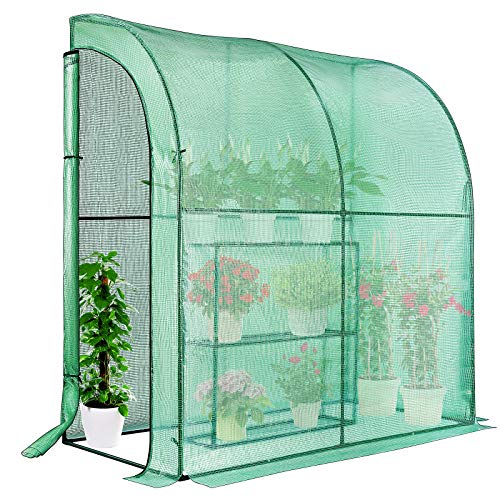
At 120 inches long, the EAGLE PEAK 3 Tier Lean-to Portable Greenhouse is the pick for a long, underused wall where a full walk-in strip is possible. Its alloy steel frame carries a reinforced polyethylene cover in clear and green, and three tiers of wire shelves run inside it, so staging trays, potted herbs and overwintering plants can share one structure. Two roll-up zipper doors mean you are not shuffling sideways past every pot to reach the far end, and the included wall mounting brackets show the frame is designed to be fixed to the house rather than simply parked against it.
VIVOSUN Lean-to Greenhouse
- Best for: Seed starters who want maximum shelf count in a compact wall footprint.
- Dimensions: 79 x 39 x 83 inches
- Frame material: metal poles
- Cover material: green polyethylene with reinforced gridlines
- Shelves: wire mesh, 3 per side, 6 total
Seed starters who want maximum shelf count in a compact wall footprint.
There are no wall brackets in the listed contents, so plan on stakes and ropes doing all the anchoring work.
The VIVOSUN Lean-to Greenhouse fits the classic seed-starting brief: a compact footprint of 79 by 39 inches, tall enough at 83 inches to stand inside, and six wire mesh shelves, three on each side, ready for trays. Its green PE cover has reinforced gridlines woven through it, and the metal pole frame keeps the whole kit under nineteen pounds, so one person can shift it along the wall as the sun moves through the year. A single roll-up door keeps the design simple, and ground stakes plus ropes are included for tying the frame down.
Ohuhu Lean-to Tomato Greenhouse
- Best for: Patio growers with a narrow strip who grow tomatoes or peppers in a single row.
- Dimensions: 79.2 x 30 x 67.2 inches
- Frame material: metal
- Cover material: polyethylene (PE)
- Door: 1 roll-up zippered door
Patio growers with a narrow strip who grow tomatoes or peppers in a single row.
At 67.2 inches tall it is the lowest kit here, so check headroom against your tallest plants and your own height.
Where the wall strip is narrow, the Ohuhu Lean-to Tomato Greenhouse makes the most sense: it runs 79.2 inches along the wall but only 30 inches deep, a profile built for one row of tall plants in grow bags or large pots. The listing names it a lean-to for outdoors and pairs a polyethylene cover with a metal frame, and at 7.71 pounds it is by far the lightest kit here, closer to a seasonal shelter you can pack away than to furniture for the garden. Its roll-up zippered door gives quick access along the row without a hinged panel swinging into the path.
Outsunny 6 x 6 Polycarbonate Greenhouse 845-243
The Outsunny 845-243 is the fixed option in this set: the listing’s variant name calls it a lean to green house, and its aluminum frame with polycarbonate panels is built to stay assembled against the wall year after year. At 72 by 71.7 inches it is nearly square, giving a deeper working area than the film-cover kits, and the title lists a rain gutter and a roof vent, two details the portable kits do not include. Weighing 58 pounds, it is a build-once project rather than a weekend experiment, suited to a paved base beside the house.
Specs
- Dimensions: 72 x 71.7 x 76.8 inches
- Size: 6 x 6 feet
- Frame material: aluminum
- Cover material: polycarbonate
- Nominal wall thickness: 0.16 inches
- Features named in the listing title: rain gutter, roof vent
- Item model number: 845-243
- Item weight: 58 pounds
Best for: Gardeners who want a permanent hard-panel lean-to on a paved base by the house.
Watch out for: The nearly square footprint needs a genuinely level surface; a sloping patio will fight the rigid panels.
ASIN: B082S9NGK6
Which One Fits Your Situation
You have a long blank wall and want a real walk-in strip
Choose the EAGLE PEAK. Its 120 inch length and 60 inch depth create an aisle you can work from, the three shelf tiers run the length of the frame, and doors at both ends stop the far plants becoming the neglected ones. The wall brackets in the box matter here, because a structure this size should be fixed, not freestanding.
Your spring is mostly seed trays and young plants
The VIVOSUN suits you best. Six wire mesh shelves inside a 79 by 39 inch footprint hold more trays per foot of wall than any other kit in this guide, and the light frame can be moved or stored once the seedlings go out. Stakes and ropes are included, which is all a sheltered wall strip usually needs.
Your only space is a narrow patio edge
Take the Ohuhu. Thirty inches of depth leaves the rest of the patio usable, the 79.2 inch length still fits a useful row of tomato plants, and the low weight means taking it down in autumn is a one-person job. Accept the lower roof as the trade for that slim profile.
You want to build once and leave it standing
The Outsunny 845-243 is your kit. Aluminum and polycarbonate shrug off the seasonal handling that wears film covers, and the roof vent and rain gutter are the sort of fittings you only get on a structure meant to stay put. Budget the extra assembly time and prepare a level base first.
Common Mistakes
- Measuring the wall but not the projection, then finding the frame swallows the path or the door swing once it is built.
- Buying a deep walk-in kit for a strip that only fits a single row, and losing yard space to an aisle nobody uses.
- Ignoring the anchoring hardware in the listing, so a kit with no wall brackets ends up against an exposed wall in the wind.
- Choosing a film cover for a permanent spot, or a bolted polycarbonate frame for a rented home where it must come down.
- Forgetting vents and door openings, then cooking seedlings on the first still, sunny weekend of spring.
Frequently Asked Questions
How much wall does a lean-to greenhouse actually need?
It needs a clear run at least as long as the kit itself, plus working room at the door end. The kits here run from about 72 to 120 inches long. Measure between windows, vents and downpipes rather than pacing the whole wall, because one obstruction in the middle can rule out an otherwise perfect spot.
Can a lean-to greenhouse stand without being fixed to the wall?
Some can, but the listing tells you what the maker intends. Kits that include wall mounting brackets, like the EAGLE PEAK, are designed to be fixed. Kits with only stakes and ropes rely on shelter and ground grip. On an exposed wall, fixing is the safer reading of any listing.
Is PE or polycarbonate the better cover for a backyard lean-to?
PE suits seasonal use: it is light, the kit packs away, and replacing a cover is simple. Polycarbonate suits a permanent structure that stays up through winter, with rigid panels on a metal frame. Match the material to how long the greenhouse will stand, not to which sounds stronger in isolation.
Where should a lean-to greenhouse face in a backyard?
Against the wall that gets the longest stretch of direct sun your yard allows, clear of overhanging branches and the drip line of the roof above it. Check the spot at different times of day before building, because a fence or neighbouring house can shade a wall that looks sunny at noon.
Related guides
More from Amazon
Programs that pair well with the guide above. Offers and eligibility are set by Amazon and may change.
Free shipping on eligible items, Prime Video and more. Eligible new members can start with a free trial.
Start a Prime free trialAudiobooks and podcasts to listen to on the go. Eligible new members can start with a free trial.
Try Audible freeAd-free music streaming. Eligible new subscribers can start with a free trial.
Try Music Unlimited freeA free business account with business pricing and bulk-buying tools for work, shop or home office.
Create a business accountAs an Amazon Associate we earn from qualifying purchases.




Write Your Review
No reviews yet. Be the first to share your experience!