
Our Short List of 3
- Best for: Households that rotate between two or three fixed drink sizes daily.
- Brand: Baratza
- Burrs: 40mm conical burrs, described in the listing comparison as Conical Burrs (S1)
- Dosing: 3 programmable dosing buttons for accurate, consistent dosing to within a 10th of a second
- Grind settings: 270, from 30 macro steps and a micro adjustment

- Best for: Beginners who want a tidy cup-to-portafilter routine on 54mm or 58mm baskets.
- Brand: Baratza
- Model: ZCG495-120V
- Burrs: 40mm Conical Steel Burrs, high precision M2 conical burrs
- Grind settings: 40, with settings 1-20 in the espresso-fine micro range and 21-40 in the brew macro range

- Best for: Single-dose drinkers who measure beans with the lid and switch coffees often.
- Brand: Fellow
- Burrs: 40mm stainless steel conical burrs, 6-blade C6-40 set
- Motor: 6Nm of torque, 350 RPM burr speed listed in product materials
- Grind settings: 41 settings, plus precision adjustments using the inner ring
All 5 Picks at a Glance
| Product | Specs | Action |
|---|---|---|
| Baratza Sette 270 Conical Burr Coffee Grinder |
| Check price on Amazon |
| Baratza Encore ESP Coffee Grinder ZCG495BLK, Black |
| Check price on Amazon |
| Fellow Opus Conical Burr Coffee Grinder, Matte Black |
| Check price on Amazon |
 Turin SK40 Single Dose Grinder, White |
| Check price on Amazon |
 Wirsh Geimori GU38 Coffee Grinder |
| Check price on Amazon |
Key takeaways
- Five conical burr espresso grinders chosen for precision dosing, from programmable timed doses and grind-by-time presets to dosing cups and single-dose load bins.
What's inside
As an Amazon Associate I earn from qualifying purchases. This post may contain affiliate links at no extra cost to you.
Precision dosing sounds abstract until a shot runs fast on Monday and chokes on Tuesday with the same beans and the same basket. Usually the grind setting did not move; the amount of coffee in the basket did. A gram drifting in or out changes resistance, flow, and taste more than most small dial turns, so the real buying decision here is how a grinder helps you land the same dose, in the same place, every morning without a separate scale routine slowing you down.
This guide is for home espresso drinkers who weigh or time their doses and want that repeatability built into the grinder itself. Every pick below is a conical burr model picked from its Amazon product name and listing details, and each one states its dosing method in its own listing: programmable timed buttons, an included espresso dosing cup, a volumetric dosing lid, a single-dose load bin, or a magnetic dosing cup paired with low retention.
Quick Picks
As an Amazon Associate we earn from qualifying purchases.
| Product | Best for | Key spec from title |
|---|---|---|
| Baratza Sette 270 Conical Burr Coffee Grinder | Saving three timed doses for different drinks | Conical Burr Coffee Grinder |
| Baratza Encore ESP Coffee Grinder ZCG495BLK, Black | Dosing straight into a 54mm or 58mm portafilter | Encore ESP Coffee Grinder |
| Fellow Opus Conical Burr Coffee Grinder, Matte Black | Measuring beans with a volumetric dosing lid | Conical Burr Coffee Grinder with 41 Settings |
| Turin SK40 Single Dose Grinder, White | Weighing one dose at a time with low retention | 40mm Stainless Steel Conical Burrs, Stepless Adjustment |
| Wirsh Geimori GU38 Coffee Grinder | Single doses caught in a magnetic dosing cup | 38mm 6-Core Stainless Steel Conical Burr, Magnetic Dosing Cup |
How to Choose
Decide whether you dose by time, by cup, or by weighing beans first
Timed dosing suits a household that pulls the same drink daily: you program a grind time once, then repeat it without handling a scale. Cup-based dosing suits someone who grinds, levels the cup, and tips it into the basket, which keeps stray grounds off the counter. Weighing beans before grinding suits single-dose drinkers who switch coffees often, because nothing sits in a hopper going stale. None of these routes is automatically better. Match the method to the routine you will actually keep on a rushed weekday morning, not the most elaborate routine you can imagine.
Check what the listing says the dose lands in
Where grounds land matters as much as how they are measured. Some models grind directly into a portafilter held under the burrs, some include a grounds bin for larger amounts, and some use a dosing cup sized for common portafilter diameters. Read the listing wording closely: a cup described as suitable for both 54mm and 58mm portafilters solves a different problem than a plain bin. If you dose into a cup and then transfer, look for a spouted or magnetic design, because that transfer step is exactly where a careful dose usually loses grounds.
Treat retention as a dosing problem, not just a freshness problem
Coffee left inside the grinder from yesterday becomes part of today’s dose, and it is ground at yesterday’s setting. Listings that describe a straight-through path, a direct drop-down design, or a low-retention build are addressing dose accuracy as well as flavour. This matters most when you change settings often: after a dial turn, the first dose out still contains grounds produced before the change. Single-dose designs with bellows or tilted bases try to clear that path each time, so the dose you weighed is closer to the dose that reaches the basket.
Confirm the fine range is spaced for espresso, not just labelled espresso
A grinder can reach espresso fineness and still be frustrating if one step jumps from too fast to too slow. Look for listing language about a micro range, macro and micro adjustment, or an inner ring for precision adjustments inside the espresso zone. Closely spaced settings in the fine range let you correct a dose or a dial change in small moves. Wide spacing across the whole range is fine for filter brewing, but espresso punishes coarse steps, especially with lighter roasts that already need a finer setting and a very consistent dose.
The 5 Best Options
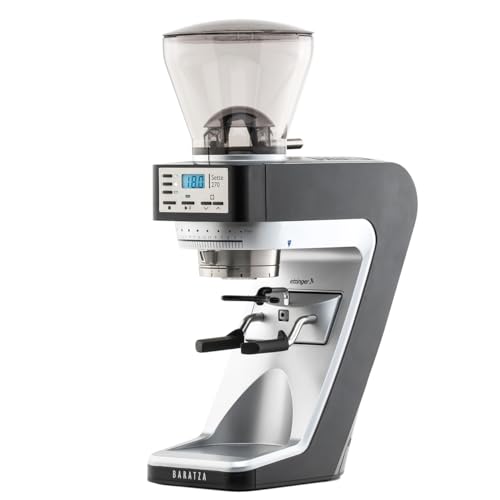
Baratza Sette 270 Conical Burr Coffee Grinder
- Best for: Households that rotate between two or three fixed drink sizes daily.
- Brand: Baratza
- Burrs: 40mm conical burrs, described in the listing comparison as Conical Burrs (S1)
- Dosing: 3 programmable dosing buttons for accurate, consistent dosing to within a 10th of a second
- Grind settings: 270, from 30 macro steps and a micro adjustment
Households that rotate between two or three fixed drink sizes daily.
Dosing is timed, not weighed, so changing beans or grind setting can shift the delivered amount until you re-check it.
Choose this one when the same household pulls several drink sizes and nobody wants to re-time a dose each time. Its listing centres on three programmable dosing buttons that hold different amounts, with grinding straight into a portafilter or into the supplied bin. That makes it the natural anchor for a counter where a single, a double, and a partner’s longer drink all happen before work, because the dose choice becomes a button rather than a fresh calculation at dawn.
Baratza Encore ESP Coffee Grinder ZCG495BLK, Black
- Best for: Beginners who want a tidy cup-to-portafilter routine on 54mm or 58mm baskets.
- Brand: Baratza
- Model: ZCG495-120V
- Burrs: 40mm Conical Steel Burrs, high precision M2 conical burrs
- Grind settings: 40, with settings 1-20 in the espresso-fine micro range and 21-40 in the brew macro range
Beginners who want a tidy cup-to-portafilter routine on 54mm or 58mm baskets.
There is no programmable timed dose on this listing, so repeatability depends on how consistently you fill and level the cup.
Pick the Encore ESP if your precision problem is transfer mess rather than timing. Its listing leads with easy espresso dosing: an included dosing cup that fits both common portafilter sizes, plus a grounds bin when you want a larger batch. The dual-range adjustment puts the first twenty settings in a finely spaced espresso micro range, so dose corrections and dial corrections stay separate jobs. It suits a first serious home bar where the routine is grind into the cup, settle it, and move it cleanly into the basket.
Fellow Opus Conical Burr Coffee Grinder, Matte Black
- Best for: Single-dose drinkers who measure beans with the lid and switch coffees often.
- Brand: Fellow
- Burrs: 40mm stainless steel conical burrs, 6-blade C6-40 set
- Motor: 6Nm of torque, 350 RPM burr speed listed in product materials
- Grind settings: 41 settings, plus precision adjustments using the inner ring
Single-dose drinkers who measure beans with the lid and switch coffees often.
The volumetric lid measures by volume, not weight, so bean density changes can move the real dose between coffees.
Opus fits the drinker who measures beans before they go in, not grounds after they come out. Its listing describes a volumetric dosing lid for measuring beans, a single-dose load bin, and a timed autostop button, which together support a weigh-or-measure, grind, and empty routine with little left behind. The direct drop-down design and anti-static technology aim to keep the measured dose intact on its way to the catch. Consider it if you change coffees frequently and want the dose decided at the lid rather than stored in a hopper.
Turin SK40 Single Dose Grinder, White
- Best for: Weigh-first single-dose drinkers who want bellows clearing between coffees.
- Brand: Turin
- Model: SK40
- Burrs: 40mm stainless steel conical burrs
- Adjustment: stepless adjustment system, allowing for infinite grind settings
Weigh-first single-dose drinkers who want bellows clearing between coffees.
There is no built-in timer or scale in the listing, so your separate weighing routine carries the whole dosing job.
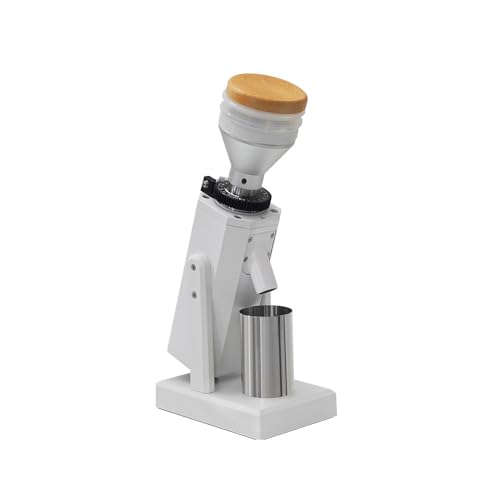
The SK40 approaches precision from the retention side. Its listing describes a single-dose grinder with a tilted base, a bellows system, and a stainless steel dosing cup, built so the dose you put in is close to the dose you get out. Infinite grind settings from its stepless adjustment help when a dose change needs a matching small dial change. It makes sense for a careful drinker who weighs each dose on a separate scale, then wants the grinder itself to add as little leftover coffee and as little mess as possible.
Wirsh Geimori GU38 Coffee Grinder
- Best for: Small counters where each weighed dose goes straight into a magnetic cup.
- Brand: Wirsh
- Model: GU38
- Burrs: 38mm 6-core stainless steel conical burr, CNC-machined SUS420 stainless steel
- Adjustment: 0.01mm stepless adjustment in the product title; 0.01mm stepless micron adjustments in the listing text
Small counters where each weighed dose goes straight into a magnetic cup.
The listing summary mentions an upgrade version, so confirm the exact configuration on the listing before ordering.
The GU38 is the compact single-dose option in this group, and its listing ties dosing to retention in plain terms: a single-dose design, a magnetic dosing cup that aligns itself under the chute, and a stated low amount of coffee remaining in the chute when the rinse technique described in the listing is used. That combination suits a small home bar where the dose is weighed per shot and counter space is tight. The included spray bottle and cleaning brush also point to a routine built around clearing the grinder between doses.
Which One Fits Your Situation
You pull the same double shot every weekday morning
Take the Sette 270. Program one of its dosing buttons for that drink, grind directly into the portafilter, and your morning becomes a single button press. Timed dosing rewards a stable routine: same beans for a stretch, same basket, same target. If the shot drifts as the beans age, adjust the grind in the micro range rather than reworking the whole routine, and re-check the delivered dose after any bigger change.
Two people use different baskets and different drink sizes
Start with the Encore ESP. Its dosing cup covers both 54mm and 58mm portafilters, so two machines or two baskets do not force two workarounds. The grounds bin also helps when one person wants a larger batch for a different brewer. Repeatability here comes from a consistent fill and level in the cup, so agree on one simple routine and both of you will land closer doses than a timed system set for only one drink.
You switch beans almost every day
Choose between the Opus and the SK40 by how you measure. Opus gives you the volumetric dosing lid and a single-dose load bin, which keeps measuring inside the grinder’s own kit. The SK40 gives you bellows and a tilted base for clearing the path, which suits a scale-first routine. Either way, avoid a hopper routine: beans stored in a hopper and grounds retained in a chute both blur the dose discipline you are trying to build.
Your counter is small and your dose is always weighed
The GU38 was built for that corner. A single-dose design, a magnetic cup that seats itself, and a compact metal body keep the weighing routine short and tidy. You still bring your own scale, because the listing offers no built-in weighing, but the grinder adds little friction after the beans go in. It is also the easiest of these five to clear out fully when the day’s last shot is done.
Common Mistakes
- Changing the grind setting and the dose in the same morning, then guessing which one fixed the shot.
- Trusting a timed dose for weeks without ever weighing what actually landed in the basket.
- Leaving beans in a hopper for days while expecting single-dose freshness and repeatability.
- Dosing into a cup that does not fit your portafilter, then losing grounds during a messy transfer.
- Ignoring retained grounds after a setting change, so the first shot still reflects the old setting.
Frequently Asked Questions
Is timed dosing accurate enough for espresso?
Timed dosing can be consistent when the beans, setting, and hopper fill stay similar, because the grinder repeats the same grind duration each time. It is not the same as weighing, since a finer setting or a different bean can change how much coffee passes in that time. Treat the timer as a repeatable starting point, and check the delivered dose with a scale whenever something in the setup changes.
Why does retention change my dose?
Retained grounds join the next dose, and they were produced at an earlier setting with older beans. In a high-retention path, part of what lands in your basket is not the coffee you just measured. Low-retention and straight-through designs reduce that share. If you change settings often, run a small purge or choose a single-dose design with bellows so the dose in the basket matches the dose you intended.
Should I dose into a cup or straight into the portafilter?
Grinding straight into the portafilter removes a transfer step and suits timed or weight-based systems built for it. A dosing cup suits drinkers who want to settle, stir, or inspect the grounds first, and a cup sized for your portafilter keeps that transfer clean. Neither route is more precise by itself; choose the one where you lose fewer grounds and repeat the same motions daily.
Does a dosing lid replace a scale?
A volumetric dosing lid measures space, not mass, so two coffees with different bean sizes and densities can fill the same lid and weigh differently. It is a fast, tidy way to keep doses close, especially for one familiar coffee. A scale remains the reference when dialling in a new bean or troubleshooting a shot. Many drinkers use the lid daily and the scale for setup changes.
Related guides
More from Amazon
Programs that pair well with the guide above. Offers and eligibility are set by Amazon and may change.
Free shipping on eligible items, Prime Video and more. Eligible new members can start with a free trial.
Start a Prime free trialAudiobooks and podcasts to listen to on the go. Eligible new members can start with a free trial.
Try Audible freeAd-free music streaming. Eligible new subscribers can start with a free trial.
Try Music Unlimited freeA free business account with business pricing and bulk-buying tools for work, shop or home office.
Create a business accountAs an Amazon Associate we earn from qualifying purchases.










Write Your Review
No reviews yet. Be the first to share your experience!