
Our Short List of 3

- Best for: Owners moving to an unpressurised basket who want espresso-specific steps without a complicated menu.
- 40 mm conical steel burrs, described on the listing as M2 conical burrs
- 40 grind settings, with settings 1-20 in the espresso-fine micro range and 21-40 in the brew macro range
- Espresso dosing cup suitable for 54 mm and 58 mm portafilters, plus a 120 g grounds bin
- Bean hopper capacity of 300 g
- Best for: Breville machine owners who want timed, repeatable doses ground directly into the portafilter.
- Stainless steel conical burrs designed to minimise grinding heat
- 60 precise grind settings from the finest Espresso to the coarsest French Press grind
- Precision electronic timer adjustable in 0.2 second increments
- 18 ounce coffee bean capacity with a locking system for hopper removal and storage
- Best for: Upgraded espresso setups in kitchens that also grind for cold brew, French press and drip.
- Commercial-grade, stainless steel conical burrs
- 70 precise settings, from coarse for Cold Brew and French Press to fine for Espresso
- Automatic Smart Dosing Technology that adjusts grind time for the selected drink
- Built-in adjustable portafilter holder and anti-static technology
All 4 Picks at a Glance
| Product | Specs | Action |
|---|---|---|
| Baratza Encore ESP Coffee Grinder ZCG495BLK, Black |
| Check price on Amazon |
| Breville Smart Grinder Pro BCG820BSS, Brushed Stainless Steel |
| Check price on Amazon |
| KitchenAid Burr Coffee Grinder – KCG8433 – Black Matte |
| Check price on Amazon |
 Baratza Sette 270 Conical Burr Coffee Grinder |
| Check price on Amazon |
Key takeaways
- Four conical burr grinders that can keep pace with an upgraded espresso machine, compared on espresso adjustment range, dosing method and portafilter fit.
What's inside
As an Amazon Associate I earn from qualifying purchases. This post may contain affiliate links at no extra cost to you.
Upgrading an espresso machine exposes the grinder that used to hide behind the old one. A new machine with an unpressurised basket punishes wide steps between grind settings: one click runs fast and sour, the next chokes the shot, and no amount of tamping fixes a gap that sits in the adjustment itself. The real decision is how much of a grinder’s range is genuinely devoted to espresso, and whether its dosing routine still suits the way you now pull shots each morning.
This guide is for owners who have moved up to a more demanding machine, or plan to, and whose current grinder was bought for an earlier setup. Every pick below was chosen from the product name and stated details on its own Amazon listing, and each one is a conical burr model whose listing describes grinding for espresso.
Quick Picks
As an Amazon Associate we earn from qualifying purchases.
| Product | Best for | Key spec from title |
|---|---|---|
| Baratza Encore ESP Coffee Grinder ZCG495BLK, Black | A first dedicated step up from a pressurised-basket grinder | Settings 1-20 form a dedicated espresso-fine micro range |
| Breville Smart Grinder Pro BCG820BSS, Brushed Stainless Steel | Timed dosing straight into a Breville-sized portafilter | 60 precise grind settings from the finest Espresso to French Press |
| KitchenAid Burr Coffee Grinder – KCG8433 – Black Matte | A wide setting range with automatic smart dosing | 70 precise settings from coarse Cold Brew to fine Espresso |
| Baratza Sette 270 Conical Burr Coffee Grinder | Fine control when a new machine exposes every step | 270 steps of grind adjustment with a stepless micro ring |
How to Choose
Count the settings that actually serve espresso
A headline setting count means little if most of that range belongs to filter brewing. What matters after a machine upgrade is how many usable steps sit inside the espresso zone, because an unpressurised basket reacts to small changes in particle size. The Encore ESP splits its 40 settings so that numbers 1 to 20 form a finely spaced micro range built for espresso, while the Sette 270 layers a stepless micro adjustment over 30 macro steps. Ask where the espresso steps are and how they are spaced, rather than comparing the biggest number on the box.
Match the dosing method to your new routine
An upgraded machine usually brings a stricter routine: weighing the dose, distributing it evenly and timing the shot. A grinder should support that routine instead of fighting it. Timed dosing, like the Breville’s electronic timer adjusted in small increments, repeats the same grind duration once you have settled on a setting. Preset timers on the Sette 270 store different amounts for different drinks. Cup-based dosing, like the Encore ESP dosing cup sized for common portafilters, suits people who weigh beans first and grind a single portion at a time.
Check portafilter fit before anything else
Portafilter sizes differ between machine brands, and a grinder that cannot hold or fill your basket cleanly adds mess and wasted coffee to every shot. Look for the sizes named on the listing itself. The Breville includes cradles for smaller and larger portafilters, the KitchenAid has a built-in adjustable portafilter holder, and the Encore ESP dosing cup suits both common basket sizes with an adapter ring. If your new machine uses an unusual basket diameter, confirm the holder or cup covers it before you order, not after the first spilled dose.
Think about beans, hopper size and switching
A machine upgrade often changes how you buy coffee: fresher bags, smaller lots, more frequent swaps between a house blend and a single origin. Hopper capacity then cuts both ways. A large hopper suits one bean used daily, while a removable hopper makes switching and storing beans easier. The KitchenAid hopper twists and lifts off for swapping, and the Breville hopper locks for removal and storage. If you change beans often, favour a design that empties cleanly and lets you purge the old coffee without tools or a long cleaning session.
The 4 Best Options
Baratza Encore ESP Coffee Grinder ZCG495BLK, Black
- Best for: Owners moving to an unpressurised basket who want espresso-specific steps without a complicated menu.
- 40 mm conical steel burrs, described on the listing as M2 conical burrs
- 40 grind settings, with settings 1-20 in the espresso-fine micro range and 21-40 in the brew macro range
- Espresso dosing cup suitable for 54 mm and 58 mm portafilters, plus a 120 g grounds bin
- Bean hopper capacity of 300 g
Owners moving to an unpressurised basket who want espresso-specific steps without a complicated menu.
Settings 21-40 are widely spaced for brew methods, so this is not the grinder for fine control at coarse ranges.
This is the natural replacement when the old grinder was chosen for a pressurised basket and the new machine is not so forgiving. Its adjustment is split into two ranges, and the first twenty settings are spaced finely for espresso work, which is exactly the part of the dial an upgraded machine depends on. The included dosing cup keeps single portions tidy and fits the basket sizes most home machines use. It remains a straightforward, twist-the-hopper machine, so the learning curve stays small while the espresso control improves substantially over a general-purpose grinder.
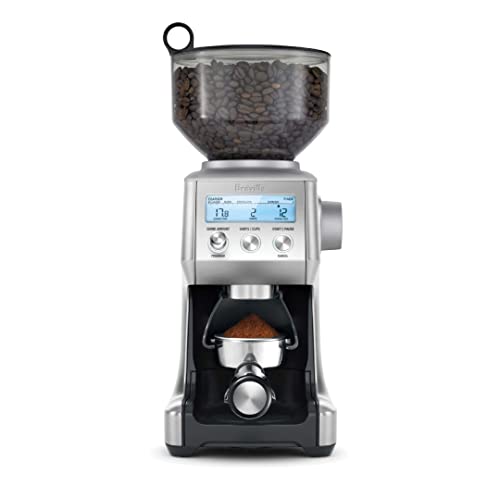
Breville Smart Grinder Pro BCG820BSS, Brushed Stainless Steel
- Best for: Breville machine owners who want timed, repeatable doses ground directly into the portafilter.
- Stainless steel conical burrs designed to minimise grinding heat
- 60 precise grind settings from the finest Espresso to the coarsest French Press grind
- Precision electronic timer adjustable in 0.2 second increments
- 18 ounce coffee bean capacity with a locking system for hopper removal and storage
Breville machine owners who want timed, repeatable doses ground directly into the portafilter.
Dosing is by time rather than weight, so changing beans or grind size means re-checking the dose on a scale.
Pairing a Breville machine upgrade with a grinder from the same family removes the portafilter guessing, because the listing includes cradles in the two sizes Breville baskets commonly use. Sixty settings run from the finest espresso grind to French press, and the electronic timer lets you program grind time in fine increments, so a dose that works on Monday repeats on Friday. The display-led routine feels familiar to anyone stepping up from a Breville appliance, and grinding straight into the portafilter keeps the upgraded workflow quick for households making several drinks in a row.
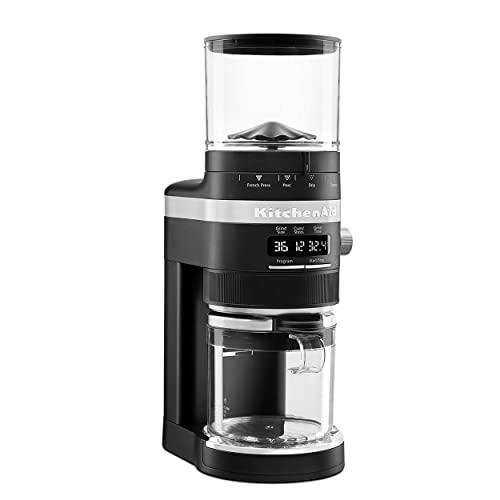
KitchenAid Burr Coffee Grinder – KCG8433 – Black Matte
- Best for: Upgraded espresso setups in kitchens that also grind for cold brew, French press and drip.
- Commercial-grade, stainless steel conical burrs
- 70 precise settings, from coarse for Cold Brew and French Press to fine for Espresso
- Automatic Smart Dosing Technology that adjusts grind time for the selected drink
- Built-in adjustable portafilter holder and anti-static technology
Upgraded espresso setups in kitchens that also grind for cold brew, French press and drip.
Seventy settings are shared across every brew method, so the espresso portion is a slice of the dial rather than the whole range.
A machine upgrade sometimes lands in a kitchen where espresso is only part of the day, and this model covers that spread with the widest setting range in this group. Its listing describes seventy precise settings running from coarse cold brew down to fine espresso, with smart dosing that adjusts grind time to deliver the chosen volume. The built-in adjustable portafilter holder handles espresso dosing, the removable hopper makes bean swaps simple, and anti-static technology aims to keep grounds off the counter. It suits an upgraded setup that still has to serve the whole household.
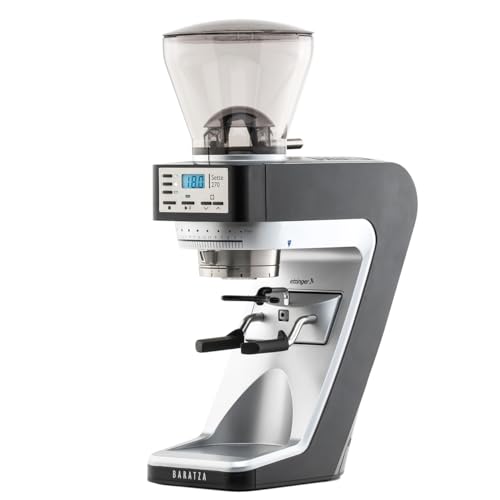
Baratza Sette 270 Conical Burr Coffee Grinder
- Best for: Owners whose upgraded machine needs between-step adjustment and fast, straight-through grinding.
- 40 mm conical steel burrs, described on the listing as S1 conical burrs in the comparison table
- 270 steps of adjustment: 30 macro steps plus a stepless micro adjustment in 9 parts
- Timed dosing in increments of 0.1 seconds with three programmable presets
- Convertible, adjustable arms for grinding into a portafilter or the supplied grounds bin
Owners whose upgraded machine needs between-step adjustment and fast, straight-through grinding.
The design is espresso-led, so coarse brewing range and quiet operation are not its priorities.
When a better machine reveals that the right grind sits between two clicks, this is the grinder built for that problem. Thirty macro steps combine with a stepless micro adjustment divided into nine parts, giving the fine control its name promises, and coffee passes straight through the grinder toward the portafilter or bin. Three programmable presets on the integrated timer store different grind amounts, which helps when an upgraded machine is used for both single and double baskets. It is the most espresso-focused design here, aimed squarely at owners who adjust by taste every few days.
Which One Fits Your Situation
You replaced a pressurised-basket machine with an unpressurised one
Start with the Encore ESP. Its first twenty settings exist specifically for espresso-fine grinding, so the change you feel at the basket is immediate, and the dosing cup matches the portafilter sizes most new machines ship with. It is the smallest change in daily routine that still fixes the problem your upgrade created.
Your new machine is a Breville and mornings are rushed
Choose the Smart Grinder Pro. The included cradles fit Breville basket sizes, the timer repeats a programmed dose, and grinding directly into the portafilter removes a transfer step when several drinks are made back to back in a busy kitchen. Keep a small scale nearby for the first week with each new bean, until the programmed time and the delivered dose agree.
One grinder now has to cover espresso and everything else
Pick the KitchenAid KCG8433. Seventy settings reach from fine espresso to coarse cold brew, smart dosing adjusts the grind time for the drink selected, and the lift-off hopper makes swapping between an espresso bean and a filter bean painless on the same morning. That breadth matters more than espresso-only finesse in a mixed kitchen where one machine serves everybody.
You keep landing between settings on your current grinder
Move to the Sette 270. The stepless micro adjustment exists for exactly that frustration, letting you nudge the grind instead of jumping a full step, and the three timed presets keep separate doses ready for different baskets. It rewards owners who taste, adjust and taste again, and who would rather change the grinder once than keep working around its steps every single day.
Common Mistakes
- Upgrading the machine but keeping a grinder whose espresso steps are too wide, then blaming the new machine for inconsistent shots.
- Comparing total setting counts without checking how many of those settings actually sit in the espresso range.
- Ordering a grinder before confirming its holder, cradle or dosing cup fits the portafilter size of the new machine.
- Filling a large hopper with fresh beans and leaving them for weeks, when smaller, fresher loads would suit an upgraded setup better.
- Changing the dose, the grind and the tamp all at once, which makes it impossible to tell which change fixed or broke the shot.
Frequently Asked Questions
Does a machine upgrade really require a new grinder?
Often, yes, when the new machine uses an unpressurised basket. That basket relies on grind size to build resistance, so a grinder with wide steps or a coarse minimum cannot control the shot. If your current grinder already offers fine, closely spaced espresso settings, keep it and judge the results first.
What does conical burr mean for an espresso upgrade?
It describes the shape of the burr set: a cone-shaped burr sitting inside a ring burr. Every model in this guide uses that design, and each listing states it for that exact model. For an upgrade, the practical point is the adjustment range built around the burrs, not the label alone.
Should dosing be timed or weighed after upgrading?
Either can work, and the listings here lean on timers and preset grind times. Timed dosing repeats well once a bean and setting are settled, but the delivered amount shifts when you change beans or grind size. Weighing the dose occasionally keeps a timer honest without slowing every morning down.
How many settings does an espresso grinder need?
There is no magic number. What counts is spacing inside the espresso range: the Encore ESP devotes twenty settings to it, while the Sette 270 adds a stepless micro ring over its macro steps. A smaller count of well-placed espresso steps beats a large count spread thinly across every brew method.
Related guides
More from Amazon
Programs that pair well with the guide above. Offers and eligibility are set by Amazon and may change.
Free shipping on eligible items, Prime Video and more. Eligible new members can start with a free trial.
Start a Prime free trialAudiobooks and podcasts to listen to on the go. Eligible new members can start with a free trial.
Try Audible freeAd-free music streaming. Eligible new subscribers can start with a free trial.
Try Music Unlimited freeA free business account with business pricing and bulk-buying tools for work, shop or home office.
Create a business accountAs an Amazon Associate we earn from qualifying purchases.










Write Your Review
No reviews yet. Be the first to share your experience!