
Key takeaways
- Five cushioned running shoes for flat feet and knee comfort, with max-cushion and guided-support picks, key listing specs, and fit checks before you buy.
What's inside
As an Amazon Associate I earn from qualifying purchases. This post may contain affiliate links at no extra cost to you.
Flat feet change how each stride loads the leg, and for many runners the complaint shows up at the knee long before the foot itself hurts. The real decision is not which shoe is softest, but how much cushioning you want underfoot and whether that cushioning should come with guidance for an inward roll or sit on a neutral platform. Getting that pairing right matters more than chasing the tallest stack or the firmest post on the shelf.
This guide is for flat-footed runners whose knees feel hard miles, walkers who log long pavement days, and neutral-gait runners who simply want a softer landing. Every pick below is a men’s road running shoe sold on Amazon, chosen from the name and specifications on its own product page: maximum-cushion models lead the list, guided options cover feet that roll inward, and each entry ends with the fit check worth doing before you order.
Quick Picks
As an Amazon Associate we earn from qualifying purchases
| Product | Best for | Key spec from title |
|---|---|---|
| Brooks Men’s Glycerin GTS 22 Supportive Running Shoe | Long easy pavement miles with gentle guidance | GuideRails support with DNA Tuned cushioning |
| Hoka Men’s Bondi 9 | Hard landings, daily miles and long walks | Maximum cushioning, premium foam midsole |
| ASICS Men’s Gel-Nimbus 27 Running Shoes | Recovery days for a neutral gait | FF BLAST PLUS ECO cushioning, PureGEL heel insert |
| New Balance Men’s Fresh Foam X More V5 Running Shoe | Max cushion on a lower, flatter platform | Fresh Foam X midsole, roughly 4 mm drop |
| Saucony Men’s Triumph 23 | Lighter, bouncier daily miles | PWRRUN PB foam, 10 mm offset |
How to Choose
Match cushion depth to how your knees feel
Start with the landing. If your knees feel jarred on pavement, a maximum-cushion midsole spreads each impact over more foam, and every pick here sits at the deep end of its brand’s range. Depth alone is not the whole story, though. A tall, soft platform like the Bondi 9 feels calm at easy paces but less planted when you turn or step off a curb, while a lower max-cushion shoe such as the More V5 keeps you closer to the ground. Pick depth by the miles that bother you, not by the biggest number on the box.
Decide whether you need guidance or a neutral platform
Flat feet cover a range. Some roll inward a long way with every step; others sit low but track fairly straight. Listings tell you which camp a shoe serves: words like GuideRails or a stated support system mean the platform is built to gently guide the foot, while a shoe described only as neutral cushioning leaves the stride alone. If your old shoes wear hard on the inner edge and your ankles cave inward, lean guided, like the Glycerin GTS 22. If wear looks even, a neutral pick such as the Nimbus 27 or Triumph 23 usually feels less intrusive.
Check the drop before your calves have to
Heel-to-toe drop changes where the work lands. The Triumph 23 lists a 10 mm offset, which keeps more load toward the heel and less on the calf, while the More V5 lists roughly 4 mm, shifting effort toward the calves and Achilles with each step. Neither is better in general; the right choice depends on what already feels tender. Runners with cranky knees often prefer a moderate or higher drop paired with deep cushioning, and anyone moving to a lower drop should build mileage over several weeks instead of switching all at once.
Confirm the exact variation, width and size chart
Shoe listings bundle many variations under one page, and the differences matter. The Glycerin comes in a neutral version and the GTS support version; the Bondi 9 and Triumph 23 offer Wide and X-Wide charts alongside Medium; several picks here also have a women’s version one click away. Before ordering, read the full listing title for the support version and the gender, then open the size chart for the width you selected. Sizing up to gain width also adds length, which can mean heel slip, so a true wide variation is the cleaner answer for broad flat feet.
The 5 Best Options
Brooks Men’s Glycerin GTS 22 Supportive Running Shoe

If your knees complain on long pavement miles but a firm motion-control shoe feels like too much, this is the balanced entry in the list. The listing pairs DNA Tuned cushioning, rated at the maximum level, with the GuideRails support system, so the platform feels soft first and guided second. That suits flat feet that roll inward moderately and want help only when the stride drifts. It also carries PDAC A5500 certification and the APMA Seal of Acceptance, both stated on the listing, which some buyers need for reimbursement paperwork.
Specs
- Cushioning: DNA Tuned, listed at Maximum level
- Support: GuideRails support system
- Weight: 10.7 oz (303.3 g)
- Sole: rubber; closure: lace-up
- Sport type: Running
- Listing states PDAC A5500 certification and APMA Seal of Acceptance
Best for: Long easy pavement miles when you want the softest landing here plus gentle guidance.
Watch out for: Check the listing title says GTS, not the neutral Glycerin, and confirm your size has an orderable offer in the color you want.
ASIN: B0D389144W
Hoka Men’s Bondi 9

Some runners do not need guidance at all; they need the ground to feel farther away. The Bondi 9 is the deepest cushion bed in this group, built on a premium foam midsole with an increased stack height, a 3D molded collar and a structured knit upper with zonal breathability. For flat feet that track fairly straight, that tall, soft platform takes the sting out of daily miles and the long walks you stack between run days. Wide and X-Wide size charts on the same listing make it the easiest fit here for broad feet.
Specs
- Cushioning level: Maximum, premium foam midsole
- Stack height: increased; exact drop not stated on the listing
- Collar: 3D molded
- Upper: structured knit with zonal breathability
- Outsole: Durabrasion rubber
- Widths: Wide and X-Wide size charts offered
Best for: Hard landings on daily miles and long walks between run days.
Watch out for: The tall, soft platform feels different from a low trainer, and if you need width, confirm you selected Wide or X-Wide rather than Medium.
ASIN: B0D5FXPFCB
ASICS Men’s Gel-Nimbus 27 Running Shoes
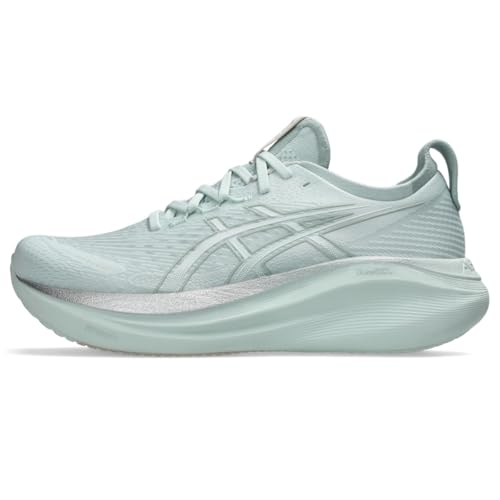
The Nimbus line is ASICS’ plush neutral flagship, and this generation leans on FF BLAST PLUS ECO cushioning with a PureGEL insert in the heel, the spot that takes the first hit of every stride. A soft engineered jacquard mesh upper keeps the fit relaxed rather than locked down. For a neutral-gait runner whose knees feel sore after steady miles, that combination makes a calm recovery-day shoe. It offers no guidance system, so it belongs with flat feet that stay fairly neutral rather than rolling far inward with each step.
Specs
- Cushioning: FF BLAST PLUS ECO with PureGEL heel insert
- Upper: soft engineered jacquard mesh
- Weight: 305 g (10.8 oz)
- Drop: not stated on the listing
Best for: Recovery days and steady daily miles for a neutral gait that wants plush heel cushioning.
Watch out for: There is no guidance system, so heavy inward roll is better served by the guided picks; confirm the colorway is the men’s version.
ASIN: B0D82C635V
New Balance Men’s Fresh Foam X More V5 Running Shoe

Not everyone trusts a tall shoe. The More V5 puts New Balance’s most cushioned Fresh Foam X experience on a lower, flatter platform, with a drop of roughly 4 mm, so you get a deep foam bed without the perched feeling of the tallest stacks here. An engineered mesh upper keeps the fit simple, and wide variations are sold in the same listing family for broader feet. If high stack heights make your knees feel less stable rather than more comfortable, this is the max-cushion pick shaped for you.
Specs
- Midsole: Fresh Foam X, with roughly 3 percent bio-based content
- Drop: roughly 4 mm
- Upper: engineered mesh
- Weight: 312 g (11 oz)
- Widths: wide variations sold in the same listing family
Best for: Max cushion on a lower, flatter platform when tall stacks feel unstable.
Watch out for: The low drop loads calves and Achilles more, so build mileage gradually and confirm the width code in your size.
ASIN: B0CLB7L53Z
Saucony Men’s Triumph 23

The Triumph 23 is the light, lively end of this list. Its PWRRUN PB foam and SRS sockliner give it a bouncier ride than the plushest picks here, and at 9.2 ounces it is the lightest shoe in the group, with a 10 mm offset that keeps the heel cushioned and the calf unloaded. Saucony describes it as a premium neutral cushioning shoe, and a Wide size chart is offered. For flat feet that do not roll far inward, it covers daily miles with soft landings and a little more spring.
Specs
- Foam: PWRRUN PB with SRS sockliner
- Offset: 10 mm (37 mm / 27 mm)
- Weight: 9.2 oz (263 g)
- Class: premium neutral cushioning, per the maker
- Widths: Wide size chart offered
Best for: Daily miles when you want soft landings in the lightest shoe here.
Watch out for: The platform is neutral with no support system, and you should confirm the variation is the men’s Triumph 23, not the women’s.
ASIN: B0FB65FG6J
Which One Fits Your Situation
Your knees ache most on long, easy pavement runs
Start with the Brooks Glycerin GTS 22. Its maximum-level DNA Tuned cushioning softens the landing, while the GuideRails system only steps in when your stride drifts, so flat feet that roll inward get support without a stiff post under the arch. It is the most balanced pairing of softness and guidance in this list for steady mileage.
You land hard and walk as much as you run
Choose the Hoka Bondi 9. The premium foam midsole and increased stack give you the deepest cushion bed here, which suits heavy landings on run days and long walks on the days between. Pick the Wide or X-Wide chart if your flat feet spread under load; just order from the width chart you actually selected, not the default Medium.
Your gait stays neutral but your heels take a beating
Look at the ASICS Gel-Nimbus 27 or the Saucony Triumph 23. Both are neutral, so neither fights your stride; the Nimbus concentrates its PureGEL insert at the heel for plush first contact, while the Triumph’s PWRRUN PB foam feels lighter and bouncier at 9.2 ounces. Pick the Nimbus for calm recovery miles and the Triumph when you want the same softness with more spring on daily runs.
Tall shoes make your knees feel less steady
Go with the New Balance Fresh Foam X More V5. It delivers the brand’s most cushioned Fresh Foam ride on a lower, flatter platform of roughly 4 mm drop, so your foot sits closer to the ground and the shoe feels planted rather than perched. Ease into the mileage, since the low drop asks more of your calves at first.
Common Mistakes
- Buying the neutral version of a shoe that also comes in a support version; the Glycerin and the Glycerin GTS are different shoes, and the listing title is the only reliable tell before the box arrives.
- Assuming flat feet always need the firmest motion control, when many flat-footed runners do better with deep cushioning and gentle guidance than with a stiff post.
- Sizing up for width instead of choosing the Wide or X-Wide variation, which adds unwanted length and invites heel slip.
- Switching to a low-drop shoe like the More V5 and keeping full mileage from day one, before calves and Achilles adapt.
- Expecting new shoes alone to settle knee pain that keeps coming back; ongoing pain deserves an assessment from a clinician or podiatrist, not another order.
Frequently Asked Questions
Will new running shoes make my knee pain go away?
Not on their own. Cushioning and guidance change how each landing feels and how load spreads through the leg, which many flat-footed runners find more comfortable, but knee pain has many possible causes. If the pain persists, sharpens, or arrives with swelling, see a clinician or podiatrist for an assessment rather than rotating through more shoes.
Are neutral shoes a bad idea for flat feet?
Not always. Flat feet that track fairly straight often do well in a plush neutral shoe like the Nimbus 27 or Triumph 23. The mismatch happens when feet roll far inward: then a guided platform such as the Glycerin GTS 22 usually feels steadier. Check the wear pattern on your current shoes; heavy inner-edge wear points toward guidance.
Should I size up or buy the wide version?
Buy the wide version when the listing offers one. Sizing up adds length as well as width, which can leave the heel loose and the toes sliding on downhills. The Bondi 9 lists Wide and X-Wide charts, and the Triumph 23 offers a Wide chart, so match your width to the chart on the listing instead of guessing with a longer shoe.
How long should I take to switch to a low-drop shoe?
Give it several weeks. A shoe like the More V5, at roughly 4 mm of drop, asks more of your calves and Achilles than a 10 mm shoe does. Start with short, easy runs in the new pair, keep longer days in your old shoes, and add time gradually. Soreness that builds instead of fading is a sign to slow the switch down.
Related guides
More from Amazon
Programs that pair well with the guide above. Offers and eligibility are set by Amazon and may change.
Free shipping on eligible items, Prime Video and more. Eligible new members can start with a free trial.
Start a Prime free trialAudiobooks and podcasts to listen to on the go. Eligible new members can start with a free trial.
Try Audible freeAd-free music streaming. Eligible new subscribers can start with a free trial.
Try Music Unlimited freeA free business account with business pricing and bulk-buying tools for work, shop or home office.
Create a business accountAs an Amazon Associate we earn from qualifying purchases.









Write Your Review
No reviews yet. Be the first to share your experience!