
Key takeaways
- Find the best card games 2026 has for families, parties, and strategy fans: five physical card games compared by players, ages, and play time in one guide.
What's inside
As an Amazon Associate I earn from qualifying purchases. This post may contain affiliate links at no extra cost to you.
As an Amazon Associate I earn from qualifying purchases.
The Short Answer
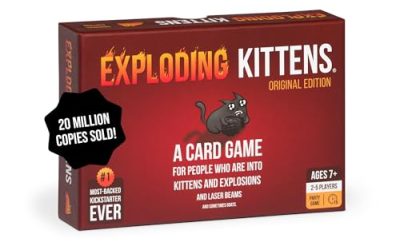
If you want one card game to buy first, buy Exploding Kittens Original Edition. It plays in about 15 minutes, works for 2 to 5 players ages 7 and up, and its rules take about two minutes to explain, so it fits family nights, casual parties, and travel alike. The box holds 56 cards, and the whole game is about avoiding the exploding kitten card while using action cards to skip turns, peek at the deck, and defuse the danger when it shows up.
Our Top Picks
- Best overall: Exploding Kittens Original Edition — quick, funny, and easy to teach to almost any group.
- Best classic for families: UNO Classic — the familiar color and number matching game for 2 to 10 players.
- Best cooperative strategy: The Crew: The Quest for Planet Nine — a trick-taking space mission with 50 levels to work through together.
- Best party game: Codenames (2nd Edition) — two teams, one-word clues, and a 5 by 5 grid of word cards.
- Best quick filler: Flip 7 — a press-your-luck card game for 3 or more players that runs about 20 minutes.
Quick Comparison
| Product | Best for | Key spec | Amazon link |
|---|---|---|---|
| Exploding Kittens Original Edition | All-round family and party play | 2–5 players, ages 7+, about 15 minutes, 56 cards | View on Amazon |
| UNO Classic | Large families and mixed ages | 2–10 players, ages 7+, 108 cards in the box | View on Amazon |
| The Crew: The Quest for Planet Nine | Cooperative strategy fans | 3–5 players, ages 10+, 50 missions | View on Amazon |
| Codenames (2nd Edition) | Big parties and team play | 4+ players, 200 cards with 400 codenames | View on Amazon |
| Flip 7 | Fast filler games | 3+ players, ages 8+, about 20 minutes | View on Amazon |
How to Choose
Begin with the size of your usual group. A game built for 2 to 5 players will sit on the shelf if your table regularly holds eight people, and a party game built for a crowd will feel thin with two. Count the people who actually show up, not the people you hope will show up, and check the player count on the listing before you buy.
Next, match the age range to the youngest regular player. The age on the box reflects reading level, attention span, and theme as much as rules. A game listed for ages 10 and up can still work for a sharp 8-year-old, but a game listed for ages 7 and up is a safer bet when younger children join in.
Play time matters more than most buyers expect. A 15-minute game gets played three times in an evening; a 45-minute game gets played once, and only when everyone is in the mood. If your group meets after dinner on a weeknight, short games win. If your group sets aside a whole Saturday afternoon, a longer cooperative campaign makes sense.
Think about how competitive your group likes to be. Trick-taking and word-clue games reward careful thinking and teamwork, while push-your-luck and take-that games reward bluffing and laughing at bad luck. A group that argues over rules will enjoy a simple game with almost nothing to dispute. A group that loves a puzzle will enjoy a game where every round asks for a real decision.
Finally, check what is actually in the box. Card counts and included accessories vary between editions of the same game, and a second edition can change the word list, the art, and the insert. Read the listing carefully and confirm on the listing the exact number of cards and the player count.
The Picks in Detail
Exploding Kittens Original Edition
Exploding Kittens is a card game where players draw cards until someone draws an exploding kitten. That player is out unless they hold a defuse card. Action cards let you skip your turn, attack the next player, peek at the top cards of the deck, or shuffle the deck to move the danger somewhere else.
The listing gives 2 to 5 players, ages 7 and up, and about 15 minutes per game. The box holds 56 cards, and the model number is EKG-ORG1-1. The box measures 4.41 by 6.38 by 1.5 inches and weighs 6.3 ounces, so it travels well in a bag or a car glove box. The cards are illustrated in a cartoon style, and the humor is light but pointed, which is why the age guidance begins at 7.
This is the top pick because it asks almost nothing of new players and still gives experienced players decisions worth making. Knowing when to play a skip, when to hold a defuse, and when to peek at the deck is a real skill, but a first-time player can learn the rules in a single round.
Pros:
- Rules take about two minutes to explain, so new players join in immediately
- Short rounds mean a bad draw never ruins the evening
- Small, light box that is easy to carry to a friend’s house or on a trip
- Works for mixed ages from 7 upward
Cons:
- Player elimination means someone can sit out the end of a round
- The humor will not suit every household, so check the card art first
- Best with 3 to 5 players; with only 2 players the game is quieter
UNO Classic
UNO is the classic color and number matching game. Players take turns matching a card from their hand to the card on top of the discard pile by color, number, or symbol. If you cannot play, you draw from the deck. Special action cards — Skips, Reverses, Draw Twos, Wild, and Draw Four Wild — change the game in a single turn. The first player to get rid of all their cards wins, and the listing reminds players to yell “UNO” when they are down to one card.
The listing gives 2 to 10 players and ages 7 and up. The model number is W2087. The box contents on the listing describe 108 cards, including 32 special action cards, plus 3 customizable and erasable Wild cards that let a group write its own rules. Confirm on the listing the exact card count for the edition you buy, since the listing title and the box contents describe the count differently.
Pros:
- Familiar to almost everyone, so there is no learning curve for most groups
- Seats up to 10 players, more than any other game in this guide
- Customizable Wild cards let a family add its own house rules
- Small box and simple components that survive years of play
Cons:
- Games can run long with many players, since a Draw Four can swing the table
- Experienced players may find the strategy shallow compared with the other picks here
- The luck of the draw decides many rounds, which frustrates competitive players
- Card count differs between the listing title and the box contents, so confirm on the listing
The Crew: The Quest for Planet Nine
The Crew is a cooperative trick-taking card game with a space theme. Players work together through 50 missions, each with its own goal, such as winning a specific trick or avoiding one. The catch is that players may not talk about their cards, so the team has to communicate through the cards they play. It won the Kennerspiel des Jahres, the German award for the connoisseur game of the year.
The listing gives 3 to 5 players, ages 10 and up, and describes 50 levels of difficulty. The model number is THA691868, from Thames and Kosmos. The mission structure means the group can play one mission or five in a single sitting.
This is the pick for a group that plays together regularly and wants a game that grows with them. The early missions teach the rules gently, and the later missions ask for genuine planning and silent coordination.
Pros:
- Cooperative play means the whole table wins or loses together
- 50 missions give the game a campaign feel without a long rulebook
- Silent communication creates memorable moments that other card games do not
- Strong choice for regular groups who want to improve together over time
Cons:
- Needs at least 3 players, so it does not work for a couple
- Not a good fit for players who want a quick, noisy party game
- The no-talking rule can frustrate players who like to discuss every move
- Trick-taking is unfamiliar to some players, so the first mission takes longer to learn
Codenames (2nd Edition)
Codenames splits the table into two teams, each led by a spymaster. Twenty-five word cards sit in a 5 by 5 grid. Each spymaster knows which words hide their team’s agents, and gives a one-word clue plus a number to point teammates toward several words at once. Teammates guess, trying to find their agents while avoiding the other team’s agents, neutral bystanders, and the one assassin card that ends the game at once.
The 2nd Edition listing gives 4 or more players, and the box includes 200 cards carrying 400 codenames, 16 agent tiles in two colors, 1 double agent tile, 7 innocent bystander tiles, 1 assassin tile, 40 key cards, 1 rulebook, 1 card stand, and the model number CGE00125, from Czech Games Edition. Publisher guidance puts a game at about 15 minutes, and the listing gives a recommended age of 14 and up, while the publisher rates it for ages 10 and up. Confirm on the listing which age guidance applies to the edition you buy.
Pros:
- Works with large groups where most card games run out of seats
- Every round is different because the 5 by 5 grid is rebuilt each time
- The 2nd Edition refreshes the word list and the art, and improves the box insert
- One-word clues make it easy for quiet players to take part
Cons:
- Needs at least 4 players, and it is at its best with 6 or more
- Wordplay in English can be hard for players who are still learning the language
- One unlucky assassin guess can end a round in seconds
- The spymaster role is demanding, and shy players may avoid it
Flip 7
Flip 7 is a press-your-luck card game. On your turn you flip a card and add it to your row. Number cards score their face value, but if you flip a number you already hold, your turn ends and you score nothing for that round. Action cards change the odds, and the first player to reach the target total wins. The tension is simple: flip again for more points, or stop while you are ahead.
The listing gives 3 or more players, ages 8 and up, and about 20 minutes of play time. The publisher is USAOPOLY. The rules fit on a single page, and the whole game is about judging risk, which makes it easy to teach and hard to put down.
Pros:
- Extremely fast to learn, with almost no setup
- Short games mean you can play several rounds in one sitting
- The push-your-luck decision keeps every turn tense
- Works for ages 8 and up, so children and adults play on equal terms
Cons:
- Luck decides more rounds than skill, which can frustrate strategic players
- Needs at least 3 players, so it is not a two-player game
- The game is light, so groups that want depth should pair it with a longer game
Who Should Choose What
Choose Exploding Kittens Original Edition if you want one game that covers the most situations: family night, a casual party, a trip, or a first game night with new friends. It is the most flexible pick in this guide.
Choose UNO Classic if your group includes young children or grandparents, or if your table regularly holds more than five people. It is the only pick here that seats 10.
Choose The Crew: The Quest for Planet Nine if your group meets regularly and likes a shared challenge. It is the only cooperative game in this guide.
Choose Codenames (2nd Edition) if your gatherings are large and loud. It is built for parties where two teams can debate clues across the room, and it stays fun with eight or more players.
Choose Flip 7 if you want a fast game to open or close an evening, or if you need a game that fits in the gap between other activities.
Common Mistakes
The first mistake is buying for the group you wish you had instead of the group you actually have. A cooperative trick-taking game will not get played if your table only ever holds two people, and a party word game will not get played if your group is quiet and small. Count your real players first.
The second mistake is ignoring the age guidance. A game listed for ages 10 and up is not just about reading level; it is about attention span, theme, and the patience needed for silent play or careful clue-giving. Bringing a game that is too old for the youngest player ends the night early.
The third mistake is buying a second edition without checking what changed. A new edition can change the word list, the art, the insert, and even the player count. Read the listing and confirm on the listing the contents of the box you are buying.
The fourth mistake is judging a game by one bad round. Push-your-luck games will punish a bold player, word games will end early on an unlucky assassin guess, and elimination games will leave someone out. Play each game at least three times before deciding whether it belongs on your shelf.
The fifth mistake is buying only one game for a whole evening. Card games are short, and even a great game gets stale if it is the only one on the table. Pair a light filler like Flip 7 with a longer game like The Crew, or a party game like Codenames with a classic like UNO.
FAQ
What is the best card game for a family with young children?
UNO Classic and Exploding Kittens Original Edition are the safest choices here, since both are listed for ages 7 and up and both take about 15 minutes to play. UNO is the better choice for very large families because it seats up to 10 players.
What is the best card game for a large party?
Codenames (2nd Edition) is the best party pick in this guide because it is built for two teams and stays fun with eight or more players.
What is the best card game for two players?
None of the five picks in this guide is designed mainly for two players. The Crew needs at least 3 players, Codenames needs at least 4, and Flip 7 needs at least 3. Exploding Kittens and UNO both list 2 players on the listing, but both are quieter and less lively with only two. If two-player play is your main use, look for a game designed for two from the outset.
How long does a game of Exploding Kittens take?
The listing gives about 15 minutes per game for 2 to 5 players ages 7 and up. A first game with new players may take a little longer while everyone learns the action cards.
What is the difference between the 1st and 2nd Edition of Codenames?
The 2nd Edition refreshes the word list and the art, streamlines the rulebook, and improves the box insert. The core game is the same: two teams, a 5 by 5 grid of word cards, and a spymaster giving one-word clues. If you are buying now, the 2nd Edition is the current listing, with model number CGE00125.
Do I need to buy expansions for these games?
No. Each of the five games in this guide is complete in its box and plays well on its own. Expansions exist for some of them, and they add new cards and new twists, but none of them is required. Buy the base game first and play it several times before deciding whether an expansion would add anything your group actually wants.
Conclusion
The best card games of 2026 are the ones that fit your table, not the ones with the longest list of features. Exploding Kittens Original Edition is the top pick because it is fast, funny, easy to teach, and flexible enough for family nights, parties, and travel. UNO Classic is the runner-up for families, thanks to its familiar rules and its room for up to 10 players.
If your group wants more depth, The Crew: The Quest for Planet Nine turns a card game into a 50-mission team challenge. If your gatherings are large, Codenames (2nd Edition) turns a room full of people into two competing teams. And if you need a fast game to fill the gaps, Flip 7 delivers 20 minutes of push-your-luck tension with almost no setup.
Related guides
More from Amazon
Programs that pair well with the guide above. Offers and eligibility are set by Amazon and may change.
Free shipping on eligible items, Prime Video and more. Eligible new members can start with a free trial.
Start a Prime free trialAudiobooks and podcasts to listen to on the go. Eligible new members can start with a free trial.
Try Audible freeAd-free music streaming. Eligible new subscribers can start with a free trial.
Try Music Unlimited freeA free business account with business pricing and bulk-buying tools for work, shop or home office.
Create a business accountAs an Amazon Associate we earn from qualifying purchases.




Write Your Review
No reviews yet. Be the first to share your experience!