
Key takeaways
- What kind of yarn is best for knitting hats? The answer by fibre and weight: wool, blends, acrylic and cotton compared, with four example yarns.
What's inside
As an Amazon Associate I earn from qualifying purchases. This post may contain affiliate links at no extra cost to you.
Almost any yarn can be knitted into something hat-shaped. The better question is which kind of yarn makes a hat that fits, stays on, keeps its wearer warm and still looks like a hat after a season of being pulled on, stuffed into pockets and washed. That outcome is decided by three properties: elasticity, because a hat must stretch over a head and then grip; warmth, because most hats exist to insulate; and care, because a hat that cannot survive its owner’s laundry habits will not be worn for long. Different fibres deliver those properties in different measures, which is why the honest answer to “what kind of yarn is best” is a short decision path rather than a single name.
This guide walks that path: the fibre types compared on what actually matters for hats, the weights that suit which style, and four example yarns — one for each major type — so you can see the reasoning applied to real, buyable yarn.
As an Amazon Associate, we earn from qualifying purchases.
Quick Picks
| Product | Type it represents | Best for |
|---|---|---|
| Lion Brand Fishermen’s Wool | Pure wool | Maximum warmth and spring |
| Lion Brand Wool-Ease Thick & Quick | Wool blend | Warmth with machine wash convenience |
| Caron Simply Soft | Acrylic | Easy care hats for anyone, any budget |
| Lion Brand 24/7 Cotton | Cotton | Cool-weather and skin-sensitive hats |
The fibre types, judged by hat standards
Pure wool is the benchmark. Its crimped fibres trap air for insulation, its natural elasticity lets a ribbed brim stretch and recover for years, and it breathes, so a wool hat stays comfortable across the temperature swing between a cold street and a heated shop. It also insulates when damp. The costs are care and feel: most pure wool is hand wash, and firmer wools can prickle sensitive foreheads. For a hat whose whole job is warmth, wool remains the answer other fibres are compared against.
Wool blends — most often wool with acrylic — exist to soften wool’s costs. A blend with a modest wool content keeps much of the warmth and spring, adds softness and durability, and often becomes machine washable. The trade is real but gentle: slightly less insulation and elasticity than pure wool at the same weight. For gift hats and family hats, where you cannot control the washing, a blend is frequently the wisest kind of yarn rather than a compromise to apologise for.
Acrylic is the practical default for most knitters. Modern acrylics are soft, light, inexpensive, available in every colour, and machine washable and dryable without drama. What acrylic lacks is wool’s spring and breathability: an acrylic hat can feel clammy in milder weather and its brim relaxes sooner over years of wear. For children, charity knitting, fashion hats and anyone with a wool sensitivity, those are acceptable trades, and acrylic is the kind of yarn that gets hats actually finished and worn.
Cotton is the specialist. It has almost no elasticity, so a cotton hat must be sized carefully and usually needs a strongly ribbed brim to stay on. In return it is cool, smooth, non-prickling and washable — the right kind for warm climates, for spring and autumn hats, and for people whose skin rejects animal fibres and synthetics alike, including many wearers of chemo hats who need a soft, breathable, seam-friendly fabric. Mercerized cotton adds sheen and durability to that profile.
Two kinds to avoid for hats: fuzzy novelty yarns, whose halo hides stitches and sheds, and inelastic plant fibres used without a plan — a pure linen or silk hat will stretch out of shape and stay there. Baby hats have their own rule set, covered by the dedicated baby yarn category: smooth, low-shed and machine washable above all.
The weight question
Weight decides the hat’s season and speed. Worsted weight (CYC 4) is the standard hat yarn: warm, defined stitches, and the weight most patterns are written in. Bulky and super bulky yarns (CYC 5 and 6) knit a hat in an evening and make the warmest, most casual hats, at the cost of stitch detail. DK weight (CYC 3) makes lighter, neater hats for milder weather, children and finer patterns. Fingering weight hats exist as lightweight layers and under-helmet liners, but they are slow projects for a small garment. Match the weight to the pattern first and the weather second — a hat knitted off-gauge in the perfect fibre still will not fit.
Example yarns, one per type
1. Lion Brand Fishermen’s Wool — the pure wool example

An undyed virgin wool with its natural lanolin retained, Fishermen’s Wool shows what pure wool does for a hat: real spring in the brim, warmth with weather resistance, and a skein large enough for several hats. It represents the type at its most traditional, natural shades and hand wash care included.
Specs
- Fiber: 100 percent pure virgin wool with natural lanolin; Yarn weight: CYC 4 medium (worsted); Skein: 8 oz (227 g), 465 yd (425 m); Care: hand wash, dry flat; Suggested needles: US 9 (5.5 mm)
Best for: Outdoor hats where warmth and elasticity matter most
Watch out for: Hand wash only, natural shades only, and a rustic feel that sensitive foreheads may notice
2. Lion Brand Wool-Ease Thick & Quick — the wool blend example
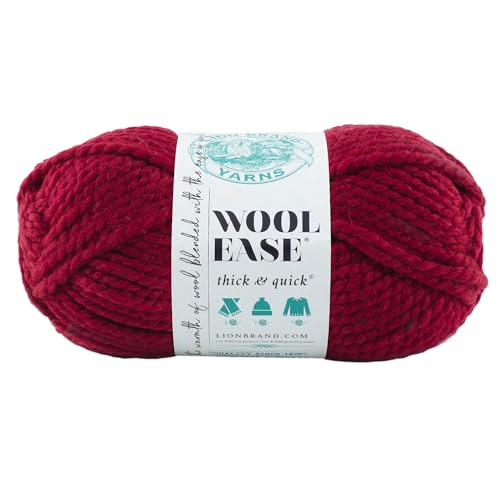
With 20 percent wool in an acrylic base, spun at super bulky weight, this yarn shows the blend bargain clearly: a hat knits in a few hours, feels warm and substantial, and — unusually for anything containing wool — is labelled machine washable and dryable. It is the type to reach for when the hat is a gift and the recipient’s laundry habits are unknown.
Specs
- Fiber: 80 percent acrylic, 20 percent wool; Yarn weight: CYC 6 super bulky; Ball: 6 oz (170 g), 106 yd (97 m) for solid colours; Care: machine wash and dry; Suggested needles: US 13 (9 mm)
Best for: Fast, warm gift hats with easy care
Watch out for: Print and metallic colourways in this line use different fibre mixes, so read the band of the exact ball you buy
3. Caron Simply Soft — the acrylic example

Simply Soft represents acrylic at its most wearable: a smooth worsted with a soft hand and slight sheen that knits into hats anyone can wear and anyone can wash. It lacks wool’s spring, so patterns for it lean on ribbing for fit, but for children’s hats, colour-led designs and everyday wear it is the type most knitters use most — for sound practical reasons.
Specs
- Fiber: 100 percent acrylic; Yarn weight: CYC 4 worsted (medium); Ball: 6 oz (170 g), 315 yd (288 m) for solid colours; Care: machine wash and dry; Suggested needles: US 8 (5 mm)
Best for: Everyday hats, children’s hats and any hat that must survive the machine
Watch out for: The brim will relax sooner than a wool brim over years of wear, so knit ribbing snugly
4. Lion Brand 24/7 Cotton — the cotton example

A mercerized cotton with a smooth, durable surface, 24/7 Cotton is the example for hats that should be cool rather than warm: spring and autumn wear, warm climates, and wearers who cannot tolerate wool or prefer plant fibre against the skin. Its crisp stitch definition flatters textured patterns, and it washes without any special handling.
Specs
- Fiber: 100 percent mercerized cotton; Yarn weight: CYC 4 worsted (medium); Ball: 3.5 oz (100 g), 186 yd (170 m); Care: machine wash and dry; Suggested needles: US 7 (4.5 mm)
Best for: Mild-weather hats and hats for fibre-sensitive wearers
Watch out for: Cotton has almost no elasticity, so size carefully and give the hat a firmly ribbed brim
Which One Fits
If the hat is for genuine cold and you will care for it, the kind is pure wool. If it is a gift or a family hat and the washing is out of your hands, the kind is a wool blend. If it is for a child, a charity box, a tight budget or a wool-sensitive wearer, the kind is acrylic. If it is for mild weather or a sensitive scalp in a warm place, the kind is cotton. In every case, worsted weight is the default unless the pattern or the season says otherwise.
Common Mistakes
Choosing the fibre before the wearer is the root mistake: the warmest wool is wrong for the brother-in-law who machine washes everything, and the easiest acrylic is wrong for the hiker who needs damp-weather insulation. The second mistake is ignoring elasticity — knitting a hat in an inelastic yarn at a size that assumes wool’s spring guarantees a hat that slides off or binds. Third, buying by softness in the ball alone; a hat presses yarn against a forehead for hours, so test the strand there, not in your palm. Finally, mismatching weight and pattern: gauge decides fit, and no fibre quality rescues a hat knitted at the wrong one.
FAQ
What is the single best kind of yarn for a hat?
If forced to one answer: a worsted weight wool or wool blend, because hats live on elasticity and warmth, and those fibres deliver both. The blend is the safer universal choice; pure wool is the warmer, springier one for owners who will hand wash.
Is acrylic yarn bad for hats?
No. Acrylic is soft, washable, inexpensive and available in every colour, which makes it the right kind for many hats. It simply has less spring and breathability than wool, so fit it with good ribbing and expect a slightly shorter service life from the brim.
What yarn is best for a hat for someone with sensitive skin?
Smooth acrylics and mercerized cotton are the usual answers, because they have no prickle and no shed. Test any yarn against the wearer’s forehead if you can, and avoid fuzzy or haloed yarns entirely for sensitive wearers.
Does yarn weight matter as much as fibre?
Yes — they decide different things. Fibre decides warmth, elasticity and care; weight decides thickness, speed and season. A hat succeeds when both match the pattern and the wearer, which is why this guide treats them as two separate choices.
Final Verdict
The best kind of yarn for knitting hats is the one whose fibre matches the wearer’s weather and laundry, in the weight the pattern asks for. Pure wool for warmth and spring, a wool blend for warmth with easy care, acrylic for practicality, cotton for cool comfort — the four examples above show each type at its best. Decide the wearer first, and the right kind of yarn follows almost automatically.
Related guides
More from Amazon
Programs that pair well with the guide above. Offers and eligibility are set by Amazon and may change.
Free shipping on eligible items, Prime Video and more. Eligible new members can start with a free trial.
Start a Prime free trialAudiobooks and podcasts to listen to on the go. Eligible new members can start with a free trial.
Try Audible freeAd-free music streaming. Eligible new subscribers can start with a free trial.
Try Music Unlimited freeA free business account with business pricing and bulk-buying tools for work, shop or home office.
Create a business accountAs an Amazon Associate we earn from qualifying purchases.

Write Your Review
No reviews yet. Be the first to share your experience!