
Key takeaways
- Compare three capable tablets for reading, streaming, schoolwork and travel, with display, storage and battery details to help you choose the right one.
What's inside
As an Amazon Associate I earn from qualifying purchases. This post may contain affiliate links at no extra cost to you.
A tablet earns its place when it fits the hours you actually spend on it, not the spec sheet you skimmed before checkout. Someone who reads in bed, streams shows on the train and answers email at the kitchen table needs a bright screen, enough storage for offline downloads and a battery that survives the day without hunting for a charger. Getting those three things right matters more than chasing the newest chip, because a tablet that dies at midday or stutters through video calls ends up in a drawer.

This guide is written for everyday buyers, students, commuters and families sharing one device between several people. Each tablet below was picked from its Amazon listing, using the display size, processor, memory, storage and battery figures published on that page, so you can compare the three side by side and match one to the way you will use it most.
Quick Picks
As an Amazon Associate we earn from qualifying purchases
| Product | Best for | Key spec from title |
|---|---|---|
| Amazon Fire HD 10 (2023) | Reading and streaming on a budget | 10.1-inch Full HD display, 32GB storage |
| Samsung Galaxy Tab A9+ | Family media and multitasking | 11-inch 90Hz display, 128GB storage |
| Lenovo Tab M11 | Schoolwork and note-taking | 11-inch display with pen and folio case |
How to Choose
Screen size and display quality
Screen size shapes nearly everything else about a tablet, from how heavy it feels in one hand to how much of a page or video frame you can see at once. A 10-inch display slips into a small bag and works well for reading, while an 11-inch panel gives documents, textbooks and split-screen apps more breathing room. Resolution matters just as much: a Full HD panel keeps text crisp and video sharp, and a higher refresh rate makes scrolling feel smoother. Before settling on a size, think about where the tablet will live most of the time, because a screen that is perfect on the sofa can feel oversized on a crowded commute.
Storage and memory
Storage decides how many apps, books, photos and downloaded shows a tablet can hold before it starts asking you to delete things. A 32GB model covers light use, but downloaded video fills it quickly, so a 64GB or 128GB model gives more headroom for a family or a student carrying course material. Memory, or RAM, decides how smoothly the tablet juggles apps: 3GB handles one task at a time comfortably, while 4GB keeps switching between a browser, notes and video noticeably calmer. A microSD slot is worth checking for, since it lets you expand storage later without replacing the whole device.
Battery life and charging
Battery life is the difference between a tablet you reach for and one you leave plugged in. Manufacturers quote figures for reading, browsing and video playback, and a rating around 10 to 13 hours usually covers a full day of mixed use with charge to spare. Real life is less tidy: bright screens, video calls and games drain power faster than reading, so treat the quoted figure as a best case. Charging matters too, because a tablet that refills slowly is still tied to an outlet even with a long-lived battery. Look for USB-C charging and check whether the charger in the box matches the charging speed the tablet supports.
Software and ecosystem
The operating system decides which apps you can install and how the tablet talks to your other devices. Android tablets open up the Google Play library and pair naturally with Android phones, while Fire OS leans on the Amazon Appstore and works best for readers and streamers already inside Amazon services. Think about the apps you cannot live without, such as a particular note-taking app, a classroom platform or a video service, and confirm they exist on that system before buying. Also consider how long the maker supports the device with updates, since a tablet that stops receiving security updates becomes a risk long before its hardware gives out.
The 3 Best Options
Amazon Fire HD 10 (2023)
The Fire HD 10 is the straightforward pick for anyone whose tablet time is mostly reading, streaming and browsing. Its 10.1-inch Full HD display is sharp enough for long reading sessions and video, and the octa-core processor with 3GB of RAM keeps everyday apps moving without fuss. Storage comes in 32GB or 64GB, with a microSD slot that accepts cards up to 1TB, so downloaded shows and books rarely force a clear-out. Battery life runs up to 13 hours, and the strengthened aluminosilicate glass plus a light 15.29-ounce body make it easy to carry around the house or slip into a bag.
Specs
- Display: 10.1-inch Full HD, 1920 x 1200 resolution, 224 ppi
- Processor: octa-core, 2x Arm Cortex-A76 up to 2.05 GHz and 6x Arm Cortex-A55 up to 2 GHz
- RAM: 3 GB
- Storage: 32 GB or 64 GB internal, microSD expandable up to 1 TB
- Battery life: up to 13 hours of reading, browsing the web, watching videos and listening to music
- Cameras: 5 MP front-facing camera and 5 MP rear camera
- Connectivity: Bluetooth 5.3, USB-C, Wi-Fi
- Operating system: Fire OS 8
- Weight: 15.29 oz (433.6 g)
Best for: readers and streamers who want a light, affordable tablet for daily use.
Watch out for: it runs Fire OS 8 without Google Play, so confirm your must-have apps are in the Amazon Appstore first.
Samsung Galaxy Tab A9+
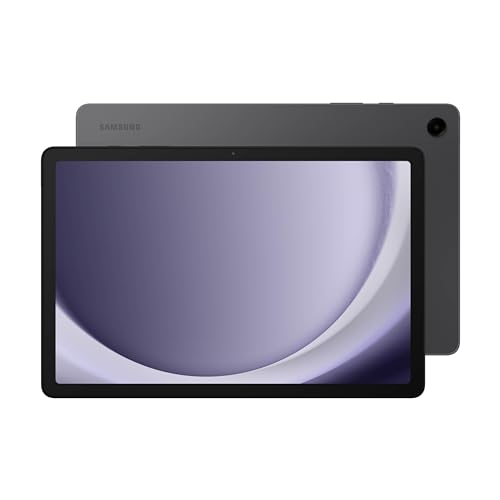
The Galaxy Tab A9+ suits households where one tablet gets passed between people and jobs, from homework to movie night. Its 11-inch display runs at 90Hz with 1920 x 1200 resolution, which keeps scrolling smooth and video looking clean, and quad speakers tuned with Dolby Atmos give films and games a fuller sound than a single speaker can manage. A Snapdragon 695 processor and 4GB of RAM handle multitasking and split-screen work, while 128GB of storage plus microSD expansion leaves room for a large offline library. The 7,040mAh battery carries it through long sessions, and the slim metal-feeling frame stays comfortable in the hand.
Specs
- Display: 11-inch, 1920 x 1200 (WUXGA), 90Hz refresh rate, TFT LCD
- Processor: Qualcomm Snapdragon 695
- RAM: 4 GB
- Storage: 128 GB internal, microSD expandable up to 1 TB
- Battery: 7,040 mAh
- Speakers: quad speakers powered by Dolby Atmos
- Cameras: 8 MP rear camera, 5 MP front camera
- Connectivity: USB Type-C, Wi-Fi, Bluetooth
- Operating system: Android
- Weight: 1.08 kg
Best for: families and multitaskers who want a big smooth screen and roomy storage.
Watch out for: the 128GB model is the one listed here, so check the storage option selected on the listing page before ordering.
Lenovo Tab M11
The Tab M11 is built around study and note-taking, with a pen and folio case included in the box, ready for class or meetings from day one. Its 11-inch WUXGA display runs at 90Hz with 1920 x 1200 resolution, and the MediaTek Helio G88 octa-core processor with 4GB of RAM keeps notes, documents and streaming running side by side. Storage is 64GB with a microSD slot for expansion, and the 7,040mAh battery is rated for up to 10 hours of video playback. Four speakers tuned with Dolby Atmos round out a tablet that suits course videos as well as writing in the margins.
Specs
- Display: 11-inch WUXGA, 1920 x 1200 resolution, 90Hz refresh rate
- Processor: MediaTek Helio G88 octa-core
- RAM: 4 GB
- Storage: 64 GB internal, microSD expandable
- Battery: 7,040 mAh, up to 10 hours of video playback
- Cameras: 8 MP rear camera, 8 MP front camera
- Speakers: quad speakers tuned by Dolby Atmos
- Connectivity: USB Type-C, Wi-Fi 6, Bluetooth 5.1
- Included in the box: Lenovo Tab Pen and folio case
- Operating system: Android 13
Best for: students and note-takers who want a pen and case included.
Watch out for: storage is 64GB, so plan on a microSD card if you keep large offline video libraries.
Which One Fits Your Situation
Reading and streaming on the couch
Pick the Fire HD 10 when the tablet mostly lives on the sofa or the bedside table. Its 10.1-inch Full HD screen is easy on the eyes for long chapters, the 13-hour battery outlasts a whole evening of shows, and the light body will not tire your hands. The 32GB model is enough if you stream rather than download, and the microSD slot covers the day you change your mind.
Schoolwork and notes
Choose the Lenovo Tab M11 for classes, revision and meetings. The included pen turns the 11-inch screen into a notebook, the folio case protects it in a bag, and the 90Hz display keeps handwriting and scrolling feeling natural. Four speakers help when a lecture video is the assignment, and the 10-hour battery covers a school day without a midday charge.
Sharing one tablet with the family
Take the Galaxy Tab A9+ when several people will use the same device. The 128GB of storage holds apps, games and downloads for everyone, the 90Hz screen and quad speakers make movie night better, and 4GB of RAM keeps switching between users and apps from turning sluggish. It is the most versatile of the three for a household.
Travel and commuting
Grab the Fire HD 10 for trains, planes and waiting rooms, since it is the lightest of the three and its battery stretches across a long travel day. Download shows and books to the microSD card before you leave, and the Full HD display makes a cramped seat feel less cramped. If you also need to work on the move, the Tab A9+ is the better second choice for its larger screen.
Common Mistakes
- Buying the smallest storage option and then discovering downloaded video and apps fill it within weeks.
- Ignoring the operating system and assuming every app from a phone will be available on the tablet.
- Choosing a screen by size alone without checking resolution, brightness and refresh rate.
- Forgetting that a tablet shared by a family needs more storage and memory than one used by a single reader.
- Skipping the charger question and finding the tablet refills far slower than the battery drains.
Frequently Asked Questions
What size tablet is best for everyday use?
A 10-inch tablet suits reading and travel because it is light and easy to hold, while an 11-inch tablet suits documents, schoolwork and split-screen apps because it shows more at once. Both sizes in this guide use Full HD resolution, so the choice comes down to how much screen space your daily tasks need rather than sharpness alone.
How much storage do I need on a tablet?
Light users who stream everything can manage with 32GB, but 64GB is a safer floor once apps, photos and offline downloads accumulate. Families and students should aim for 128GB or a tablet with a microSD slot, since video and course material fill storage faster than most people expect.
Can I expand a tablet with a microSD card?
All three tablets in this guide accept microSD cards, with the Fire HD 10 and Galaxy Tab A9+ supporting cards up to 1TB. A card is the cheapest way to add room for downloaded shows, books and photos, and it lets you keep the smaller, cheaper storage model without running out of space.
Is a stylus worth having with a tablet?
A stylus is worth it if you take handwritten notes, annotate documents or sketch, because writing directly on the screen is faster than typing for many people. The Lenovo Tab M11 includes a pen in the box, while the other two tablets support stylus use through compatible pens sold separately.
Related guides
More from Amazon
Programs that pair well with the guide above. Offers and eligibility are set by Amazon and may change.
Free shipping on eligible items, Prime Video and more. Eligible new members can start with a free trial.
Start a Prime free trialAudiobooks and podcasts to listen to on the go. Eligible new members can start with a free trial.
Try Audible freeAd-free music streaming. Eligible new subscribers can start with a free trial.
Try Music Unlimited freeA free business account with business pricing and bulk-buying tools for work, shop or home office.
Create a business accountAs an Amazon Associate we earn from qualifying purchases.









Write Your Review
No reviews yet. Be the first to share your experience!