
Our Short List of 3

- Best for: Cooks who want a single long-term block set where vegetable prep sits inside varied daily cooking.
- Brand: Wüsthof
- Construction Type: Forged
- Blade Material: High Carbon Stainless Steel
- Tempered to 58 HRC, precision-forged from a single piece of steel
- Best for: Vegetable-heavy cooks who prefer a santoku for daily slicing and want a hardwood block on the counter.
- Brand: HENCKELS
- Construction Type: Forged
- Blade Material: Stainless Steel
- Fabricated from high-quality German stainless steel

- Best for: Plant-focused cooks who want a nakiri and santoku as the core of the set, in a compact wooden storage format.
- Brand: FAMCÜTE
- Construction Type: Forged
- Blade Material Type: 5 Layer 9CR18MOV Clad Steel
- Hand forged, hardened to 58 – 60 HRC
All 4 Picks at a Glance
| Product | Specs | Action |
|---|---|---|
| WÜSTHOF Classic 11-Piece Knife Block Set, Acacia |
| Check price on Amazon |
| HENCKELS Classic 11-Piece Knife Block Set |
| Check price on Amazon |
| FAMCÜTE Japanese Knife Block Set |
| Check price on Amazon |
 XCHIEF PRO Chef Knife Set |
| Check price on Amazon |
Key takeaways
- Forged knife sets chosen for daily vegetable prep, with santoku and nakiri options, hardness figures and care notes taken from each Amazon listing.
What's inside
As an Amazon Associate I earn from qualifying purchases. This post may contain affiliate links at no extra cost to you.
Vegetable prep punishes the wrong knife in quiet, daily ways. A thick blade wedges into a sweet potato instead of parting it, a dull edge skates across tomato skin and crushes the flesh underneath, and a handle that sits badly in the hand turns a pile of onions, carrots and herbs into slow, tiring work. When you chop every day, the real decision is whether the blade stays keen enough for ripe tomatoes and herbs, and whether the balance still feels calm after twenty minutes at the board.
This guide is for home cooks who prepare vegetables most nights, for people building a first serious knife set around plant-heavy cooking, and for anyone replacing a lightweight stamped set that never felt solid. Every set below was chosen from its own Amazon product page. Each listing had to state forged construction for the set itself, and preference went to sets listing a santoku or a nakiri alongside a chef knife.
Quick Picks
As an Amazon Associate we earn from qualifying purchases
| Product | Best for | Key spec from title |
|---|---|---|
| WÜSTHOF Classic 11-Piece Knife Block Set, Acacia | A long-term block set for mixed daily prep | Precision-forged high-carbon stainless steel |
| HENCKELS Classic 11-Piece Knife Block Set | Santoku-led vegetable work in a hardwood block | Fully forged construction, German stainless steel |
| FAMCÜTE Japanese Knife Block Set | Thin slicing of vegetables with a nakiri included | Hand forged 5-layer 9CR18MOV clad steel |
| XCHIEF PRO Chef Knife Set | A roll-style set built around nakiri and santoku | Hand forged, high carbon steel, 56 HRC |
How to Choose
Forged From One Piece of Steel, and the Hardness Figure Behind It
Forged construction matters because a blade shaped from a single piece of steel carries its weight in a steadier way at the board. When you rock through parsley or push down through a dense cabbage, that solidity helps the edge track where your hand intends. Confirm the claim on the listing itself, in the construction field or description, rather than trusting a headline alone. Then look for a hardness figure in Rockwell terms. The sets here state 58 HRC, a range of 58 to 60 HRC, or 56 HRC, numbers that help you judge whether an edge is built to stay keen through frequent board work.
A Nakiri or Santoku in the Box, Not Only a Chef Knife
A chef knife can handle vegetables, yet its curved belly is a compromise shape. A nakiri, with a flatter edge and a broad blade, is made for straight chopping of carrots, cucumbers and leeks, and its height helps you scoop a pile of dice. A santoku sits between the two and suits cooks who slice many onions and peppers. Read the included components line before buying. If a set offers only a chef knife and steak knives, daily prep still depends on one blade.
Blade Thickness, Edge Angle and How Food Releases
Listings rarely give a full thickness measurement for every blade, so use the details they do state. An edge angle is a useful clue. One set here lists a hand-polished 16-degree V-shaped edge, and another lists a 15 degree edge, both pointing toward finer slicing of tomatoes and onions rather than heavy splitting work. A hollow edge, sometimes called a granton edge, appears on the santoku in one set below, with small indentations along the blade that help slices of potato or cucumber release instead of clinging. Think about your board habits too. Thin, fine edges reward a cook who lifts and places the blade, while anyone who twists the knife to scrape dice into a pan will shorten the life of any fine edge, forged or not.
Hand Washing, Storage and the Life of the Edge
Care decides how long a forged set stays pleasant. Hot detergent and rattling in a dishwasher are unkind to fine edges and wooden handles such as rosewood, so hand wash where the listing points that way. Dry each knife and store it in the block, wooden storage or bag the listing includes, not loose in a drawer. A honing steel appears in some sets here and suits quick realignment before a big prep session.
The 4 Best Options
WÜSTHOF Classic 11-Piece Knife Block Set, Acacia
- Best for: Cooks who want a single long-term block set where vegetable prep sits inside varied daily cooking.
- Brand: Wüsthof
- Construction Type: Forged
- Blade Material: High Carbon Stainless Steel
- Tempered to 58 HRC, precision-forged from a single piece of steel
Cooks who want a single long-term block set where vegetable prep sits inside varied daily cooking.
The block footprint is large, so measure your counter and cabinet clearance before choosing it.
This set suits a cook who wants one substantial block serving vegetable prep inside a wider daily routine. The listing describes full-tang knives precision-forged from a single piece of high-carbon stainless steel, tempered to 58 HRC, a blade built for steady, controlled chopping. A honing steel and kitchen shears live in the same acacia wood block, so edge care sits with the knives. If your prep moves from onions and herbs to bread and roasts in one session, this broad set fits.
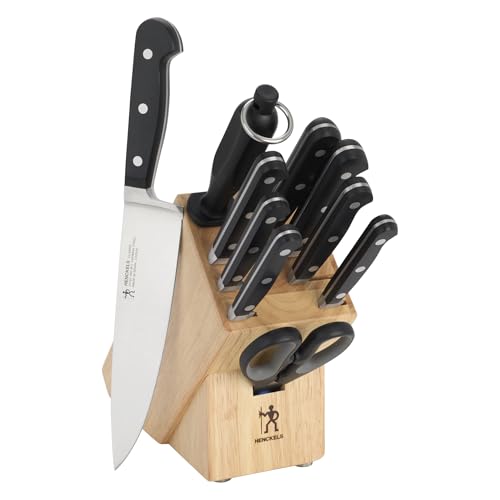
HENCKELS Classic 11-Piece Knife Block Set
- Best for: Vegetable-heavy cooks who prefer a santoku for daily slicing and want a hardwood block on the counter.
- Brand: HENCKELS
- Construction Type: Forged
- Blade Material: Stainless Steel
- Fabricated from high-quality German stainless steel
Vegetable-heavy cooks who prefer a santoku for daily slicing and want a hardwood block on the counter.
The listing mixes an 11-piece title with a shorter component list in its description, so check the contents line on the page again before ordering.
Anyone whose vegetable work leans on a santoku should look closely at this set. Its listing includes a 7-inch hollow-edge santoku next to an 8-inch chef knife, and the hollow edge is the sort of detail that helps when you slice potatoes, courgettes or apples and want the slices to fall away instead of sticking to the blade. The description states fully forged construction with a full bolster, giving a seamless transition from blade to handle, and says the steel is high-quality German stainless steel, with the knives manufactured in Spain. Traditional triple-rivet handles complete a set that feels aimed at cooks who chop in volume and want balance while they work through a board of onions or a whole cauliflower.
FAMCÜTE Japanese Knife Block Set
- Best for: Plant-focused cooks who want a nakiri and santoku as the core of the set, in a compact wooden storage format.
- Brand: FAMCÜTE
- Construction Type: Forged
- Blade Material Type: 5 Layer 9CR18MOV Clad Steel
- Hand forged, hardened to 58 – 60 HRC
Plant-focused cooks who want a nakiri and santoku as the core of the set, in a compact wooden storage format.
Rosewood handles and fine edges call for hand washing and gentle storage, not a crowded dishwasher rack.
This smaller Japanese-style set suits a cook whose board is mostly vegetables and fruit, with meat playing a supporting role. The title names a chef knife, a santoku, a nakiri and a fruit knife, which is an unusually direct match for vegetable preparation, since the nakiri handles straight chopping and the santoku covers finer slicing. The listing describes hand-forged knives in a 5-layer construction of 9CR18MOV clad steel, hardened to 58 to 60 HRC, with rosewood handles and wooden storage. A hand-polished 16-degree V-shaped edge is also stated, a fine angle that favours clean cuts through ripe tomatoes, onions and herbs over forceful work on hard bones or frozen food, which the listing itself warns against.
XCHIEF PRO Chef Knife Set
- Best for: Cooks who want nakiri and santoku shapes in a portable set for home, cabin or outdoor cooking.
- Brand: XCHIEF PRO
- Construction Type: Forged
- Blade Material: High Carbon Steel
- Hardness of 56 HRC stated on the listing
Cooks who want nakiri and santoku shapes in a portable set for home, cabin or outdoor cooking.
Storage is a bag rather than a counter block, and the boning and Serbian chef shapes will go unused in a strictly vegetable kitchen.
Where the other sets live in a block, this one travels and stores in a bag, which changes who it suits. The listing names six knives, among them a 7-inch santoku and a 7-inch nakiri, plus an 8-inch chef knife, so the vegetable shapes are present alongside boning and utility knives for mixed kitchen and outdoor cooking. It states that the blade is forged, gives a hardness of 56 HRC, and lists a 15 degree edge that is finely honed. Full tang construction and a wood handle are also stated. For a cook who preps vegetables at home some days and cooks away from the main kitchen on others, at a cabin, a campsite or a holiday rental, that portable format is the point.
Which One Fits Your Situation
You Chop a Large Pile of Vegetables Most Evenings
Choose the FAMCÜTE set or the HENCKELS Classic set, and decide by storage and handle feel. FAMCÜTE puts a nakiri beside a santoku, which covers both straight chopping of carrots and finer slicing of onions, in a compact set. HENCKELS answers with a hollow-edge santoku inside a larger block, better if you also want shears and a sharpening steel within reach. Either way, your main vegetable knife is a listed part of the set rather than a later extra purchase.
Your Cooking Mixes Vegetables With Bread, Roasts and Everything Else
The WÜSTHOF Classic block set fits this kitchen best. Its 11-piece scope, honing steel and shears mean the same block serves a morning of tomato slicing and an evening roast dinner without reaching for another kit. The forged, full-tang build stated on the listing suits a household where knives are picked up many times a day by confident hands. Smaller households that rarely cook meat may find its breadth more than they need, and the smaller FAMCÜTE set would leave more counter space free.
You Cook in More Than One Place
Pick the XCHIEF PRO set. A storage bag, six knives including santoku and nakiri shapes, shears and a honing steel make a self-contained kit you can carry to a rental house or a campsite and still prep vegetables properly. The trade is discipline. Knives in a bag need to go back clean and dry after each session, and there is no block keeping edges separated on a counter. If your second kitchen is really a family member’s house where you always cook, that routine is easy to keep.
You Are Replacing a Lightweight Set and Want More Heft
Start with the HENCKELS Classic or the WÜSTHOF Classic. Both listings stress forged construction and balance, and both include a santoku or a broad range of prep knives for vegetable work. The difference is emphasis. HENCKELS highlights its full bolster and German stainless steel made in Spain, while WÜSTHOF states a hardness of 58 HRC and a synthetic handle built to resist fading and discoloration. Choose by which contents list matches the knives you already reach for most.
Common Mistakes
- Buying a forged set with no santoku or nakiri, then discovering daily vegetable prep still rests on a single chef knife.
- Treating a hardness figure as a guarantee and ignoring edge angle, even though a fine edge matters more for tomato skin than a number alone.
- Putting rosewood or other wooden handles through the dishwasher because the blades are stainless steel.
- Storing sharp knives loose in a drawer, where the edges strike each other and dull quickly.
- Using a thin vegetable knife on bones, frozen food or hard shells, work the listings themselves warn against.
Frequently Asked Questions
Is a nakiri necessary if a set already has a good chef knife?
No, but it changes the feel of repetitive chopping. A nakiri has a flatter edge profile suited to straight up-and-down cuts through carrots, leeks and cabbage, and a tall blade that helps move chopped food. If you mostly slice small amounts, a chef knife and a santoku may be enough. Frequent, larger vegetable prep is where a nakiri earns its place.
What does the HRC figure on a listing actually tell me?
It is a hardness measurement for the steel, stated in Rockwell terms. In this guide the listings state figures between 56 HRC and a range of 58 to 60 HRC. Higher figures generally point to an edge that holds its sharpness through more board work, while somewhat lower figures can be more forgiving. Treat it as one clue alongside construction and edge angle, not as a verdict on its own.
Can I put these forged knives in the dishwasher?
Follow the care guidance on the listing for the set you choose, and lean toward hand washing for any set with wooden handles or fine edges. Dishwashers expose knives to heat, strong detergent and contact with other items, which can dull an edge and damage a handle. Washing by hand, drying straight away and returning the knife to its block, storage or bag is the safer routine for all four sets here.
How do I check that a set is genuinely forged before buying?
Read the product information on that exact listing and look for a construction field that states forged, supported by description wording for the same model, such as forged from a single piece of steel. A brand-level claim on a different model is not evidence for the set in your basket. If the listing for a set never states forged construction for that set, treat the question as unanswered and choose a set whose listing states it plainly.
Related guides
More from Amazon
Programs that pair well with the guide above. Offers and eligibility are set by Amazon and may change.
Free shipping on eligible items, Prime Video and more. Eligible new members can start with a free trial.
Start a Prime free trialAudiobooks and podcasts to listen to on the go. Eligible new members can start with a free trial.
Try Audible freeAd-free music streaming. Eligible new subscribers can start with a free trial.
Try Music Unlimited freeA free business account with business pricing and bulk-buying tools for work, shop or home office.
Create a business accountAs an Amazon Associate we earn from qualifying purchases.










Write Your Review
No reviews yet. Be the first to share your experience!