
Key takeaways
- Discover the best cameras for fashion photography, from a 61MP full-frame body to a 102MP medium-format camera for editorial detail and large prints.
What's inside
As an Amazon Associate I earn from qualifying purchases. This post may contain affiliate links at no extra cost to you.
As an Amazon Associate I earn from qualifying purchases.
The Short Answer
The best camera for fashion photography is the Sony Alpha 7R V. Its 61MP full-frame sensor captures the fine detail editorial work demands, from the weave of a fabric to the texture of skin, and its AI-driven autofocus keeps a moving model sharp through a full sequence of frames. For most fashion photographers, it is the strongest all-round choice.
If your work leans toward large editorial prints or campaign imagery that will be cropped and enlarged, the Fujifilm GFX100 II is the specialist pick, with a 102MP medium-format sensor that records detail no full-frame body can match. The Canon EOS R5 Mark II and the Nikon Z8 sit close behind the Sony as fast, high-resolution full-frame bodies, while the Canon EOS R6 Mark II is the sensible choice for photographers who want full-frame image quality and dependable autofocus in a lighter, more approachable body.
Fashion photography is not the same as general photography: the subject is detail — fabric, fit, silhouette, skin, and color. A camera that is excellent for travel may fall short in a studio, where a client examines every thread at full magnification. The picks below were chosen for resolution, color fidelity, autofocus on people, tethered shooting support, and files that survive heavy retouching and large prints.
Our Top Picks
- Sony Alpha 7R V — Best overall for fashion photography, with a 61MP sensor and AI autofocus.
- Canon EOS R5 Mark II — Best for fast studio and runway work, with a 45MP stacked sensor and 30 fps electronic shutter.
- Nikon Z8 — Best for flagship speed in a compact body, with a 45.7MP stacked sensor.
- Fujifilm GFX100 II — Best for maximum detail and large prints, with a 102MP medium-format sensor.
- Canon EOS R6 Mark II — Best for moving up to full frame, with a 24.2MP sensor and reliable autofocus.
Quick Comparison
| Product | Best for | Key spec | Amazon link |
|---|---|---|---|
| Sony Alpha 7R V | Overall fashion work | 61MP full-frame sensor, AI autofocus | View on Amazon |
| Canon EOS R5 Mark II | Fast studio and runway shooting | 45MP stacked sensor, 30 fps electronic shutter | View on Amazon |
| Nikon Z8 | Flagship speed in a compact body | 45.7MP stacked sensor, 8K video | View on Amazon |
| Fujifilm GFX100 II | Maximum detail and large prints | 102MP medium-format sensor | View on Amazon |
| Canon EOS R6 Mark II | Moving up to full frame | 24.2MP full-frame sensor | View on Amazon |
How to Choose
Resolution and file size
Resolution is the first decision in fashion photography. A 24MP file is enough for web lookbooks and social media, but editorial and campaign work often ends up cropped, retouched, and printed large. A 45MP or 61MP file gives the retoucher room to crop a full-length shot into a detail shot. A 102MP medium-format file goes further still, and it is the standard for high-end print campaigns. The trade-off is file size: high-resolution bodies fill cards and drives quickly and demand a computer that can handle large RAW files.
Skin tones and color
Fashion photography lives or dies on color. Fabric colors must be accurate, and skin tones must look natural after retouching. Every brand renders color slightly differently, and every brand has its own profile of skin tones. If your retouching workflow is built around one brand’s files, switching brands means rebuilding presets and profiles. Handle sample files from each system before committing, and confirm on the listing which color profiles each body provides.
Autofocus on people
A fashion shoot moves fast. A model walks, turns, and changes pose in seconds, and the camera must hold focus on the eye through all of it. Eye-detection autofocus is a core feature of every camera on this list, but the implementations differ. The Sony A7R V uses a dedicated AI processing unit for subject recognition, the Canon R5 Mark II uses subject tracking shared with the flagship EOS R1, and the Nikon Z8 and Fujifilm GFX100 II each have their own subject-detection systems. For runway work, autofocus speed and stickiness matter more than raw resolution.
Tethering and studio workflow
Most professional fashion shoots are tethered: the camera connects to a laptop so the photographer, stylist, and client can see each frame on a large screen. Before buying, check that the camera works with your tethering software. All five bodies here support USB tethering, but cable standards and transfer speeds vary. A slow tether turns a smooth shoot into a frustrating one, especially with 45MP or larger files. Confirm the USB standard and supported tethering software on the listing.
Lens system and weight
A camera body is only half the system. Fashion photography uses a small set of lenses again and again: a 50mm or 85mm prime for portraits, a 24-70mm zoom for versatility, and sometimes a 70-200mm for runway work. Before choosing a body, check the cost of the lenses you will need in that mount. Each mount has a strong lens lineup, but they are not interchangeable. Weight matters too: a medium-format body with a large lens is heavy on a long location day, while a compact full-frame body is easier to carry.
Video capability
Fashion work increasingly includes motion: behind-the-scenes clips, social content, and short campaign films. Every camera on this list records high-quality video, from 4K to 8K, but video is secondary for most fashion photographers. If video is a large part of your work, the R5 Mark II and Z8 are the strongest hybrid bodies here.
The Picks in Detail
Sony Alpha 7R V

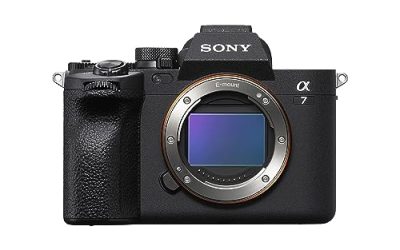
The Sony Alpha 7R V is the best all-round camera for fashion photography, and it earns the top spot on resolution, autofocus, and workflow combined. Its 61.0MP full-frame back-illuminated Exmor R CMOS sensor records more detail than any other full-frame body in this guide, which gives retouchers the freedom to crop aggressively and still deliver a sharp, printable file. The dedicated AI processing unit drives next-generation autofocus with Real-time Recognition, holding focus on a subject through movement and changing poses. The BIONZ XR engine boosts overall processing speed, and the camera shoots at up to 10 fps with continuous autofocus and auto exposure tracking.
For video, the A7R V records 8K at 24p and 25p and 4K at 60p, which covers behind-the-scenes and short-form campaign work. The 9.44 million-dot viewfinder is bright and detailed, and the 4-axis multi-angle LCD tilts and flips for low angles and vertical shooting.
Pros:
- 61MP full-frame sensor delivers exceptional detail for cropping and large prints
- AI-driven autofocus with Real-time Recognition holds focus on moving subjects
- Dual card slots and a large, detailed viewfinder suit professional shoots
- Wide Sony E-mount lens lineup, including fast portrait primes
Cons:
- Large RAW files demand fast storage and a capable computer
- 10 fps continuous shooting is slower than the fastest bodies here
View the Sony Alpha 7R V on Amazon
Canon EOS R5 Mark II

The Canon EOS R5 Mark II is the fastest high-resolution body in this guide, and it is the best choice for fashion photographers who shoot runway, movement, and fast-changing studio setups. Its brand-new 45MP stacked and back-illuminated sensor reads out quickly enough for a 30 fps electronic shutter at full resolution, so a model walking the runway can be captured in a long burst. Autofocus has been updated with subject tracking shared with the flagship EOS R1, including an Action priority mode.
The R5 Mark II records 8K video at up to 60 frames per second internally. The 0.5-inch 5.76 million-dot OLED viewfinder gives approximately 100 percent coverage, and the body has dual CFexpress card slots for the high data rates that 45MP bursts and 8K video demand. Five-axis in-body stabilization works with stabilized RF lenses, and the body is dust and weather resistant.
Pros:
- 45MP stacked sensor with a 30 fps electronic shutter for fast-moving subjects
- Subject tracking shared with the flagship EOS R1, including Action priority mode
- Strong Canon color rendering for skin tones
- Dust and weather resistant body with dual CFexpress slots
Cons:
- 45MP resolution is lower than the Sony A7R V and the Fujifilm GFX100 II
- High-speed shooting and 8K video demand fast, high-capacity CFexpress cards
View the Canon EOS R5 Mark II on Amazon
Nikon Z8

The Nikon Z8 packs the speed and resolution of Nikon’s flagship Z9 into a smaller, lighter body, and it is the best choice for fashion photographers who want flagship performance without flagship bulk. Its 45.7MP stacked CMOS sensor delivers the resolution that editorial work needs, The listing describes a 493-point autofocus system, which gives broad frame coverage for runway work.
The Z8 is built for professional use, with a rugged body and a deep grip. Its stacked sensor reads out fast, which reduces rolling shutter distortion when a model moves quickly across the frame. Nikon Z mount lenses include excellent fast primes for portrait work.
Pros:
- 45.7MP stacked sensor with flagship-level speed in a compact body
- Broad 493-point autofocus coverage for runway and moving subjects
- Rugged professional build with a comfortable deep grip
- Strong Nikon Z-mount lens lineup for portrait and fashion work
Cons:
- Large files and deep menus demand time and storage to manage
- Battery life under heavy use should be checked against your shooting day; confirm on the listing
Fujifilm GFX100 II

The Fujifilm GFX100 II is the specialist pick in this guide, and it is the best camera here for maximum detail. Its 102MP medium-format sensor measures 43.8 by 32.9 millimeters, which captures detail, tonal gradation, and dynamic range that full-frame bodies cannot match. For high-end editorial and campaign work printed large or cropped heavily, the GFX100 II produces files with a depth and richness that stands apart.
It pairs its 102MP CMOS II HS sensor with the X-Processor 5, shoots at up to 8 fps, and records 8K at 30 fps and 4K at 60 fps. Fujifilm’s color science is a genuine asset for fashion work: its film simulations render skin tones and fabric colors with a character many photographers prefer straight out of camera. The large sensor gives a shallower depth of field at equivalent settings, which isolates a model beautifully against a soft background.
Pros:
- 102MP medium-format sensor delivers unmatched detail and tonal range
- Excellent Fujifilm color science for skin tones and fabric
- Shallow depth of field isolates subjects beautifully
- Suited to large prints and heavy cropping
Cons:
- Larger, heavier body than full-frame alternatives
- Autofocus is slower than the fastest full-frame bodies for runway work
- Very large files demand serious storage and computing power
View the Fujifilm GFX100 II on Amazon
Canon EOS R6 Mark II

The Canon EOS R6 Mark II is the most approachable full-frame camera in this guide, and it is the best choice for photographers moving up to full frame for fashion work. Its 24.2MP full-frame CMOS sensor delivers clean files with good dynamic range, . Canon’s autofocus and color rendering carry over from the higher-end bodies, so skin tones look natural and focus on the eye is reliable in studio and location work.
At 24.2MP, the R6 Mark II does not give the same cropping freedom as the 45MP and 61MP bodies here, but it is more than enough for web lookbooks, social content, and editorial work that will not be printed at very large sizes. Its files are smaller and faster to process, which suits photographers who deliver large volumes on tight deadlines. The body is lighter than the R5 Mark II, and it uses the same RF mount, so lenses bought for this body carry forward if you upgrade later.
Pros:
- Full-frame 24.2MP sensor with clean files and good dynamic range
- Reliable Canon autofocus and natural skin tone rendering
- Smaller files are faster to process and easier to store
- Lighter body suits long location days
Cons:
- 24.2MP resolution limits heavy cropping and very large prints
- Fewer resolution and video features than the R5 Mark II
View the Canon EOS R6 Mark II on Amazon
Who Should Choose What
- Choose the Sony Alpha 7R V if you want the best all-round fashion camera: maximum full-frame resolution, AI autofocus, and a deep lens lineup.
- Choose the Canon EOS R5 Mark II if you shoot runway, movement, and fast studio sessions, and you want the fastest high-resolution body here.
- Choose the Nikon Z8 if you want flagship speed and resolution in a compact body, and you shoot Nikon glass.
- Choose the Fujifilm GFX100 II if your work is high-end editorial and campaign imagery, where maximum detail and large prints matter more than speed or portability.
- Choose the Canon EOS R6 Mark II if you are moving up to full frame, shoot mainly for web and editorial use, and want dependable autofocus in a lighter body.
If you shoot both stills and motion, the R5 Mark II and Z8 are the strongest hybrid choices. If you shoot stills only for print, put resolution first and choose between the A7R V and the GFX100 II. If you are building your first kit, the R6 Mark II leaves room for the lenses and lighting that shape your images as much as the body.
Common Mistakes
Buying resolution you do not need. A 102MP camera is a specialist tool. If your work is delivered for web and social media, its files will slow your workflow without improving the final image.
Ignoring the lens budget. A mid-range body with an excellent 85mm prime will produce better fashion images than a flagship body with a mediocre kit lens. Budget for glass before you max out the body.
Forgetting tethering. Many photographers discover too late that their camera does not work smoothly with their tethering software. Test the tethered workflow before a paid shoot, not during one.
Shooting runway with the wrong autofocus settings. Eye detection is powerful, but it needs the right mode for a model walking toward the camera. Practice the settings on a test shoot first.
Underestimating storage. High-resolution fashion shoots generate hundreds of large RAW files. Without fast cards, fast drives, and a backup routine, a shoot can be lost or a deadline can slip.
Choosing a system for one feature. A single specification rarely decides a fashion shoot. Color, autofocus behavior, lens choice, and workflow matter together. Choose the system that fits your whole way of working.
FAQ
What is the best camera for fashion photography overall?
The Sony Alpha 7R V. Its 61MP full-frame sensor captures the detail editorial work demands, and its AI autofocus keeps moving subjects sharp.
How many megapixels do I need for fashion photography?
For web lookbooks and social content, 24MP is enough. For editorial print and campaign work, 45MP or more gives the retoucher room to crop and still deliver a sharp file. For large prints, the 102MP Fujifilm GFX100 II is the benchmark.
Is medium format worth it for fashion photography?
Medium format is worth it when your work is printed large, cropped heavily, or examined at full magnification. For web and standard editorial work, a high-resolution full-frame body is hard to tell apart, with faster autofocus and lower cost.
Do I need a fast burst rate for fashion photography?
For studio portraits, a modest burst rate is enough. For runway work, a fast burst rate matters, because the model is moving toward the camera and the best pose may last a fraction of a second. The Canon EOS R5 Mark II is the strongest choice for runway shooting.
Can I use these cameras for video as well as stills?
Yes. Every camera in this guide records high-quality video, from 4K to 8K. The Canon EOS R5 Mark II and Nikon Z8 are the strongest hybrid bodies for motion work.
Should I buy the camera body only or a kit with a lens?
Body-only listings are used here so you can choose your own lens. For fashion work, a fast 50mm or 85mm prime is usually a better first lens than a kit zoom.
Conclusion
The best cameras for fashion photography balance resolution, color, autofocus, and workflow, and the Sony Alpha 7R V does that better than any other body in this guide. Its 61MP sensor, AI autofocus, and deep lens lineup make it the right choice for most fashion photographers.
The Canon EOS R5 Mark II is the runner-up, and the better choice if your work is heavy on runway and movement, where its 30 fps electronic shutter and subject tracking shine. The Nikon Z8 is close behind as a compact flagship, the Fujifilm GFX100 II is the specialist for maximum detail and large prints, and the Canon EOS R6 Mark II is the sensible full-frame first step. Whichever body you choose, pair it with a fast portrait lens, plan your storage, and test your tethered workflow before the shoot that counts.
Related guides
More from Amazon
Programs that pair well with the guide above. Offers and eligibility are set by Amazon and may change.
Free shipping on eligible items, Prime Video and more. Eligible new members can start with a free trial.
Start a Prime free trialAudiobooks and podcasts to listen to on the go. Eligible new members can start with a free trial.
Try Audible freeAd-free music streaming. Eligible new subscribers can start with a free trial.
Try Music Unlimited freeA free business account with business pricing and bulk-buying tools for work, shop or home office.
Create a business accountAs an Amazon Associate we earn from qualifying purchases.
Write Your Review
No reviews yet. Be the first to share your experience!