
Key takeaways
- Compare women's marathon running shoes for race day and long training runs, covering plated racers, plush trainers, cushioning, drop and fit.
As an Amazon Associate I earn from qualifying purchases. This post may contain affiliate links at no extra cost to you.
A marathon asks more of a shoe than any other road race. Across 26.2 miles your feet swell, your stride shortens, and the cushioning that felt fresh at mile 3 has been compressed thousands of times by mile 23. For women training toward a marathon, the right shoe depends on the goal: a carbon-plated racer for a time target, or a plush, durable trainer that protects your legs through the build and still feels kind in the final 10K. This guide compares four women’s running shoes that cover both jobs, all genuine marathon-appropriate models sold on Amazon US, and explains how to split training miles and race-day miles between them. Every shoe here is a women’s road running shoe; there are no walking shoes, trail shoes or lifestyle sneakers mixed in.
As an Amazon Associate, we earn from qualifying purchases.
Quick Picks
| Product | Best for | Key point |
|---|---|---|
| Nike Vaporfly 3 Women’s | Racing for a time goal | Carbon Flyplate with ZoomX foam |
| Brooks Glycerin 21 Women’s | Plush long-run training | Soft DNA Loft v3, several widths |
| ASICS Gel-Nimbus 26 Women’s | Maximum comfort finish | PureGEL heel with thick soft stack |
| Brooks Ghost 16 Women’s | Balanced daily trainer | Predictable ride, traditional feel |
How to Choose
Decide first whether you are buying a race shoe, a training shoe, or one shoe that must do both. A plated racer like the Vaporfly 3 is a specialist tool: light, propulsive and fragile by design. Most women race best in it after training in something else. A plush trainer such as the Glycerin 21 or Gel-Nimbus 26 is the opposite trade, built to absorb hundreds of training miles and keep long runs comfortable. If you can only buy one pair, buy the trainer and race in it; a comfortable finish beats a fast shoe that hurts at mile 18.
Next, look at cushioning and drop together. Higher-stack, softer shoes reduce the pounding of long runs but can feel vague at faster paces. Drop, the height difference between heel and forefoot, ranges here from about 8 mm in the Nimbus and Vaporfly to 12 mm in the Ghost. Higher drops shift work toward the knees and away from the calves and Achilles, which suits some runners and irritates others; match the drop roughly to what your current shoes use unless you plan a gradual change.
Fit deserves real attention in a marathon shoe. Feet swell over long distances, so you want a thumb’s width of space in front of your longest toe, and a midfoot that locks down without squeezing. Women with wider feet should use the width options Brooks offers rather than sizing up in a narrow shoe, which changes the fit everywhere. Finally, plan the timing: do your longest training runs in the shoe you will race in, and avoid debuting any shoe, even a fresh pair of a familiar model, on race morning.
Best Options
1. Nike Vaporfly 3 Women’s Road Racing Shoes

The Vaporfly 3 is the race-day end of this list: a shoe built around a full-length carbon fiber Flyplate set inside Nike ZoomX foam, the lightest racing foam Nike makes. For a woman racing a marathon rather than simply finishing one, that plate-and-foam pairing is the point of the shoe. The Atomknit 3.0 upper is a thin engineered mesh that holds the midfoot with a snug, almost sock-like wrap, and the offset laces are designed to reduce pressure across the top of the foot over long distances. The midsole is cut away in the midfoot to save weight, which gives the shoe its distinctive sculpted look, and the outsole uses thin rubber placed only where road contact demands it. This is not a training shoe and should not be bought as one: the foam and plate are tuned for a handful of goal races, and the narrow racing fit will feel foreign if your daily miles happen in wide, soft trainers. Women targeting a personal best, a Boston qualifying time, or an aggressive goal pace are the audience. Slower first-time marathoners who plan to walk sections will get more from the cushioned trainers below, because the Vaporfly rewards a steady, efficient stride and can feel unstable at very easy paces or during walk breaks.
Specs
- Style DV4130 (women’s); ZoomX foam midsole with full-length carbon fiber Flyplate; Atomknit 3.0 engineered mesh upper; heel-to-toe drop about 8 mm; weight about 6.5 oz (184 g) in a women’s size 8; thin rubber outsole with midfoot cutout; racing fit, narrow midfoot
Best for: Women racing a marathon for a time goal who want a plated super shoe for race day
Watch out for: The fit is narrow and the foam is not built for daily training volume, so keep it for key workouts and race day, and size carefully if your feet swell late in long runs
2. Brooks Glycerin 21 Women’s Neutral Running Shoe

The Glycerin 21 is the long-run workhorse of this group, and for many women it is the smarter marathon purchase: the shoe you will actually train in for four months. Its midsole uses DNA Loft v3, a nitrogen-infused foam that Brooks tunes for soft landings without the sinking feeling of very plush shoes, and the GuideRails-free neutral platform keeps the ride simple and predictable. The engineered mesh upper has a smooth, accommodating fit with a padded collar, and the shoe is offered in multiple widths, which matters enormously across a marathon build when feet swell on hot long runs. A broad base and a generous layer of RoadTack rubber underfoot give it the durability to absorb weekly long runs of 16 to 22 miles without feeling dead by the peak weeks. On race day, plenty of women race their marathon in exactly this kind of shoe, trading the plate of a super shoe for comfort they trust at mile 23. If your goal is a strong, comfortable finish rather than a podium time, the Glycerin 21 is the balanced pick, and its softer step-in feel makes it the easiest shoe here to like from the first run.
Specs
- Model 120408 (women’s); DNA Loft v3 nitrogen-infused midsole; heel-to-toe drop 10 mm; weight about 8.8 oz (249 g) in a women’s size 8; engineered mesh upper; RoadTack rubber outsole; available in narrow, medium, wide and extra wide fits
Best for: Women building marathon mileage who want one plush, durable trainer for long runs and race day
Watch out for: It has no plate, so it will not return energy like the Vaporfly, and the soft ride can feel muted on faster tempo days
3. ASICS Gel-Nimbus 26 Women’s Running Shoe
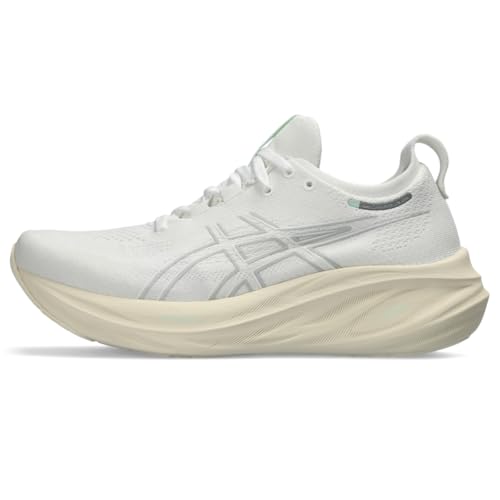
The Gel-Nimbus 26 is ASICS’ flagship cushioned trainer, and its marathon case rests on protection: a thick stack of FF Blast Plus Eco foam with a PureGEL insert in the heel that is designed to soften landings late in a run, when form breaks down and impact rises. The engineered mesh upper is soft and stretchy with a knit-like collar, and the overall fit suits women who find racing shoes and firmer trainers unforgiving over three or four hours on their feet. ASICS pairs the foam with a Hybrid ASICSGRIP outsole that blends grip with durability, useful for long runs that mix wet pavement, park paths and city streets. Compared with the Glycerin, the Nimbus feels a touch softer and more relaxed; compared with the Vaporfly it is a completely different tool, built for completion and comfort rather than speed. It is a particularly sensible marathon choice for first-time marathoners, heavier-training-load runners who stack back-to-back long days, and anyone whose training history says their legs, not their lungs, are the limiting factor in the final 10K of the race.
Specs
- Model 1012B601 (women’s); FF Blast Plus Eco foam with rearfoot PureGEL; heel-to-toe drop 8 mm; weight about 9.2 oz (262 g) in a women’s size 8; engineered mesh upper; Hybrid ASICSGRIP outsole
Best for: First-time marathoners and comfort-first runners who want maximum softness for long hours on the road
Watch out for: The soft, relaxed ride is not responsive at faster paces, and the plush upper holds more heat than a racing mesh on warm race days
4. Brooks Ghost 16 Women’s Neutral Running Shoe

The Ghost 16 is the dependable middle option: not the softest shoe here and not a racer, but a balanced daily trainer that has carried more women through marathon training cycles than almost any other model. The update to DNA Loft v3 foam gives it a lighter, smoother ride than older Ghosts, and the segmented crash pad in the outsole is shaped to move you from landing to toe-off without any dramatic rocker or plate. The fit is secure through the midfoot with a roomier toe box than a racing shoe, the upper is a breathable engineered air mesh, and like the Glycerin it comes in several widths. For a woman training for her first marathon on a sensible budget of shoes, a Ghost for daily miles paired with fresh legs on race day is a proven formula. It also doubles as the race shoe for runners who dislike very soft foam and want a firmer, more traditional feel underfoot in the closing miles. Choose it if you value predictability: the Ghost feels the same at mile 2 and mile 20, and that consistency is a genuine marathon virtue.
Specs
- Model 120407 (women’s); DNA Loft v3 nitrogen-infused midsole; heel-to-toe drop 12 mm; weight about 8.5 oz (241 g) in a women’s size 8; engineered air mesh upper; RoadTack rubber outsole with segmented crash pad; multiple widths available
Best for: Women who want a balanced, traditional-feel trainer for the whole marathon build and race day
Watch out for: The 12 mm drop is higher than most modern trainers, which loads the calves less but will not suit runners who prefer a flatter, lower ride
Which One Fits
- Chasing a qualifying time or personal best: the Nike Vaporfly 3, saved for race day and a few key workouts.
- Training for a first marathon with comfort as the goal: the ASICS Gel-Nimbus 26, the softest and most forgiving shoe here.
- One shoe for the whole build and the race: the Brooks Glycerin 21, plush enough for long runs and durable enough for the full cycle.
- Prefer a firmer, traditional ride: the Brooks Ghost 16, consistent from the first mile to the last.
Common Mistakes
The most common marathon shoe mistake is racing in a brand-new pair. Even an identical model feels different before the foam and upper settle, so give any race shoe at least a few runs, including one long run. The second mistake is buying a plated racer and training in it daily; super-shoe foams lose their liveliness with volume, and the cost per mile is poor. Save the plate for the days that matter.
A third mistake is choosing by looks or by what a faster friend wears. Marathon shoes are tools matched to your stride, your injury history and your goal. A shoe that carries a lighter runner to a fast time may leave a heavier runner under-cushioned at mile 20. Finally, do not ignore width. Many women size up for length when the real problem is forefoot width, ending with a shoe that is both too long and still too tight. Use the width fittings offered in the Brooks models, and check the fit late in the day when your feet are at their largest.
FAQ
Can I run a marathon in a daily trainer instead of a racing shoe?
Yes, and most women do. A plush trainer like the Glycerin 21 or Gel-Nimbus 26 is designed for exactly the long, steady miles a marathon demands. A plated racer helps runners chasing a time, but comfort and durability matter more for a first marathon or a finish-focused goal.
How many miles should a marathon shoe last?
Most cushioned trainers in this guide are built for roughly 300 to 500 miles of road running, depending on the runner and the foam. Plated racers like the Vaporfly 3 are usually reserved for far fewer miles, because their foams are tuned for performance rather than longevity. Track your training mileage and retire a shoe when the ride feels flat or new aches appear.
Should I buy two different shoes for marathon training?
A two-shoe rotation is the approach many coaches suggest: a durable trainer for most miles and either a second trainer or a racer for long runs and race day. Rotating also lets foam recover between runs. It is not required, though; one well-chosen trainer, replaced when worn, covers a full marathon build.
How much room should I leave in the toe box for a marathon?
Aim for about a thumb’s width, roughly half an inch, between your longest toe and the end of the shoe when standing. Feet swell during long runs, and downhill sections push feet forward. If your toes touch the front on a long training run, the shoe is too short for marathon distance.
Final Verdict
For women racing a marathon for time, the Nike Vaporfly 3 is the specialist pick, and it should be protected for race day. For the months of training that make race day possible, the Brooks Glycerin 21 and ASICS Gel-Nimbus 26 are the plush workhorses, with the Nimbus the softer of the two. The Brooks Ghost 16 remains the balanced, no-drama option for runners who prefer a traditional feel. Match the shoe to the job, respect the fit, and break it in well before the race.
Related guides
More from Amazon
Programs that pair well with the guide above. Offers and eligibility are set by Amazon and may change.
Free shipping on eligible items, Prime Video and more. Eligible new members can start with a free trial.
Start a Prime free trialAudiobooks and podcasts to listen to on the go. Eligible new members can start with a free trial.
Try Audible freeAd-free music streaming. Eligible new subscribers can start with a free trial.
Try Music Unlimited freeA free business account with business pricing and bulk-buying tools for work, shop or home office.
Create a business accountAs an Amazon Associate we earn from qualifying purchases.









Write Your Review
No reviews yet. Be the first to share your experience!