
Key takeaways
- Compare running shoes for knee pain with maximum cushioning, smooth rocker rides and supportive fits, plus guidance on drop and training load.
As an Amazon Associate I earn from qualifying purchases. This post may contain affiliate links at no extra cost to you.
Knee pain is the most common complaint in running, and the shoe conversation around it needs care. Shoes do not treat knee conditions, and pain that is sharp, swollen, locking or always in one exact spot belongs in front of a clinician, not in a shopping cart. What a well-chosen shoe can do is soften the impact that travels to the knee with every stride, smooth the transition so the joint is not jarred, and keep your stride steady when fatigue sets in. This guide compares four deeply cushioned running shoes whose designs suit knee-sensitive runners, and explains how drop, stack height and fit interact with sore knees. Every pick is a cushioned road running shoe built for daily training; there are no racing flats, trail shoes or casual sneakers here.
As an Amazon Associate, we earn from qualifying purchases.
Quick Picks
| Product | Best for | Key point |
|---|---|---|
| HOKA Bondi 9 Men’s | Maximum cushioning | 43 mm stack with Meta-Rocker roll |
| ASICS Gel-Nimbus 26 Women’s | Softest smooth ride | PureGEL heel softens landings |
| Saucony Triumph 22 Women’s | Cushion with life | PWRRUN PB foam, 10 mm drop |
| Brooks Glycerin 21 Women’s | Balanced daily comfort | Soft foam, four width options |
How to Choose
Cushioning is the first filter for knee-sensitive runners, but read it correctly. A tall, soft stack, like the Bondi 9’s, absorbs more of the impact that would otherwise travel up the leg, and a rocker shape helps the shoe roll forward so your stride stays smooth instead of braking at each landing. Softer is not automatically better, though: a platform that is too soft for your weight and stride can feel unstable, and instability makes muscles around the knee work harder. Match the shoe to how it feels across a whole run, not a few steps in a shop.
Drop deserves thought too. A higher drop, 8 to 10 mm as in the Nimbus, Triumph and Glycerin, shifts some demand away from the calf and Achilles and toward the knee and hip; a lower drop does the reverse. For runners whose knee pain comes with very tight calves, a moderate drop is a sensible middle ground, and the Bondi’s 5 mm drop should be adopted gradually. There is no single correct number, only the number your body tolerates, so change gradually and judge over weeks.
Fit and freshness complete the picture. A secure heel and midfoot stop the foot sliding and twisting inside the shoe, which keeps the knee tracking more cleanly, and width options matter for the same reason. Worn foam is the hidden factor: once a midsole is packed down, usually after roughly 300 to 500 miles, it stops cushioning as designed and knee aches often return. Replacing shoes on time is part of knee care, not a luxury.
Best Options
1. HOKA Bondi 9 Men’s Road Running Shoes

The Bondi 9 is HOKA’s maximum-cushion flagship, and it is the headline pick for knee-sensitive runners because its job is simple: put as much soft foam as possible between your knees and the road. The midsole uses a premium supercritical foam with a tall 43 mm heel stack in the men’s version, shaped with HOKA’s Meta-Rocker geometry so the shoe rolls forward rather than asking your legs to push hard off tired joints. A structured heel counter and the Active Foot Frame design cradle the foot inside the foam rather than letting it sit loosely on top, which keeps the ride calmer than the stack height suggests. The engineered mesh upper is roomy and forgiving, and the shoe comes in wide fits. For runners whose knees ache on downhills, on concrete, or in the last miles of long runs, the Bondi’s soft, rolling platform is the most protective ride in this guide. It is not a fast shoe and does not pretend to be; it is the pair you reach for when the goal is to run tomorrow as well as today.
Specs
- Men’s model; supercritical EVA foam midsole; heel stack about 43 mm; heel-to-toe drop 5 mm; weight about 10.5 oz (297 g) in a men’s size 9; Meta-Rocker geometry with Active Foot Frame; engineered mesh upper; regular and wide fits
Best for: Runners with knee aches who want the maximum cushioning and a gentle rolling ride
Watch out for: The tall soft stack feels vague at faster paces, and the low 5 mm drop shifts some load to the calves and Achilles
2. ASICS Gel-Nimbus 26 Women’s Running Shoe
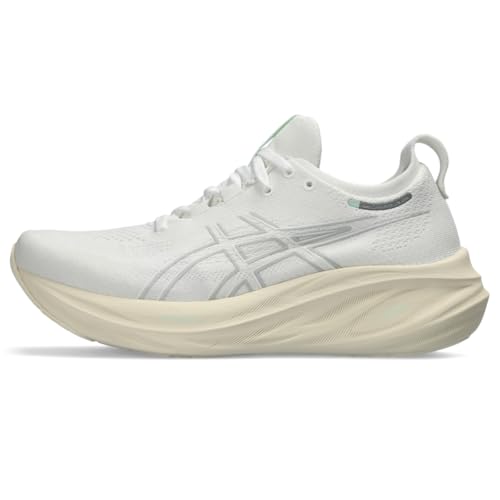
The Gel-Nimbus 26 approaches knee comfort from softness plus smoothness. Its FF Blast Plus Eco foam is thick and plush, the PureGEL insert in the heel is specifically placed to soften the landing phase where knee load peaks, and the overall geometry is tuned for an easy, flowing stride rather than a snappy one. Runners with sore knees often find that a shoe which lands softly and transitions without jarring keeps their symptoms quieter across a full run, and that is exactly the Nimbus brief. The engineered mesh upper is stretchy and pressure-free over the forefoot, the fit suits longer distances, and the Hybrid ASICSGRIP outsole keeps footing secure on wet streets so tired legs are not fighting for grip. Compared with the Bondi, the Nimbus sits a little lower and feels a touch more conventional, which some runners prefer. It is a women’s model, sized and shaped accordingly, and it doubles happily as a walking and standing shoe on non-running days.
Specs
- Model 1012B601 (women’s); FF Blast Plus Eco foam with rearfoot PureGEL; heel-to-toe drop 8 mm; weight about 9.2 oz (262 g) in a women’s size 8; engineered mesh upper; Hybrid ASICSGRIP outsole
Best for: Women runners with knee discomfort who want a plush, smooth trainer for daily and long runs
Watch out for: The soft ride is not built for speed work, and runners who like a firm, responsive platform will find it too relaxed
3. Saucony Triumph 22 Women’s Running Shoe
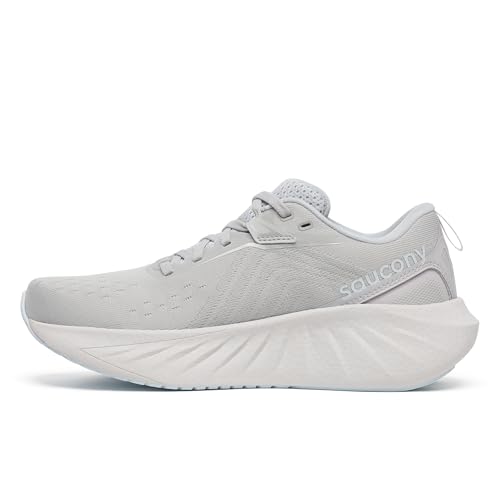
The Triumph 22 is Saucony’s premium cushioned trainer, and its PWRRUN PB foam gives it a different character from the other soft shoes here: light, springy and a little livelier, while still carrying a deep 37 mm heel stack to absorb impact. For knee-sensitive runners who dislike the sinking, marshmallow feel of maximum-cushion shoes, the Triumph splits the difference, protecting the joints without muting the run entirely. The engineered mesh upper uses an adaptive lacing system that locks the midfoot comfortably, the heel counter is padded and secure, and the XT-900 rubber outsole is a durability strength, keeping its grip and shape deep into a training cycle. The 10 mm drop is the highest among the plush picks here, which many knee-pain runners prefer because it reduces the demand on the calf and Achilles while keeping the stride familiar. Choose the Triumph if you want cushioning that still lets you run with some rhythm, on easy days and long runs alike.
Specs
- Model S10964 (women’s); PWRRUN PB foam midsole; heel stack about 37 mm; heel-to-toe drop 10 mm; weight about 9.0 oz (255 g) in a women’s size 8; engineered mesh upper with adaptive lacing; XT-900 rubber outsole
Best for: Runners with sore knees who want deep cushioning that still feels lively rather than mushy
Watch out for: It is a neutral shoe with no guidance system, so runners who need stability support should look at a support model instead
4. Brooks Glycerin 21 Women’s Neutral Running Shoe

The Glycerin 21 is the refined all-rounder of this knee-pain group: a thick layer of nitrogen-infused DNA Loft v3 foam that lands softly and transitions calmly, a broad stable base for a neutral shoe, and a fit that Brooks offers in four widths. Knee comfort is often about the whole system, and the Glycerin gets the details right: the padded collar does not rub, the engineered mesh upper holds without squeezing, and the RoadTack rubber outsole keeps the shoe dependable across a long training life. Its 10 mm drop keeps the stride in familiar territory for runners coming from traditional trainers, and the ride is soft without the towering stack of the Bondi, which makes it the easiest recommendation here for runners who are nervous about very tall shoes. If your knees grumble on ordinary daily miles rather than only on long runs, the Glycerin is the balanced daily answer: protective enough for the job, normal enough to forget you are wearing it.
Specs
- Model 120408 (women’s); DNA Loft v3 nitrogen-infused midsole; heel-to-toe drop 10 mm; weight about 8.8 oz (249 g) in a women’s size 8; engineered mesh upper; RoadTack rubber outsole; narrow, medium, wide and extra wide fits
Best for: Runners with knee aches who want a balanced, soft daily trainer without a towering stack
Watch out for: It lacks the maximum stack of the Bondi 9, so runners who need every millimetre of cushioning for long runs may prefer the HOKA
Which One Fits
- Knees ache most on long runs and hard surfaces: the HOKA Bondi 9, the deepest cushioning and smoothest roll here.
- You want plush landings with a conventional feel: the ASICS Gel-Nimbus 26, soft and smooth without a towering stack.
- Soft shoes usually feel too mushy for you: the Saucony Triumph 22, cushioned but livelier underfoot.
- Everyday miles with an easy, balanced ride: the Brooks Glycerin 21, protective and normal in the best way.
Common Mistakes
The most damaging mistake is treating a shoe purchase as a diagnosis. Knee pain has many causes, from training errors to strength gaps to conditions no shoe can influence. If pain persists, worsens, or comes with swelling or instability, get assessed. The second mistake is changing everything at once: new shoes, new drop, more mileage and a new training plan in the same week makes it impossible to know what helped or hurt, and overloads tissue that was already complaining.
A third mistake is assuming the softest shoe is automatically the kindest to knees. For some runners a very soft, tall shoe increases wobble and muscle fatigue around the joint. Comfort across a full run is the test, not the squeeze test in the shop. Finally, do not run your shoes into the ground. Dead foam quietly removes the protection you bought the shoe for, and many recurring knee aches are simply a retirement notice for an old pair.
FAQ
Can cushioned shoes reduce knee pain when running?
They can reduce the impact forces that aggravate sensitive knees, and many runners find plush, smooth-riding shoes more comfortable. They do not treat the underlying cause of knee pain, which may involve training load, strength or a specific condition. Use cushioning as one part of a plan, and seek medical advice for persistent pain.
Is a higher or lower heel drop better for knees?
Neither is universally better. Higher drops shift some load toward the knee and away from the calf and Achilles; lower drops do the opposite. Many knee-sensitive runners do well in the moderate 8 to 10 mm range used by the Nimbus, Triumph and Glycerin, and any change should be gradual.
How often should I replace running shoes if I have knee pain?
Most cushioned trainers last roughly 300 to 500 miles before the foam loses its protective quality. Knee-sensitive runners should be strict about retirement: when a shoe’s ride feels flat, harsh or uneven, or when familiar aches return, it is time. Rotating two pairs also extends the life of each.
Should I stop running if my knees hurt?
Mild, diffuse soreness that eases as you warm up is common and often manageable with load adjustments and strength work. Sharp pain, swelling, locking, giving way, or pain that changes your stride are reasons to stop and get professional assessment rather than pushing through in new shoes.
Final Verdict
For maximum protection, the HOKA Bondi 9 leads this group, with the ASICS Gel-Nimbus 26 close behind for runners who prefer a lower, smoother plush ride. The Saucony Triumph 22 adds life to deep cushioning, and the Brooks Glycerin 21 is the balanced daily choice with the best width range. Pick the cushioning level your knees tolerate across a full run, keep the shoes fresh, and treat persistent pain as a medical question, not a shopping one.
Related guides
More from Amazon
Programs that pair well with the guide above. Offers and eligibility are set by Amazon and may change.
Free shipping on eligible items, Prime Video and more. Eligible new members can start with a free trial.
Start a Prime free trialAudiobooks and podcasts to listen to on the go. Eligible new members can start with a free trial.
Try Audible freeAd-free music streaming. Eligible new subscribers can start with a free trial.
Try Music Unlimited freeA free business account with business pricing and bulk-buying tools for work, shop or home office.
Create a business accountAs an Amazon Associate we earn from qualifying purchases.

Write Your Review
No reviews yet. Be the first to share your experience!