
Our Short List of 3

- Best for: Beginners who want one compact for everyday photos, travel, and occasional video.
- Sensor: 20.1MP 1-inch stacked CMOS
- Processor: DIGIC 8
- Lens: 4.2x optical zoom, 24-100mm equivalent, f/1.8-2.8
- Video: UHD 4K at up to 29.97 fps, Full HD up to 120p

- Best for: New vloggers and creators who want polished video with minimal setup.
- Sensor: 20.1MP 1-inch Exmor RS CMOS
- Lens: ZEISS Vario-Sonnar T* 18-50mm equivalent zoom, f/1.8-4.0
- Video: 4K at up to 30 fps, Full HD up to 120p
- Screen: 3-inch vari-angle touchscreen, 921,600 dots

- Best for: Travelers and concert-goers who want long reach in a pocketable body.
- Sensor: 20.3MP 1/2.3-inch High-Sensitivity MOS
- Lens: Leica DC Vario-Elmar 30x optical zoom, 24-720mm equivalent, f/3.3-6.4
- Stabilization: 5-axis Hybrid O.I.S.
- Video: 4K at 30p, Full HD up to 60p, high-speed Full HD at 120 fps
All 5 Picks at a Glance
| Product | Specs | Action |
|---|---|---|
| Canon PowerShot G7 X Mark III |
| Check price on Amazon |
| Sony ZV-1 II |
| Check price on Amazon |
| Panasonic Lumix ZS99 |
| Check price on Amazon |
 Canon PowerShot SX740 HS |
| Check price on Amazon |
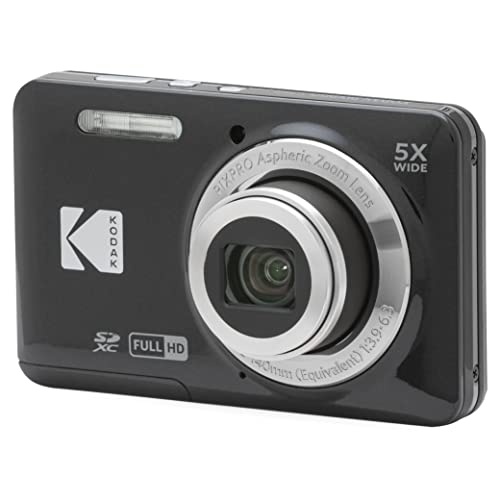 Kodak Pixpro FZ55 |
| Check price on Amazon |
Key takeaways
- Five beginner-friendly point and shoot cameras compared by sensor, zoom, screen and video specs, so a first-time buyer can pick with confidence.
What's inside
As an Amazon Associate I earn from qualifying purchases. This post may contain affiliate links at no extra cost to you.
Your first real camera decision is less about chasing the longest spec sheet and more about one question: will this camera come out of your bag often enough to beat your phone? A beginner point and shoot earns its place by being small, forgiving in auto mode, and noticeably better than a phone in dim rooms, at a distance, or in motion.
This guide is for first-time buyers, parents, travelers, students, and new content creators who want that clear step up in image quality without learning interchangeable lenses, extra batteries for a lens collection, or a bag full of gear. Every camera below is a fixed-lens compact, and each pick was chosen from the model names and specifications printed on its Amazon product page, so the numbers you see here match what the listing itself states.
Quick Picks
As an Amazon Associate we earn from qualifying purchases
| Product | Best for | Key spec from title |
|---|---|---|
| Canon PowerShot G7 X Mark III | Everyday photos and selfies | 20.1MP 1-inch sensor, 4.2x optical zoom |
| Sony ZV-1 II | Beginners who mostly shoot video | 20.1MP 1-inch sensor, 18-50mm wide-angle zoom |
| Panasonic Lumix ZS99 | Travel and concerts from the back row | 30x zoom, 24-720mm lens, 4K video |
| Canon PowerShot SX740 HS | Maximum reach on a simple body | 20.3MP sensor, 40x optical zoom, 4K video |
| Kodak Pixpro FZ55 | The simplest possible first camera | 16MP sensor, 5x optical zoom, 1080p video |
How to Choose
Sensor size matters more than megapixels
Beginners often sort cameras by megapixel count, but the physical sensor size behind those pixels shapes low-light quality far more. The 1-inch sensors in the Canon G7 X Mark III and Sony ZV-1 II gather more light than the smaller 1/2.3-inch chips in the Panasonic ZS99, Canon SX740 HS, and Kodak FZ55, so indoor shots stay cleaner after dark. Megapixels still count for cropping and prints, yet a 20.1MP 1-inch camera will usually beat a 20.3MP small-sensor camera at a candlelit dinner. Match the sensor to where you actually shoot, not to the biggest number on the box.
Zoom range: wide scenes versus distant subjects
A zoom specification written as 24-100mm covers group photos, street scenes, and portraits, which is where most beginners live. Long zooms such as the Panasonic’s 24-720mm or the Canon SX740 HS’s 40x lens pull in wildlife, stage performers, and landmarks you cannot walk toward. The trade-off is light: long-zoom lenses narrow to apertures like f/6.4 at full reach, so distant shots in shade get harder. Decide whether your frustration is usually “I can’t fit everyone in” or “my subject is too far away,” then buy for that problem.
Screens and controls you will actually use
A tilting touchscreen changes how a beginner frames shots. Screens that flip up or forward, like those on the G7 X Mark III, ZV-1 II, and ZS99, make selfies and low-angle pet photos far easier than crouching behind a fixed display. Touch focus also shortens the learning curve: tap the face, and the camera handles the rest. Fixed screens, as on the SX740 HS and FZ55, keep the body simpler and cheaper to build. If you plan to appear in your own photos or videos regularly, treat a movable screen as a requirement, not a luxury.
Video, audio, and getting photos off the camera
All five cameras here record video, but the details split them. The Canon, Sony, and Panasonic models shoot 4K, while the Kodak stops at 1080p Full HD, which is still fine for screens and social clips. Beginners who talk to the camera should note the Sony’s built-in three-capsule microphone and directional audio. Finally, check the transfer path before buying: Wi-Fi and Bluetooth models send photos to a phone in minutes, while a camera without wireless means cables or a card reader after every outing, a small friction that quietly kills habits.
The 5 Best Options
Canon PowerShot G7 X Mark III
- Best for: Beginners who want one compact for everyday photos, travel, and occasional video.
- Sensor: 20.1MP 1-inch stacked CMOS
- Processor: DIGIC 8
- Lens: 4.2x optical zoom, 24-100mm equivalent, f/1.8-2.8
- Video: UHD 4K at up to 29.97 fps, Full HD up to 120p
Beginners who want one compact for everyday photos, travel, and occasional video.
The listing notes a 10-minute maximum recording limit in 4K, so long continuous clips need planning.
For most beginners, this is the safest all-round starting point. Its 1-inch stacked sensor and bright f/1.8-2.8 lens handle restaurants, evening streets, and indoor birthdays better than small-sensor rivals, while the 24-100mm range covers the scenes a new photographer actually encounters. The screen tilts a full 180 degrees for selfies and vlogging, touch controls keep the learning curve gentle, and fast 20 fps burst shooting helps with kids and pets who refuse to sit still.
Sony ZV-1 II
- Best for: New vloggers and creators who want polished video with minimal setup.
- Sensor: 20.1MP 1-inch Exmor RS CMOS
- Lens: ZEISS Vario-Sonnar T* 18-50mm equivalent zoom, f/1.8-4.0
- Video: 4K at up to 30 fps, Full HD up to 120p
- Screen: 3-inch vari-angle touchscreen, 921,600 dots
New vloggers and creators who want polished video with minimal setup.
Stabilization for video is electronic Active Mode rather than optical, and the 18-50mm range offers little reach for distant subjects.
Choose the Sony if your camera will spend more time recording you than pointing at other people. The 18mm wide end fits your face, a friend, and the room behind you without a long arm stretch, and the side-opening vari-angle screen makes framing yourself simple. A built-in three-capsule microphone with directional pickup, a Bokeh Switch for one-tap background blur, and real-time Eye AF all remove decisions a beginner should not have to make mid-sentence.
Panasonic Lumix ZS99
- Best for: Travelers and concert-goers who want long reach in a pocketable body.
- Sensor: 20.3MP 1/2.3-inch High-Sensitivity MOS
- Lens: Leica DC Vario-Elmar 30x optical zoom, 24-720mm equivalent, f/3.3-6.4
- Stabilization: 5-axis Hybrid O.I.S.
- Video: 4K at 30p, Full HD up to 60p, high-speed Full HD at 120 fps
Travelers and concert-goers who want long reach in a pocketable body.
The smaller 1/2.3-inch sensor cannot match the 1-inch models in dim light, especially at the long end of the zoom.
The ZS99 answers the beginner who keeps saying “I wish I could get closer.” Its Leica-branded 30x zoom stretches from a wide 24mm to a genuinely distant 720mm, yet the body still slips into a jacket pocket. The tilting touchscreen flips forward for selfies, USB-C charging means one cable serves phone and camera on trips, and 4K Photo modes let you pull an 8MP still from a burst after the moment has passed, which forgives slow beginner reflexes.
Canon PowerShot SX740 HS
- Best for: Beginners photographing sports fields, wildlife, and distant landmarks.
- Sensor: 20.3MP CMOS
- Lens: 40x optical zoom, 24-960mm equivalent
- Video: 4K UHD
- Screen: 3.0-inch LCD
Beginners photographing sports fields, wildlife, and distant landmarks.
Confirm which listing variant you are buying, since this model is sold both as a camera-only listing and in third-party bundles with cards and cases.
If the ZS99’s reach appeals but you want even more of it, the SX740 HS stretches to a 40x optical zoom while staying in the same simple point-and-shoot format. It pairs that lens with a 20.3MP CMOS sensor and 4K video, and built-in Wi-Fi plus Bluetooth handle phone transfers without a computer. The control layout stays approachable for a first camera, and the zoom framing assist style features on this class of Canon help relocate a subject after zooming in too far.
Kodak Pixpro FZ55
- Best for: Absolute beginners and families wanting the simplest, most affordable style of compact.
- Sensor: 16MP CMOS
- Lens: 5x optical zoom, 28mm wide angle
- Video: 1080p Full HD
- Screen: 2.7-inch LCD
Absolute beginners and families wanting the simplest, most affordable style of compact.
There is no 4K video and no tilting screen, and low-light results will trail the 1-inch sensor models noticeably.
The FZ55 strips the first-camera decision down to almost nothing. Sixteen megapixels, a 5x zoom starting at a usefully wide 28mm, one rechargeable battery, and a small 2.7-inch screen: it is a camera a beginner can understand in an afternoon and hand to a child without anxiety. Video tops out at 1080p Full HD, which remains perfectly serviceable for family clips and social posting. For buyers whose real alternative is never taking the camera out at all, that simplicity is the entire point.
Which One Fits Your Situation
You mostly shoot family life indoors
Pick the Canon PowerShot G7 X Mark III. Birthday candles, school plays, and living-room gatherings punish small sensors, and its 1-inch sensor with an f/1.8 lens gathers far more light than the zoom-focused models here. The flip-up screen also helps when you want to join the group photo instead of always being the one holding the camera.
You are starting a video channel or vlogging habit
The Sony ZV-1 II was built for exactly this. Its wide 18mm view fits you and your surroundings, the vari-angle screen faces you, the three-capsule microphone prioritizes your voice, and the Bokeh Switch blurs backgrounds without any menu diving. Beginners can grow into its manual options later instead of replacing the camera within a year.
Your trips involve scenery, stages, and animals
Take the Panasonic Lumix ZS99 for its 24-720mm range, forward-tilting screen, and USB-C charging, or step up to the Canon SX740 HS if you routinely shoot across stadiums and fields and want the longest reach. Both stay pocketable, but the Panasonic’s tilting touchscreen and 4K Photo modes make it the friendlier travel companion for most beginners.
You want the lowest-effort first step into cameras
The Kodak Pixpro FZ55 removes nearly every decision. It covers casual snapshots and 1080p clips with a wide-enough 28mm lens and simple controls, at the cost of low-light finesse and 4K. If your honest goal is a dedicated camera for camp, school trips, and family outings rather than a new hobby, it fits that brief well.
Common Mistakes
- Choosing by megapixels alone, when sensor size and lens brightness shape real-world image quality far more.
- Buying a long-zoom camera for mostly indoor shooting, where its narrow maximum aperture works against you.
- Ignoring how photos get to your phone; a camera that is awkward to empty tends to stay home.
- Forgetting the memory card and spare battery, neither of which is guaranteed in every listing variant.
- Paying for a third-party bundle without checking whether its card, case, and reader match what you would pick yourself.
Frequently Asked Questions
Is a point and shoot camera still better than a phone for a beginner?
For zoom, low light, and fast-moving subjects, yes. A 1-inch sensor compact like the G7 X Mark III collects more light than a phone sensor, and an optical zoom lens reaches distant subjects without the softness of digital cropping. Phones still win on convenience and instant sharing, which is why wireless transfer matters when choosing a camera.
How much zoom does a beginner actually need?
Most everyday photography happens between 24mm and 100mm, which covers groups, landscapes, and portraits. Long zooms of 30x or 40x help at concerts, sports, and wildlife outings, but they come with smaller sensors and dimmer lenses. Buy reach only if distant subjects are a regular part of your shooting, not as insurance for a rare zoo trip.
Should a first camera shoot 4K video?
Only if you will actually use it. Four of the five cameras here record 4K, which gives sharper footage and room to crop, but files are larger and some models cap clip length. If your videos go straight to social platforms at 1080p, the Kodak FZ55’s Full HD recording is adequate, and simpler files are easier for a beginner to manage.
What else should I buy with my first point and shoot?
A fast SD card sized for video, a spare battery, and a small padded case cover most needs. Check the listing carefully first, because some variants include a card or case and others are camera-only. A mini tripod helps for group shots and low-light scenes, but skip large accessory kits until you know which gaps your own shooting reveals.
Related guides
More from Amazon
Programs that pair well with the guide above. Offers and eligibility are set by Amazon and may change.
Free shipping on eligible items, Prime Video and more. Eligible new members can start with a free trial.
Start a Prime free trialAudiobooks and podcasts to listen to on the go. Eligible new members can start with a free trial.
Try Audible freeAd-free music streaming. Eligible new subscribers can start with a free trial.
Try Music Unlimited freeA free business account with business pricing and bulk-buying tools for work, shop or home office.
Create a business accountAs an Amazon Associate we earn from qualifying purchases.










Write Your Review
No reviews yet. Be the first to share your experience!