
Our Short List of 3

- Best for: Commercial and landscape photographers printing at the largest sizes, or cropping medium format files aggressively.
- Sensor: 102MP medium format CMOS II HS (43.8 x 32.9mm)
- Effective still resolution: 102 MP
- Processor: X-Processor 5
- Continuous shooting: up to 8 fps

- Best for: Landscape, studio and portrait photographers who want maximum full-frame detail inside a mature lens system.
- Sensor: 61.0 MP full-frame back-illuminated Exmor R CMOS
- Processor: BIONZ XR with dedicated AI processing unit
- Video: 8K 24/25p, 4K up to 60p
- Stabilization: 5-axis in-body, up to 8.0 stops

- Best for: Wedding, wildlife and event photographers who crop heavily but refuse to give up burst speed.
- Sensor: 45.7MP full-frame stacked CMOS
- Processor: EXPEED 7
- Continuous shooting: 20 fps RAW, up to 120 fps JPEG
- Video: 12-bit 8K/60p and 4K/120p RAW, 10-bit ProRes 422 HQ internal
All 4 Picks at a Glance
| Product | Specs | Action |
|---|---|---|
| Fujifilm GFX100 II |
| Check price on Amazon |
| Sony Alpha a7R V |
| Check price on Amazon |
| Nikon Z 8 |
| Check price on Amazon |
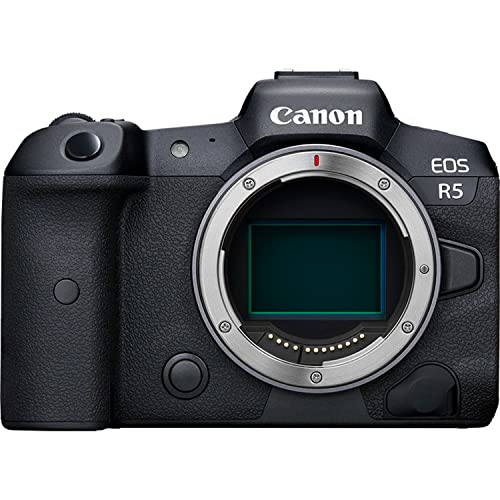 Canon EOS R5 |
| Check price on Amazon |
Key takeaways
- Compare the highest-resolution mirrorless cameras sold on Amazon, from 102MP medium format to 45MP full frame, with crop room and print-size guidance.
What's inside
As an Amazon Associate I earn from qualifying purchases. This post may contain affiliate links at no extra cost to you.
Buying a high-resolution camera is really a decision about what happens after the shutter closes: how large you can print, how hard you can crop, and how much fine detail survives in textures like fabric, foliage and stone. The megapixel figure on the box is only the start of that decision, because sensor size, lens quality and file handling all decide whether the extra pixels turn into visible detail or just bigger files.
This guide is for landscape, product, architecture and studio photographers whose output is limited by detail, plus full-frame shooters who crop heavily. Every camera below was picked from the names and specifications printed on its Amazon product page, and all four are interchangeable-lens mirrorless bodies with the highest stills resolution in their class.
Quick Picks
As an Amazon Associate we earn from qualifying purchases
| Product | Best for | Key spec from title |
|---|---|---|
| Fujifilm GFX100 II | Maximum detail for huge prints and commercial work | 102MP medium format sensor |
| Sony Alpha a7R V | High-resolution full-frame stills with subject-recognition AF | 61.0MP full-frame Exmor R CMOS sensor |
| Nikon Z 8 | High-resolution stills that still need flagship burst speed | 45.7MP stacked CMOS sensor |
| Canon EOS R5 | Canon RF shooters who need 45MP stills and 8K video | 45 megapixel CMOS sensor |
How to Choose
Start With Sensor Size, Not Just the Megapixel Count
A 102MP medium format sensor and a 61MP full-frame sensor do not deliver the same kind of detail. The Fujifilm GFX sensors measure 43.8 x 32.9mm, so each pixel sits on a physically larger site than the pixels packed into a 35mm frame. Larger photosites generally mean cleaner tonal gradation and more forgiving behaviour as light drops. Full-frame bodies such as the Sony a7R V answer with smaller, lighter systems and far deeper lens catalogues. Decide first whether your work justifies a new lens mount and larger files, because resolution bought on the wrong sensor format is resolution you will rarely enjoy using.
Check Whether Your Lenses Can Feed the Sensor
A demanding sensor is an honest reporter of lens flaws. On a 61MP or 102MP body, a soft zoom that looked acceptable on a 24MP camera will show corner blur and chromatic fringing at full magnification. Diffraction also arrives earlier: at f/16 or f/22 the smallest apertures soften detail on densely packed sensors, so high-resolution work often means shooting nearer a lens’s sweet spot and using focus stacking or tilt movements instead of simply stopping down. Before buying the body, confirm that at least one or two lenses in the system are known for resolving fine detail across the frame.
Budget for Cards, Storage and Burst Limits
Resolution multiplies everything downstream. A single uncompressed RAW file from a 102MP body is a large file, and a day of landscape bracketing or product focus stacks can fill fast cards quickly. Several bodies here rely on CFexpress media for their best continuous rates, and buffer depth shrinks fast at full resolution: the 102MP body in this guide tops out at 8 frames per second, well below the Nikon Z 8’s stacked-sensor rates. Work out your cost per shoot in cards and archive drives, and check the stated burst depth at full RAW quality, not the headline JPEG frame rate.
Match the Pixel Count to Your Real Output
Work backwards from the print or crop you actually sell. A 45MP file prints very large at gallery quality and still leaves room to crop a vertical from a horizontal frame. A 61MP file stretches that further, and 102MP files suit billboard-scale reproduction or aggressive reframing of product and architecture shots. If your images live on screens or in modest prints, the resolution premium buys little, and the slower handling becomes a daily tax. Choose the smallest sensor that comfortably covers your largest real output, then spend the difference on the lens that feeds it.
The 4 Best Options
Fujifilm GFX100 II
- Best for: Commercial and landscape photographers printing at the largest sizes, or cropping medium format files aggressively.
- Sensor: 102MP medium format CMOS II HS (43.8 x 32.9mm)
- Effective still resolution: 102 MP
- Processor: X-Processor 5
- Continuous shooting: up to 8 fps
Commercial and landscape photographers printing at the largest sizes, or cropping medium format files aggressively.
GF lenses are a separate, costlier system than full-frame glass, and 102MP RAW files demand fast cards and serious archive space.
If resolution is the entire brief, this is the ceiling among interchangeable-lens cameras sold on Amazon. The 102MP medium format sensor records 11,648 x 8736-pixel stills, which means a landscape frame can be cropped hard and still hold print-grade detail, and product textures survive close inspection. The body adds up to 8 stops of in-body stabilization and continuous shooting up to 8 frames per second, so the big sensor is usable outside a locked-down studio. It suits commercial, architecture and landscape photographers who print very large and can build a GF lens kit around the body.
Sony Alpha a7R V
- Best for: Landscape, studio and portrait photographers who want maximum full-frame detail inside a mature lens system.
- Sensor: 61.0 MP full-frame back-illuminated Exmor R CMOS
- Processor: BIONZ XR with dedicated AI processing unit
- Video: 8K 24/25p, 4K up to 60p
- Stabilization: 5-axis in-body, up to 8.0 stops
Landscape, studio and portrait photographers who want maximum full-frame detail inside a mature lens system.
Full-resolution bursts slow to around 7 fps in the highest-quality RAW modes, and CFexpress Type A cards cost more than SD media.
Sony’s a7R V pairs the highest resolution in full-frame, a 61.0MP back-illuminated Exmor R sensor, with a dedicated AI processing unit that recognises people, animals, birds, insects and vehicles. For resolution-first buyers it is the most flexible option here: huge landscape and studio files, 8K video when a job needs it, and an E-mount catalogue deep enough to find genuinely sharp glass. Dual slots each accept CFexpress Type A or SD UHS-II cards, and the 5-axis stabilization is rated up to 8 stops, which matters when every pixel of shake shows at this density.
Nikon Z 8
- Best for: Wedding, wildlife and event photographers who crop heavily but refuse to give up burst speed.
- Sensor: 45.7MP full-frame stacked CMOS
- Processor: EXPEED 7
- Continuous shooting: 20 fps RAW, up to 120 fps JPEG
- Video: 12-bit 8K/60p and 4K/120p RAW, 10-bit ProRes 422 HQ internal
Wedding, wildlife and event photographers who crop heavily but refuse to give up burst speed.
The two card slots take different media, so budget for CFexpress Type B cards to reach the fastest burst and video modes.
The Z 8 is the pick when 45.7MP still has to keep up with moving subjects. Its stacked full-frame CMOS sensor reads out fast enough for a silent electronic shutter up to 1/32000 sec with minimal rolling shutter, 20 fps RAW bursts and 120 fps JPEG shooting, so the resolution does not force you back to a tripod-bound workflow. The Amazon listing also confirms 12-bit 8K/60p and 4K/120p RAW video for hybrid shooters. Wildlife, wedding and event photographers who crop into distant subjects get flagship speed and a file size that still rewards cropping.
Canon EOS R5
- Best for: Canon RF owners stepping up to 45MP for landscapes, interiors and detailed product work.
- Sensor: 45 megapixel full-frame CMOS
- Processor: DIGIC X
- Continuous shooting: up to 12 fps mechanical shutter
- Video: 8K
Canon RF owners stepping up to 45MP for landscapes, interiors and detailed product work.
Confirm which card type a given shooting mode requires before a trip, since the two slots use different media with very different speeds.
Canon’s EOS R5 remains a straightforward route to 45MP inside the RF system. The listing headline specs are the ones that matter for detail work: a 45 megapixel full-frame CMOS sensor, DIGIC X processing, up to 12 fps with the mechanical shutter and 8K video, with dual memory card slots for overflow or instant backup. In-body stabilization works with RF lenses for coordinated correction, which helps handheld architecture and interior work where a tripod is impractical. For photographers already holding RF glass, it is the lowest-friction upgrade to genuinely print-grade resolution.
Which One Fits Your Situation
You Print Very Large or License Images for Commercial Display
Choose the Fujifilm GFX100 II. Nothing else in this guide approaches 102MP on a sensor this large, and that headroom is exactly what billboard reproduction, gallery prints and heavy reframing consume. Accept the slower, more deliberate pace and the GF lens investment as part of the format, and plan your storage around files that dwarf full-frame RAWs.
You Shoot Landscapes and Studio Work in a Full-Frame System
Choose the Sony Alpha a7R V. Its 61MP sensor is the full-frame resolution leader here, the AI-driven autofocus handles portrait and wildlife detours credibly, and the E-mount lens range gives you the best chance of owning glass that resolves the sensor. It is the balanced answer when medium format is more system than your work needs.
Your Subjects Move and You Crop Into the Frame Afterwards
Choose the Nikon Z 8. The stacked sensor keeps 45.7MP files coming at 20 fps in RAW, so a bird in flight or a wedding moment can be captured first and composed later in the crop. Photographers who routinely shoot at the long end and reframe will feel the benefit of resolution and readout speed arriving in the same body.
You Already Own Canon RF Lenses
Choose the Canon EOS R5. Staying in your mount protects your lens investment, and 45MP is a decisive step up for print size and crop room over lower-resolution RF bodies. Dual card slots and 8K video cover hybrid assignments, making it the sensible resolution upgrade for an established Canon workflow rather than a system switch.
Common Mistakes
- Buying the highest megapixel count, then mounting a soft consumer zoom that cannot resolve the sensor, so the expensive pixels record blur in finer detail.
- Stopping down to f/22 for depth of field and losing the sharpness to diffraction that the resolution was bought for; use focus stacking or a moderate aperture instead.
- Ignoring the media bill: full-resolution RAW bursts need CFexpress cards and much larger archives than a 24MP workflow.
- Expecting sports-camera burst depth at full resolution; high-megapixel bodies clear their buffers more slowly, especially in uncompressed RAW.
- Judging a file only at 100 percent on a monitor and rejecting a camera whose output would look excellent at the actual print size.
Frequently Asked Questions
How Many Megapixels Do I Need for a Large Print?
For a print viewed at normal distance, 45MP already produces very large, detailed output, and it tolerates moderate cropping before quality drops. Move to 61MP when you regularly crop or print bigger, and treat 102MP medium format as the choice for the largest commercial reproductions, where files are inspected closely and reframed often.
Does Higher Resolution Make Low-Light Images Worse?
Smaller individual pixels gather less light each, so pixel-level noise looks stronger when you inspect a high-resolution file at full magnification. Downsampled to the same output size, much of that difference evens out. In practice, sensor size matters more: the larger GFX sensor keeps an advantage, while full-frame high-resolution bodies reward careful exposure and good lenses.
Can I Just Crop Instead of Buying a Longer Lens?
Partly. Cropping a 61MP or 102MP file keeps enough pixels for many uses, and it is a genuine reason to buy resolution for wildlife and sports. But cropping cannot restore the perspective, subject isolation or light gathering of a longer lens, and every crop spends the detail you paid for. Use crop room as insurance, not as your only telephoto plan.
Do High-Resolution Cameras Need Special Memory Cards?
Usually, yes. The fastest burst rates and the highest video modes on these bodies are tied to CFexpress media, and the slot layouts differ: the Sony takes Type A cards, the Nikon and Canon pair a CFexpress slot with an SD slot. Check the exact card each mode requires on the product page before buying media, because an SD-only kit can quietly limit the camera.
Related guides
More from Amazon
Programs that pair well with the guide above. Offers and eligibility are set by Amazon and may change.
Free shipping on eligible items, Prime Video and more. Eligible new members can start with a free trial.
Start a Prime free trialAudiobooks and podcasts to listen to on the go. Eligible new members can start with a free trial.
Try Audible freeAd-free music streaming. Eligible new subscribers can start with a free trial.
Try Music Unlimited freeA free business account with business pricing and bulk-buying tools for work, shop or home office.
Create a business accountAs an Amazon Associate we earn from qualifying purchases.










Write Your Review
No reviews yet. Be the first to share your experience!