
Our Short List of 3

- Best for: Solo creators filming talking-head videos, tutorials, and product demos at home.
- 20.1MP 1-inch stacked Exmor RS CMOS sensor with BIONZ X processor
- ZEISS Vario-Sonnar T* 24-70mm f/1.8-2.8 lens
- 4K HDR video recording
- 3.0-inch side flip-out touchscreen LCD

- Best for: Everyday photographers who also post short videos and want one camera for both.
- 20.1MP 1.0-inch stacked CMOS sensor with DIGIC 8 processor
- 4.2x optical zoom lens, 24-100mm f/1.8-2.8, with optical image stabilizer
- 4K 30p and Full HD 120p video
- 3-inch tilting touchscreen LCD

- Best for: Travelers and concertgoers who need serious zoom reach from a camera that still fits in a jacket pocket.
- 20.3MP effective resolution on a 1/2.3-inch MOS sensor
- LEICA DC 24-720mm lens with 30x optical zoom
- 5-Axis HYBRID O.I.S.+ optical image stabilization
- 4K 3840 x 2160 30p video and 4K Photo mode
All 4 Picks at a Glance
| Product | Specs | Action |
|---|---|---|
| Sony ZV-1 |
| Check price on Amazon |
| Canon PowerShot G7 X Mark III |
| Check price on Amazon |
| Panasonic LUMIX ZS99 |
| Check price on Amazon |
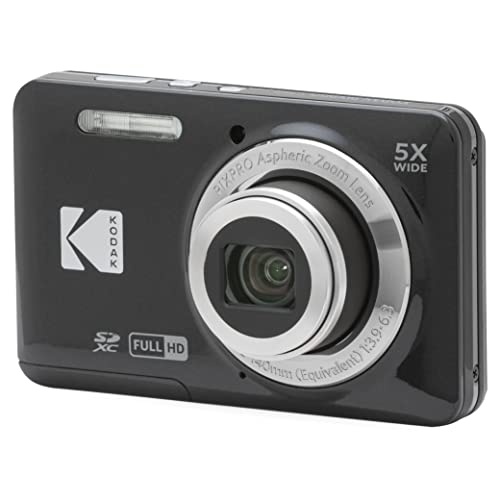 Kodak PIXPRO FZ55 |
| Check price on Amazon |
Key takeaways
- Compare the best point and shoot digital cameras on Amazon US: a creator-focused Sony, a travel zoom Panasonic, a Canon all-rounder and a simple Kodak pick.
What's inside
As an Amazon Associate I earn from qualifying purchases. This post may contain affiliate links at no extra cost to you.
Buying a point and shoot camera in 2026 comes down to one honest question: what does your phone still fail at? For some buyers it is zoom reach on trips, for others it is clean video with a flip screen, and for many it is simply a dedicated camera that stays simple. The right choice depends on which of those gaps matters most, because no compact camera wins at all three.
This guide is for travelers, casual creators, and families who want a real camera without interchangeable lenses or menus full of manual controls. The four picks below were selected from the names and specifications on their Amazon US product pages: a creator-focused Sony, an all-round Canon, a long-zoom Panasonic, and a straightforward Kodak.
Quick Picks
As an Amazon Associate we earn from qualifying purchases.
| Product | Best for | Key spec from title |
|---|---|---|
| Sony ZV-1 | Creators who film themselves and products | 20.1MP 1-inch sensor, 4K HDR video |
| Canon PowerShot G7 X Mark III | Everyday photos plus social video | 20.1MP stacked CMOS, 4K 30p video |
| Panasonic LUMIX ZS99 | Travel and concerts from a distance | 30x zoom 24-720mm LEICA lens, 4K video |
| Kodak PIXPRO FZ55 | Simple snapshots without complexity | 16MP CMOS sensor, 1080P Full HD video |
How to Choose
Sensor size decides low-light quality
Most point and shoot cameras use either a 1-inch sensor or a much smaller 1/2.3-inch sensor, and that difference shows up after sunset. A 1-inch sensor collects more light per pixel, so indoor photos and evening street scenes stay cleaner with less grain. The Sony ZV-1 and Canon G7 X Mark III both use 1-inch sensors, while the Panasonic ZS99 and Kodak FZ55 use 1/2.3-inch sensors. If your photos are mostly daylight travel shots, the smaller sensor is fine. If birthdays, restaurants, and dim rooms are your normal subjects, sensor size should be your first filter.
Zoom range versus lens brightness
A long zoom and a bright lens pull in opposite directions. Travel zooms like the ZS99 stretch to 720mm equivalent, which frames distant landmarks and stage performers, but the aperture narrows at full zoom and low-light shots suffer. Shorter zooms such as the 24-70mm on the ZV-1 and the 24-100mm on the G7 X Mark III open to f/1.8 at the wide end, gathering far more light and blurring backgrounds. Decide which you actually do: if you mostly shoot people nearby, brightness wins; if you shoot subjects across a field or arena, reach wins.
Video features that matter for casual creators
If you plan to film, check four things on the product page: maximum video resolution, whether the screen flips toward you, whether there is a microphone input, and how the camera stabilizes footage. The ZV-1 was built around video, with a side flip-out screen, a 3.5mm mic jack, and a Product Showcase mode that shifts focus to objects held up to the lens. The G7 X Mark III adds vertical video and live streaming support. The ZS99 records 4K and offers a 4K Photo mode, while the FZ55 stops at 1080p, which is enough for simple family clips.
Simplicity, battery, and everyday carry
A camera only helps if it is with you, so size and charging habits matter more than spec sheets suggest. Pocketable models like the FZ55 weigh very little and run on a rechargeable lithium-ion battery, while larger compacts trade pocket space for better controls. Check how the camera charges: the ZS99 uses USB Type-C, which matches most modern phones and power banks. Also confirm what memory card the camera needs before ordering, because none of these cameras record far without one, and card speed classes differ between 1080p and 4K models.
The 4 Best Options
Sony ZV-1
- Best for: Solo creators filming talking-head videos, tutorials, and product demos at home.
- 20.1MP 1-inch stacked Exmor RS CMOS sensor with BIONZ X processor
- ZEISS Vario-Sonnar T* 24-70mm f/1.8-2.8 lens
- 4K HDR video recording
- 3.0-inch side flip-out touchscreen LCD
Solo creators filming talking-head videos, tutorials, and product demos at home.
The 24-70mm zoom range is short, so check that you do not need real telephoto reach before choosing it over a travel zoom.
The ZV-1 is the pick for people who talk to the camera. Its side flip-out touchscreen makes framing yourself easy, Real-time Eye Autofocus holds focus on your face, and the Product Showcase setting snaps focus to an item you hold up, which suits review and craft videos. The bright ZEISS lens and 1-inch sensor keep skin tones clean indoors, and the built-in directional microphone with its wind screen handles basic audio, with a 3.5mm jack and Multi Interface shoe if you later add a better microphone.
Canon PowerShot G7 X Mark III
- Best for: Everyday photographers who also post short videos and want one camera for both.
- 20.1MP 1.0-inch stacked CMOS sensor with DIGIC 8 processor
- 4.2x optical zoom lens, 24-100mm f/1.8-2.8, with optical image stabilizer
- 4K 30p and Full HD 120p video
- 3-inch tilting touchscreen LCD
Everyday photographers who also post short videos and want one camera for both.
Confirm the exact color and whether the listing is the camera alone or a seller bundle, since bundle contents vary between listings.
The G7 X Mark III is the balanced option: a 1-inch stacked sensor and DIGIC 8 processor for stills, 4K video, and features aimed at social posting. Its screen tilts up for selfies, it supports vertical video for phone-first platforms, and Canon lists live streaming to YouTube directly from the camera. An external microphone terminal and clean HDMI output give it room to grow, while the 24-100mm range covers group shots and moderate close-ups without swapping anything.
Panasonic LUMIX ZS99
- Best for: Travelers and concertgoers who need serious zoom reach from a camera that still fits in a jacket pocket.
- 20.3MP effective resolution on a 1/2.3-inch MOS sensor
- LEICA DC 24-720mm lens with 30x optical zoom
- 5-Axis HYBRID O.I.S.+ optical image stabilization
- 4K 3840 x 2160 30p video and 4K Photo mode
Travelers and concertgoers who need serious zoom reach from a camera that still fits in a jacket pocket.
The small sensor and narrow maximum aperture at full zoom mean dim venues will push ISO up, so expect softer results there than from the 1-inch models.
The ZS99 exists for one job: getting closer without carrying a bigger camera. Its LEICA DC lens runs from 24mm wide angle to 720mm telephoto, so landscapes, wildlife at the zoo, and performers on a stage all fit in one pocket-sized body. The 1/2.3-inch sensor gives up some low-light quality to make that zoom possible, but 5-Axis HYBRID O.I.S.+ keeps long-zoom shots steadier. It also records 4K video, pulls stills with 4K Photo mode, and charges over USB Type-C.
Kodak PIXPRO FZ55
- Best for: Casual shooters who want simple, reliable snapshots and short clips without learning manual settings.
- 16MP CMOS sensor, 16.35MP effective resolution, 1/2.3-inch size
- 5x optical zoom, 28-140mm equivalent, f/3.9-6.3
- 1080p Full HD video recording
- 2.7-inch LCD screen with 230k dots
Casual shooters who want simple, reliable snapshots and short clips without learning manual settings.
It tops out at 1080p video and uses digital rather than optical stabilization, so check that matches the quality you expect before buying.
The FZ55 is the no-fuss option for people who want a camera, not a hobby. It has a 16MP CMOS sensor, a 5x optical zoom starting at a 28mm wide angle, and one-touch 1080p Full HD video, all in a body light enough to forget in a bag. There is no flip screen, no 4K, and no microphone input, which is exactly the point: fewer settings means fewer ways to get a shot wrong. It suits families, older relatives, and anyone replacing an old compact.
Which One Fits Your Situation
You film yourself teaching, reviewing, or crafting
Choose the Sony ZV-1. The flip-out screen faces you, Eye AF keeps your face sharp while you move, and Product Showcase refocuses on whatever you hold toward the lens. The built-in microphone and wind screen are workable from day one, and the mic jack leaves an upgrade path open for when your channel or course outgrows basic audio.
You want one camera for trips, family, and posting online
Choose the Canon G7 X Mark III. Its 1-inch sensor handles mixed light well, the 24-100mm lens covers most everyday scenes, and vertical video plus live streaming support fit social workflows. It is the least specialized camera here, which makes it the easiest to live with as an only camera for years of mixed use.
You shoot from far away on trips or at events
Choose the Panasonic LUMIX ZS99. The 24-720mm zoom reaches subjects the other three cannot, from distant viewpoints to stage performers, and optical stabilization helps at the long end. Accept softer results in dark venues as the trade for that reach in a pocketable body that still slips into a jacket or small daypack.
You just want easy photos without your phone
Choose the Kodak PIXPRO FZ55. It turns on, zooms a little, records HD video, and recharges its included battery, with no menu system to master. For party snapshots, school events, camp trips, and a first camera for a teenager, that simplicity is the feature, and the light body means it actually gets carried along.
Common Mistakes
- Buying a long-zoom camera for mostly indoor photos, then blaming the camera for grainy results that the small sensor and narrow aperture predict.
- Assuming every compact records 4K, when some current models like the FZ55 stop at 1080p by design.
- Forgetting to order a memory card, or buying one below the speed class the camera requires for 4K recording.
- Choosing a flip screen camera for stills only, or a fixed-screen camera for solo video, instead of matching the screen to how you actually shoot.
- Comparing megapixel counts across different sensor sizes, when a 20MP 1-inch sensor and a 20MP 1/2.3-inch sensor behave very differently in low light.
Frequently Asked Questions
Is a point and shoot camera still better than a phone?
For zoom reach, flash, and handling, yes: a 30x optical zoom and a larger sensor produce results a phone’s digital crop cannot match. For quick sharing, phones stay more convenient. Many buyers keep both, using the camera when image quality or reach is the point of the outing.
What memory card do these cameras need?
All four use SD-family cards, but the speed requirement differs. The Kodak FZ55 lists SD, SDHC, and SDXC cards up to 512GB at Class 10 or higher, and 4K models generally want a fast UHS-I card. Check the product page for your model before ordering a card.
Can these cameras connect to a phone for sharing?
The Panasonic ZS99 includes Wi-Fi and Bluetooth for sharing and remote control, and the Sony ZV-1 offers Bluetooth and Wi-Fi transfer through its companion app. The Kodak FZ55 has no wireless transfer listed, so plan on moving files with the card or a USB cable.
Which of these is best for low-light photos?
The two 1-inch sensor models, the Sony ZV-1 and the Canon G7 X Mark III, are the strongest in dim light because their larger sensors and f/1.8 wide-end apertures gather more light. The ZS99 and FZ55 use smaller 1/2.3-inch sensors, so their low-light results show more noise.
Related guides
More from Amazon
Programs that pair well with the guide above. Offers and eligibility are set by Amazon and may change.
Free shipping on eligible items, Prime Video and more. Eligible new members can start with a free trial.
Start a Prime free trialAudiobooks and podcasts to listen to on the go. Eligible new members can start with a free trial.
Try Audible freeAd-free music streaming. Eligible new subscribers can start with a free trial.
Try Music Unlimited freeA free business account with business pricing and bulk-buying tools for work, shop or home office.
Create a business accountAs an Amazon Associate we earn from qualifying purchases.










Write Your Review
No reviews yet. Be the first to share your experience!