
Our Short List of 3
All 5 Picks at a Glance
| Product | Specs | Action |
|---|---|---|
 1. Renogy 12 Volt 200Ah Deep Cycle AGM Battery | Check price on Amazon | |
 2. Renogy 12 Volt 100Ah Deep Cycle AGM Battery | Check price on Amazon | |
 3. Mighty Max Battery MM-G31M 12V 110Ah AGM | Check price on Amazon | |
 4. Interstate Batteries Marine/RV Battery 12V 100Ah Group 31M AGM | Check price on Amazon | |
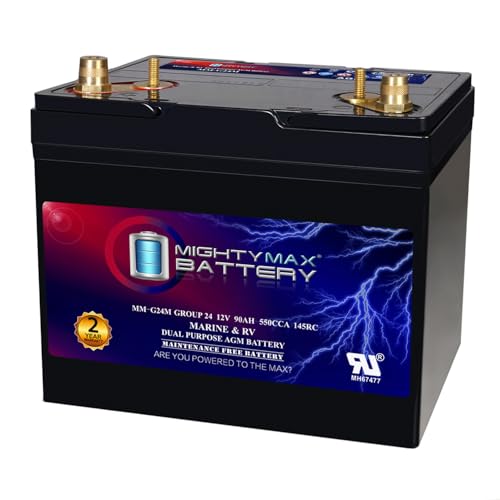 5. Mighty Max Battery MM-G24M 12V 90Ah AGM | Check price on Amazon |
Key takeaways
- Find the best battery for house RV power: sealed AGM deep-cycle picks sized for real house loads, with fit, charging, and cold-weather guidance.
What's inside
- Quick Answer
- 1. Renogy 12 Volt 200Ah Deep Cycle AGM Battery
- 2. Renogy 12 Volt 100Ah Deep Cycle AGM Battery
- 3. Mighty Max Battery MM-G31M 12V 110Ah AGM
- 4. Interstate Batteries Marine/RV Battery 12V 100Ah Group 31M AGM
- 5. Mighty Max Battery MM-G24M 12V 90Ah AGM
- How to Choose
- Who Should Skip It
- FAQ
- Final Verdict
- Product and ASIN Reference
As an Amazon Associate I earn from qualifying purchases. This post may contain affiliate links at no extra cost to you.
An RV house battery does a different job from the battery that starts the engine. It runs the lights, water pump, furnace fan, and everything wired into the 12-volt system while the rig is parked, giving up its charge slowly over hours rather than in one short burst. Pick the wrong type and the lights dim early or the furnace cuts out on a cold night. Pick the right one and the fridge stays cold, the pump runs strong, and the battery is ready again after a drive or a day on solar. This guide compares five sealed AGM deep-cycle batteries built for RV house service, from a compact Group 24 unit to a 200Ah bank-in-a-box, and explains how to match capacity, size, and charging to your rig.
As an Amazon Associate, we earn from qualifying purchases.
Quick Answer
For most RV house systems, a 12-volt AGM deep-cycle battery is the simplest choice, and a 100Ah Group 31 size fits most trays. Lithium iron phosphate gives more usable energy per pound if your converter has a lithium setting. Match the group size to your tray, size capacity to your overnight loads, and keep the battery charged between trips.
1. Renogy 12 Volt 200Ah Deep Cycle AGM Battery
The Renogy 200Ah AGM is the pick for RVers who want a large house bank without wiring two batteries together. One case holds 200Ah, enough for a residential-style fridge, lights, a water pump, and a furnace fan through the night with room to spare. Because it is a single battery rather than a pair, there are no inter-battery cables to size and no mismatch between two units aging at different rates. That simplicity matters in a big Class A or fifth wheel where the battery compartment already holds an inverter, a converter, and heavy-gauge cable. The trade is weight and footprint. At close to 128 pounds and more than 20 inches long, this battery needs a reinforced tray, a compartment that actually fits its length, and two people or a lift to install safely. Measure first, including the height above the terminals, because the case will not squeeze into a standard Group 24, 27, or 31 box. The sealed AGM build needs no water checks and will not spill, and its plates support very high discharge currents, which helps when an inverter starts a microwave or a fridge compressor. Charging is straightforward on a standard RV converter set for sealed lead-acid batteries, and the battery accepts charge below freezing, a real advantage for four-season travel.
2. Renogy 12 Volt 100Ah Deep Cycle AGM Battery
The Renogy 100Ah AGM is the straightforward drop-in house battery for most travel trailers and smaller motorhomes. Its capacity covers a night of lights, pump, and furnace fan use in a typical weekend rig, and its footprint fits the Group 31 style trays found on many RVs. The sealed AGM construction means no water to check, no acid spills on rough roads, and no venting worries inside a compartment. For owners replacing a tired flooded battery, this is the easiest upgrade in the guide: same voltage, same basic wiring, and a charger setting the stock converter already supports. What sets this battery apart is surge tolerance. The listing rates a 1,100-amp maximum discharge for five seconds, the figure that matters when a fridge compressor kicks on or an inverter starts a microwave. Monthly self-discharge stays low at room temperature, so the battery holds a charge through weeks of storage, and the discharge range runs from well below freezing to high summer heat. The battery ships with M8 terminal bolts and supports series and parallel connections, so a second unit can be added later if the first proves too small. The main limit is shared by every AGM battery: draining it below half on a regular basis shortens its life, so the practical usable capacity is about half the rated figure.
3. Mighty Max Battery MM-G31M 12V 110Ah AGM
The Mighty Max MM-G31M packs a little extra capacity into the familiar Group 31 footprint, a smart choice for RVers whose tray fits a Group 31 case but whose overnight loads run slightly past what a 100Ah battery covers. The extra 10Ah can be the margin that keeps the furnace running on a cold morning instead of cutting out at dawn. The battery is a dual-purpose design, so it also carries a cranking rating, which suits rigs where the house battery occasionally helps with starting duties or runs a slide motor that draws hard for a few seconds. Cycle life is the standout figure here. Mighty Max rates the MM-G31M for up to 700 cycles when cycled to half depth, a published number that many competing AGM batteries simply do not state. Reserve capacity is 240 minutes, generous for the size, and the cranking figures sit high enough for dual-purpose service. The sealed AGM build is spill-proof and maintenance-free, housed in an impact-resistant ABS case that handles road vibration and rough terrain. At roughly 71 to 72 pounds, the MM-G31M is heavy for a single Group 31 unit, so check the tray rating and plan the lift before the battery arrives.
4. Interstate Batteries Marine/RV Battery 12V 100Ah Group 31M AGM
Interstate is the familiar name on this list, and the 100Ah Group 31M AGM is the battery for owners who would rather buy a known brand from a dealer network they can actually visit. The construction uses thick pure lead plates, which the maker says last about twice as long as conventional alloy AGM plates in cyclic service. That is a build-quality signal rather than a hard number, since no cycle count is published, but the underlying idea is sound: thicker plates resist the shedding that slowly kills deep-cycle batteries. In practical terms, this battery behaves like the other 100Ah Group 31 units in the guide. It delivers roughly 600 watt-hours of usable energy when kept above half discharge, carries a 200-minute reserve capacity, and provides 825 cold cranking amps with a marine cranking figure just above 1,000. Dual marine terminals carry both standard automotive posts and threaded studs, which makes wiring easier when the house leads, a solar controller, and an inverter all need to land on the same battery. The main thing to weigh is the absence of a published cycle-life figure. Owners who value a long-established brand, a wide dealer network, and pure lead plate construction will find this Interstate an easy choice.
5. Mighty Max Battery MM-G24M 12V 90Ah AGM
The Mighty Max MM-G24M is the compact pick for RVs with a small battery box. Its Group 24 footprint fits tongue boxes and compartments that cannot take a Group 31 case, and at about 52 to 54 pounds it is the lightest battery in this guide by a clear margin. That matters twice: once when lifting the battery into a tight compartment, and again on the tongue, where every pound counts against the tow rating. For pop-up campers, small teardrop trailers, and older rigs with a factory Group 24 box, this is often the largest battery that fits without modifying the tray. Smaller size means less capacity. A 90Ah battery holds about 540 watt-hours of usable energy at half discharge, which covers lights, a water pump, and a furnace fan for a night in a modest rig, but it will not carry a residential fridge or a long inverter session. Owners with heavy loads should plan on two units in parallel rather than expecting one small battery to do a big job. Like its larger sibling, the MM-G24M carries a published cycle rating of up to 700 cycles at half depth of discharge, along with 550 cold cranking amps, 700 marine cranking amps, and 145 minutes of reserve capacity. The sealed AGM construction is spill-proof and maintenance-free, and the rugged ABS case resists vibration on rough roads.
How to Choose
Start with the tray, because the best battery in the world is useless if it does not fit. Measure the length, width, and height of the battery compartment, including the space above the terminals for cable bends, and note the group size of the battery that came out. Group 24, 27, and 31 are the common RV sizes, and each step up adds capacity at the cost of weight and length. A battery that is too tall can press cables against a lid; a battery that is too long simply will not go in. Check the tray weight rating as well, especially on a trailer tongue, where a 128-pound battery can exceed what the factory box was built to hold.
Next, work out the overnight load. Add up what runs after dark: lights, the water pump, the furnace fan, the fridge controls, a phone charger, and anything on the inverter. A single 100Ah AGM battery holds about 600 watt-hours of usable energy when kept above half discharge, which covers a modest night in most trailers. A residential fridge or a CPAP machine through the night pushes the need toward 200Ah or two batteries in parallel. Lithium iron phosphate changes the math because nearly all of its rated capacity is usable, so a 100Ah lithium battery delivers roughly twice the usable energy of a 100Ah AGM battery, but only if the converter and solar controller have a lithium setting.
Chemistry is the third decision. Sealed AGM is the simplest choice for most owners: it drops into the existing system, charges on the stock converter, needs no water, and accepts charge in cold weather. Flooded lead-acid costs less up front but needs water checks, vents gas, and must stay upright. Lithium costs more and weighs far less, lasts through many more cycles, and charges faster, but it needs a lithium-capable charger and, in freezing weather, a heated battery or a warm compartment.
Pay attention to the details that show up after the first season. A published cycle-life rating is worth more than a vague durability claim, because it lets two batteries be compared on the same terms. Dual marine terminals with threaded studs make wiring easier when several cables share one post, and a high surge rating matters for inverter loads, since a fridge compressor can pull many times its running draw for a few seconds at startup. Finally, check the warranty terms and where service is handled, because a battery bought online is only as good as the warranty process behind it.
Who Should Skip It
Skip a big AGM house battery if the rig already runs on lithium and the charging system is set up for it. Going back to AGM would add weight, cut usable capacity, and waste the lithium-capable converter already installed. Skip the 200Ah single unit if the tray is a standard Group 31 box or the tongue weight is already near its limit; a battery that does not fit or overloads the tray is a hazard, not an upgrade. Skip any deep-cycle battery as a starting battery for a large diesel motorhome engine, since house batteries are built for slow discharge and can be damaged by repeated high-current cranking. Owners who only ever camp with hookups and never run the house system overnight may not need a deep-cycle upgrade at all. Finally, skip a battery with no published specs for capacity, cycle life, or dimensions, because a battery that cannot be compared cannot be trusted to fit the job.
FAQ
How long will a 100Ah AGM house battery run my RV overnight?
A single 100Ah AGM battery holds about 600 watt-hours of usable energy when kept above half discharge. That covers LED lights, a water pump, a furnace fan cycling through the night, and phone charging in most trailers. Heavy inverter loads drain it much faster, so heavy users should plan on 200Ah or a second battery in parallel.
Can I replace a flooded house battery with a sealed AGM battery?
Yes, in most cases the swap is direct. A sealed AGM battery uses the same voltage and the same basic wiring, and most stock RV converters already have a sealed lead-acid setting that suits it. The battery needs no water checks and will not spill, which makes it a good fit for compartments that are hard to reach.
Do I need a special charger for an AGM house battery?
No special charger is needed, but the charger should have a sealed lead-acid or AGM setting. A converter stuck on a flooded profile can overcharge an AGM battery over time, while a lithium-only profile can undercharge it. Keep the battery fully charged between trips to slow the sulfation that shortens AGM life.
How do I know what size house battery my RV needs?
Measure the tray first to learn the largest group size that fits, then add up the overnight loads in watt-hours and double the figure for AGM, since only about half the rated capacity should be used regularly. A modest trailer often runs well on one 100Ah battery, while a rig with a residential fridge usually needs 200Ah or more.
Final Verdict
The best battery for a house RV is the one that fits the tray, covers the overnight load, and charges happily on the converter already in the rig. For most owners that means a sealed AGM deep-cycle battery in Group 31 size, and the Renogy 100Ah is the most straightforward version of it: standard size, strong surge tolerance, and an easy upgrade path to a second unit. Owners with a big rig and heavy loads should step up to the Renogy 200Ah single unit or a pair of Group 31 batteries, while owners with a small box should take the Mighty Max MM-G24M and accept its smaller capacity. Keep the battery above half discharge and charged between trips, and the house system will run quietly for years.
Product and ASIN Reference
| Product | ASIN |
|---|---|
| Renogy 12 Volt 200Ah Deep Cycle AGM Battery | B075RGX1WR |
| Renogy 12 Volt 100Ah Deep Cycle AGM Battery | B075RFXHYK |
| Mighty Max Battery MM-G31M 12V 110Ah AGM | B0G7LQ87LG |
| Interstate Batteries Marine/RV Battery 12V 100Ah Group 31M AGM | B0BHTT7K4J |
| Mighty Max Battery MM-G24M 12V 90Ah AGM | B0G83YHSRK |
Related guides
More from Amazon
Programs that pair well with the guide above. Offers and eligibility are set by Amazon and may change.
Free shipping on eligible items, Prime Video and more. Eligible new members can start with a free trial.
Start a Prime free trialAudiobooks and podcasts to listen to on the go. Eligible new members can start with a free trial.
Try Audible freeAd-free music streaming. Eligible new subscribers can start with a free trial.
Try Music Unlimited freeA free business account with business pricing and bulk-buying tools for work, shop or home office.
Create a business accountAs an Amazon Associate we earn from qualifying purchases.










Write Your Review
No reviews yet. Be the first to share your experience!