
Our Short List of 3

- Best for: A juice bar or café counter running celery drinks through a busy service, where jug capacity and a genuine commercial line matter most.
- Brand line: Breville | Commercial (listing)
- Juice jug: 70 oz (title)
- Extraction: Cold Spin Technology; stainless steel cutting disc with Italian-made mesh filter (bullet claim)
- Build: brushed stainless steel (title)

- Best for: A small café or deli counter with little room, needing continuous pulp ejection for fibrous stalks inside a compact commercial footprint.
- Brand line: Waring Commercial (title)
- Design: heavy-duty stainless steel juice extractor with pulp ejection (title)
- Motor speed: about 16,000 RPM (feature list)
- Dimensions: 17 in H x 7.5 in W x 7.5 in D (listing details)
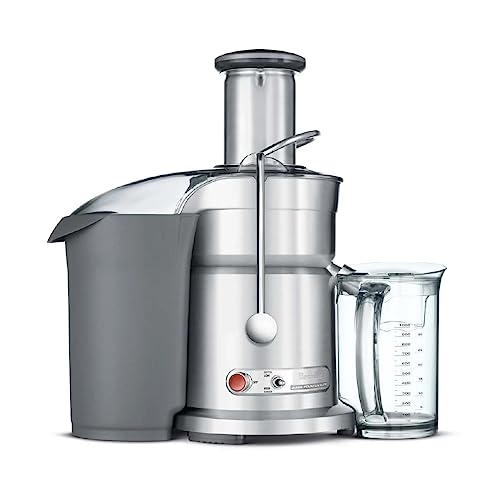
- Best for: A serious home juicer who runs celery most days and wants the strongest stated power and disc figures in this set.
- Motor: 1000 watts, up to 13,000 RPM (bullet)
- Cutting disc: titanium-reinforced (bullet)
- Filter: over 40,000 filtering pores (bullet)
- Listing claim: up to 30% more juice than traditional juicers (bullet claim)
All 5 Picks at a Glance
| Product | Specs | Action |
|---|---|---|
| Breville Commercial Juice Fountain XL Pro |
| Check price on Amazon |
| Waring Commercial JE2000 Juice Extractor |
| Check price on Amazon |
| Breville Juice Fountain Elite 800JEXL |
| Check price on Amazon |
 Kuvings NJ-9500U Centrifugal Juice Extractor |
| Check price on Amazon |
 Omega J4000 Centrifugal Juicer |
| Check price on Amazon |
Key takeaways
- Five commercial centrifugal juicers for celery work, compared on pulp ejection, feed tubes and continuous-run claims from their Amazon listings.
What's inside
As an Amazon Associate I earn from qualifying purchases. This post may contain affiliate links at no extra cost to you.
Celery is the produce that exposes a centrifugal juicer. The stalks are long, stringy and mostly water, so a weak feed arrangement means constant cutting, a basket that packs with fibre stops the run, and a small jug fills before one bunch is finished. The buying decision is therefore about throughput: how stalks go in, how pulp gets out, and how long the machine keeps moving without a pause to empty or clean.
This guide serves juice bars, cafés and serious home juicers who run celery in batches. One honesty point comes first: none of the five listings below mentions celery, and no centrifugal machine here has a celery part, so the picks are argued from feed openings, pulp ejection and continuous-run wording on the Amazon product pages, with the two genuine commercial lines separated from three heavy-duty home machines.
Quick Picks
As an Amazon Associate we earn from qualifying purchases.
| Product | Best for | Key spec from title |
|---|---|---|
| Breville Commercial Juice Fountain XL Pro | A juice bar or café counter running celery drinks through a busy service, where jug capacity and a genuine commercial line matter most. | 70 oz juice jug |
| Waring Commercial JE2000 Juice Extractor | A small café or deli counter with little room, needing continuous pulp ejection for fibrous stalks inside a compact commercial footprint. | Pulp ejection, about 16,000 RPM |
| Breville Juice Fountain Elite 800JEXL | A serious home juicer who runs celery most days and wants the strongest stated power and disc figures in this set. | 1000 W, up to 13,000 RPM |
| Kuvings NJ-9500U Centrifugal Juice Extractor | A home or small-studio juicer who dislikes pre-cutting and wants the one stated whole-produce feed tube in this set. | 3 in feed tube for whole produce |
| Omega J4000 Centrifugal Juicer | A patient home juicer running long, slow celery sessions who values uninterrupted ejection over raw disc speed. | Continuous pulp ejection, 3,500 RPM |
How to Choose
Feed opening decides the pre-cutting
Only one listing in this set states a feed tube width: the Kuvings NJ-9500U, at 3 inches for whole produce. For celery that figure translates into whole or halved stalks rather than a board of short pieces, and it is the only chute claim this guide can print. The other four listings leave the dimension unstated in the data captured, so the honest comparison is stated against unstated. A buyer whose celery routine starts with a knife should weigh the one stated opening heavily, and treat any chute figure quoted elsewhere for the other models as unverified until the live listing shows it.
Pulp ejection keeps a fibrous run moving
Celery fibre does not leave a spinning basket politely. Two listings answer the problem directly: the Waring JE2000 puts pulp ejection in its title, and the Omega J4000’s description has pulp ejecting into a rear container for uninterrupted juicing. Ejection matters more for celery than for soft fruit because stringy pulp packs tightly and chokes a closed basket early. The Breville pair and the Kuvings rely on basket capacity and jug size instead, which works until the basket fills. Match the design to your batch length: short runs forgive a closed basket, while long celery sessions reward a machine that throws pulp clear as it works.
Continuous-run wording, read literally
Batch celery work is a sequence of bunches, so a listing’s continuous-operation language deserves a literal reading. The Kuvings NJ-9500U cites dozens of cups of continuous juicing, up to 50 cups in its description, the strongest such figure here. The Omega J4000 argues continuity through ejection design rather than a cup count, and the Waring through its heavy-duty extractor framing. None of these phrases is a duty-cycle specification, and none promises a number of bunches per hour. Size your choice by jug capacity and ejection instead, the parts of a long run you can actually verify.
Commercial line versus heavy-duty home machine
Two of these five are sold under commercial brand lines: the Breville Commercial XL Pro and the Waring JE2000. The other three, the Breville 800JEXL, the Kuvings NJ-9500U and the Omega J4000, are heavy-duty home machines whose listings use professional language; the Elite’s bullet even urges buyers to embrace the power of professionals. That is framing, not certification: no listing in this set carries an NSF or foodservice claim in the data captured. A café can still choose a home machine knowingly, but it should do so for its stated figures, not for a commercial status its listing never grants.
The 5 Best Options
Breville Commercial Juice Fountain XL Pro
- Best for: A juice bar or café counter running celery drinks through a busy service, where jug capacity and a genuine commercial line matter most.
- Brand line: Breville | Commercial (listing)
- Juice jug: 70 oz (title)
- Extraction: Cold Spin Technology; stainless steel cutting disc with Italian-made mesh filter (bullet claim)
- Build: brushed stainless steel (title)
A juice bar or café counter running celery drinks through a busy service, where jug capacity and a genuine commercial line matter most.
Do not import the home Cold XL model’s figures for this machine: its wattage, speed and chute width were not captured from this listing, so check the live page before quoting any of them.
The XL Pro is the anchor pick for celery in volume. It is the one machine here sold under a commercial brand line, Breville | Commercial, and its listing describes it as bringing the bar industry’s favourite centrifugal juicer into the commercial space, the closest any of these pages comes to a high-volume drinks context. The 70 oz jug swallows a full bunch of celery plus the apple or cucumber that usually travels with it, so a batch finishes before the jug needs emptying. Its Cold Spin Technology routes juice up through a stainless steel cutting disc inside an Italian-made mesh filter.
Watch out for: Do not import the home Cold XL model’s figures for this machine: its wattage, speed and chute width were not captured from this listing, so check the live page before quoting any of them.
Waring Commercial JE2000 Juice Extractor
- Best for: A small café or deli counter with little room, needing continuous pulp ejection for fibrous stalks inside a compact commercial footprint.
- Brand line: Waring Commercial (title)
- Design: heavy-duty stainless steel juice extractor with pulp ejection (title)
- Motor speed: about 16,000 RPM (feature list)
- Dimensions: 17 in H x 7.5 in W x 7.5 in D (listing details)
A small café or deli counter with little room, needing continuous pulp ejection for fibrous stalks inside a compact commercial footprint.
This is the weakest verification in the set: the figures come from a secondary page quoting the listing, so confirm the live Amazon page before relying on any of them.
The JE2000 is the foodservice veteran of the set and one of only two true commercial lines here. Its title leads with the mechanism celery cares about: pulp ejection, which throws stringy pulp clear instead of letting it pack the basket during a long stalk session. The feature list puts the motor at about 16,000 RPM, the fastest disc in this group, and the body is compact for a commercial extractor at 7.5 inches square. Its listing data is the oldest in the set, though, and that age is part of the entry rather than a footnote.
Watch out for: This is the weakest verification in the set: the figures come from a secondary page quoting the listing, so confirm the live Amazon page before relying on any of them.
Breville Juice Fountain Elite 800JEXL
- Best for: A serious home juicer who runs celery most days and wants the strongest stated power and disc figures in this set.
- Motor: 1000 watts, up to 13,000 RPM (bullet)
- Cutting disc: titanium-reinforced (bullet)
- Filter: over 40,000 filtering pores (bullet)
- Listing claim: up to 30% more juice than traditional juicers (bullet claim)
A serious home juicer who runs celery most days and wants the strongest stated power and disc figures in this set.
Do not repeat the widely circulated chute figure for this model: it was not in the listing text captured, so the live page is the only place to confirm it.
The 800JEXL is the power benchmark at the home end of this set. Its bullets state a 1000 watt motor spinning up to 13,000 RPM behind a titanium-reinforced cutting disc, a combination that suits fibrous stalks because the disc keeps its edge and speed under load. Over 40,000 filtering pores are the listing’s figure for the mesh, and the same bullets claim up to 30% more juice than traditional juicers, a maker’s claim this guide reports rather than endorses. Frame it honestly, though: the listing’s professional language is marketing, and the machine is a premium home unit.
Watch out for: Do not repeat the widely circulated chute figure for this model: it was not in the listing text captured, so the live page is the only place to confirm it.
Kuvings NJ-9500U Centrifugal Juice Extractor
- Best for: A home or small-studio juicer who dislikes pre-cutting and wants the one stated whole-produce feed tube in this set.
- Motor: 350 watts (title)
- Speed: up to 11,000 RPM, adjustable between 9,500 and 11,000 RPM (listing)
- Feed tube: 3 inches, for whole produce (listing description)
- Continuous juicing: dozens of cups without cleaning; the listing cites up to 50 cups
A home or small-studio juicer who dislikes pre-cutting and wants the one stated whole-produce feed tube in this set.
The continuous figure is worded inconsistently across captures of the listing, so treat up to 50 cups as the maker’s framing rather than a guaranteed batch size.
The NJ-9500U is the usability pick for celery, because it is the only machine here whose listing states a feed tube: 3 inches, for whole produce. Whole or halved stalks go in without a cutting board session first. Its description cites continuous juicing of dozens of cups, up to 50 cups, and its speed adjusts between 9,500 and 11,000 RPM, so a softer load can run slower than a stalk-heavy one. At 350 watts it is modestly powered beside the Breville pair, and its framing is heavy-duty home rather than commercial line, but for stalk feeding its stated facts are the most complete.
Watch out for: The continuous figure is worded inconsistently across captures of the listing, so treat up to 50 cups as the maker’s framing rather than a guaranteed batch size.
Omega J4000 Centrifugal Juicer
- Best for: A patient home juicer running long, slow celery sessions who values uninterrupted ejection over raw disc speed.
- Motor: 1/3 HP, 250 watts (title)
- Speed: 3,500 RPM (title)
- Parts: surgical stainless steel parts and stainless steel blade (title)
- Pulp handling: continuous ejection into a rear container (listing description)
A patient home juicer running long, slow celery sessions who values uninterrupted ejection over raw disc speed.
A secondary source gives 5,200 RPM for this model; the listing title’s 3,500 RPM governs, so do not quote the higher figure.
The J4000 is the slow, steady outlier: a centrifugal machine whose title states 3,500 RPM, far below the others, paired with a continuous pulp-ejection design that sends pulp into a rear container for uninterrupted juicing. For celery that trade is coherent, because ejection, not disc speed, is what keeps a fibrous run from stalling. Its motor is 1/3 HP at 250 watts, and its parts and blade are surgical stainless steel per the title. Its listing never calls it commercial, and this guide follows the listing: a heavy-duty home design with a long production history.
Watch out for: A secondary source gives 5,200 RPM for this model; the listing title’s 3,500 RPM governs, so do not quote the higher figure.
Which One Fits Your Situation
Running a juice bar’s morning celery batch
Take the Breville Commercial Juice Fountain XL Pro. A service batch is a jug problem and a line problem at once: the 70 oz jug holds a full round of celery drinks, and the machine is the set’s purpose-built commercial unit, sold under Breville’s commercial line for exactly this kind of counter work.
A tiny café counter with no spare inches
Take the Waring Commercial JE2000. Its footprint is 7.5 inches square, the smallest stance here, and its title-stated pulp ejection keeps fibrous stalks moving without opening the machine mid-service to clear a packed basket. Its commercial line and heavy-duty stainless build suit a counter that works all day rather than a home shelf.
Daily celery at home with minimal chopping
Take the Kuvings NJ-9500U. It is the only listing here that states a feed tube, 3 inches for whole produce, so stalks go in whole or halved, and its continuous-juicing wording suits a bunch-at-a-time home routine. That combination makes it the low-friction choice for a daily bunch-and-greens routine at home.
Raw power for a serious home celery habit
Take the Breville Juice Fountain Elite 800JEXL for its stated 1000 watts, 13,000 RPM and titanium-reinforced disc, while remembering its own listing frames it as a premium home machine, not commercial equipment. Just keep its category straight when you budget: the figures are commercial-grade, the machine’s own framing is not.
Common Mistakes
- Assuming one of these machines has a celery mode or celery end caps, when none of the five listings mentions celery at all; celery-specific caps exist on horizontal masticating models, a different class entirely.
- Quoting a feed chute size for the Breville pair or the Waring from memory or from a sibling model, when only the Kuvings listing states a chute width in the data captured for this set.
- Reading the Kuvings continuous-juicing wording as a duty-cycle promise, when it is the maker’s framing of intended use rather than a specified number of bunches per hour.
- Calling the 800JEXL, the NJ-9500U or the J4000 commercial equipment in a café buying decision, when their listings use professional language without any foodservice certification claim.
- Feeding a closed-basket machine bunch after bunch of celery without emptying it, then blaming the motor for a stall that pulp build-up caused.
Frequently Asked Questions
Does any centrifugal juicer here have a celery setting?
No. None of the five listings mentions celery, a celery mode or a celery part. Celery-specific end caps exist on certain horizontal masticating juicers, which are a different class. In this set, celery fit is argued from feed openings, pulp ejection and continuous-run wording only.
Why does pulp ejection matter so much for celery?
Celery pulp is stringy and packs tightly inside a spinning basket, so a closed design fills and stalls sooner than it would on soft fruit. The Waring JE2000 and the Omega J4000 state ejection paths in their listings, which is why they suit longer stalk sessions.
Which of these are genuinely commercial machines?
Two are sold under commercial brand lines: the Breville Commercial XL Pro and the Waring Commercial JE2000. The Breville 800JEXL, Kuvings NJ-9500U and Omega J4000 are heavy-duty home machines with professional wording in their listings, and none of the five carries an NSF claim in the data captured.
How much celery can I juice before stopping?
The listings do not give bunch counts. The practical limits are jug size, 70 oz on the XL Pro, basket or ejection capacity, and the Kuvings description’s continuous figure of up to 50 cups. Plan a batch around the smallest of those limits on the machine you choose.
Related guides
More from Amazon
Programs that pair well with the guide above. Offers and eligibility are set by Amazon and may change.
Free shipping on eligible items, Prime Video and more. Eligible new members can start with a free trial.
Start a Prime free trialAudiobooks and podcasts to listen to on the go. Eligible new members can start with a free trial.
Try Audible freeAd-free music streaming. Eligible new subscribers can start with a free trial.
Try Music Unlimited freeA free business account with business pricing and bulk-buying tools for work, shop or home office.
Create a business accountAs an Amazon Associate we earn from qualifying purchases.










Write Your Review
No reviews yet. Be the first to share your experience!