
Our Short List of 3

- Best for: Wildlife, portrait and commercial photographers who need very high resolution on moving subjects.
- 61.0 MP full-frame back-illuminated Exmor R CMOS sensor
- BIONZ XR processor
- Dedicated AI processing unit
- Real-time Recognition AF with deep-learning subject recognition
- Best for: Canon photographers upgrading to a high-resolution body for landscape, studio and commercial stills.
- 45 MP full-frame CMOS sensor
- DIGIC X processor
- Dual Pixel CMOS AF II
- Up to 12 fps mechanical / 20 fps electronic

- Best for: Photographers who need flagship speed and 45 MP quality in the same weather-sealed body.
- 45.7 MP full-frame stacked CMOS sensor
- EXPEED 7 processor
- 8K/60p and 4K/120p RAW video
- 10-bit ProRes 422 HQ internal recording
All 4 Picks at a Glance
| Product | Specs | Action |
|---|---|---|
| Sony Alpha 7R V |
| Check price on Amazon |
| Canon EOS R5 |
| Check price on Amazon |
| Nikon Z 8 |
| Check price on Amazon |
 Fujifilm GFX100 II |
| Check price on Amazon |
Key takeaways
- Four quality-first cameras compared for stills detail, from 45 and 61 MP full-frame bodies to a stacked-sensor Nikon and a 102 MP medium format Fujifilm.
What's inside
As an Amazon Associate I earn from qualifying purchases. This post may contain affiliate links at no extra cost to you.
A quality-first camera purchase is a decision about how much truth a file should hold. More resolution means a landscape keeps its texture across a wall-sized print and a portrait survives a hard crop, while smarter autofocus decides whether that detail lands on the subject or a fraction behind it. The four cameras below chase image quality by different routes, and choosing between them means deciding where your photography feels the limit today: detail, focus accuracy, speed, or all three at once.
This group is for landscape photographers who print big, commercial and studio shooters whose clients inspect files closely, fine-art photographers building a body of work around detail, and demanding enthusiasts who want a camera that stops being the weak link. Each was chosen from the names and specifications on its Amazon product page. Three are flagship-grade full-frame bodies from Sony, Canon and Nikon; the fourth is a medium format Fujifilm that plays by different rules entirely.
Quick Picks
As an Amazon Associate we earn from qualifying purchases
| Product | Best for | Key spec from title |
|---|---|---|
| Sony Alpha 7R V | High resolution with AI subject recognition | 61.0 MP full-frame sensor, dedicated AI unit |
| Canon EOS R5 | Canon shooters stepping up in quality | 45 MP full-frame sensor with 8K video |
| Nikon Z 8 | Speed and resolution in one body | 45.7 MP stacked sensor, up to 120 fps |
| Fujifilm GFX100 II | Maximum detail for prints and studio work | 102 MP medium format sensor |
How to Choose
Put sensor size at the top of the list
Sensor size shapes everything downstream: depth of field, low-light behaviour, lens size and the sheer amount of information in each file. The Fujifilm GFX100 II uses a medium format sensor measuring 43.8 x 32.9 mm, visibly larger than the full-frame sensors in the Sony, Canon and Nikon bodies here, and that area is the foundation of its detail and tonal depth. Full-frame remains the practical sweet spot for most photographers, balancing quality against lens choice and body size. Decide which side of that line your work sits on before comparing anything else.
Match resolution to prints, crops and storage
Megapixels only help when your output spends them. The 61.0 MP Sony A7R V and 102 MP Fujifilm suit photographers who print large or crop aggressively, while the 45 MP class Canon EOS R5 and Nikon Z 8 still deliver enormous files with a little less storage pressure. Remember that every step up in resolution multiplies card capacity, hard drive space and backup time across a whole year of shooting. A honest look at your largest regular print and your deepest typical crop will tell you which resolution tier is enough.
Judge autofocus by intelligence, not just point counts
At 45 MP and beyond, a focus miss is obvious, so the quality of subject recognition matters as much as raw resolution. Sony gives the A7R V a dedicated AI processing unit feeding its Real-time Recognition AF, Nikon fits the Z 8 with 493-point AF and subject detection, and Fujifilm lists AI-developed subject-detection and tracking AF on the GFX100 II. If your subjects move, animals, athletes, children, prioritise the system that recognises them. For still life and landscape, any of these focus systems is more than sufficient.
Consider stabilization and shutter design at high resolution
High-resolution sensors punish small movements, so stabilization becomes a quality feature rather than a convenience. Sony lists up to 8 stops of in-body stabilization on the A7R V, Fujifilm matches that figure on the GFX100 II, and Canon uses sensor-shift 5-axis IBIS on the EOS R5. The Nikon Z 8 takes a different path with a purely electronic shutter and a blackout-free viewfinder, removing mechanical vibration and letting you watch the subject continuously through a burst. Handheld shooters should weigh these systems heavily.
The 4 Best Options
Sony Alpha 7R V
- Best for: Wildlife, portrait and commercial photographers who need very high resolution on moving subjects.
- 61.0 MP full-frame back-illuminated Exmor R CMOS sensor
- BIONZ XR processor
- Dedicated AI processing unit
- Real-time Recognition AF with deep-learning subject recognition
Wildlife, portrait and commercial photographers who need very high resolution on moving subjects.
Files from a 61 MP sensor are large, so fast cards and serious storage become part of the real cost.
The A7R V builds its quality case on a 61.0 MP full-frame back-illuminated Exmor R CMOS sensor and then protects that resolution with the smartest autofocus in this group: a dedicated AI processing unit drives Real-time Recognition AF with deep-learning subject recognition. In-body stabilization rated up to 8 stops keeps handheld frames worthy of the sensor, continuous shooting runs to 10 fps with AF/AE tracking, and video reaches 8K at 24p/25p and 4K at 60p. It is the resolution body for photographers whose subjects will not pose twice.
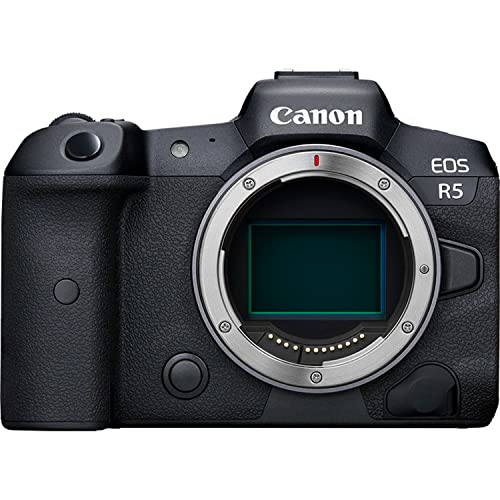
Canon EOS R5
- Best for: Canon photographers upgrading to a high-resolution body for landscape, studio and commercial stills.
- 45 MP full-frame CMOS sensor
- DIGIC X processor
- Dual Pixel CMOS AF II
- Up to 12 fps mechanical / 20 fps electronic
Canon photographers upgrading to a high-resolution body for landscape, studio and commercial stills.
This is a body-only listing, and RF lenses are a significant second investment for newcomers to the mount.
The EOS R5 remains the quality benchmark inside the Canon system. A 45 MP full-frame CMOS sensor and DIGIC X processor deliver files with deep cropping room, while Dual Pixel CMOS AF II keeps focus dependable across the frame. Bursts run to 12 fps mechanical or 20 fps electronic, sensor-shift 5-axis IBIS steadies handheld work, and 8K video is there when a stills camera must also film. At about 1.6 lb it is also the lightest body in this group, which matters on long location days.
Nikon Z 8
- Best for: Photographers who need flagship speed and 45 MP quality in the same weather-sealed body.
- 45.7 MP full-frame stacked CMOS sensor
- EXPEED 7 processor
- 8K/60p and 4K/120p RAW video
- 10-bit ProRes 422 HQ internal recording
Photographers who need flagship speed and 45 MP quality in the same weather-sealed body.
At about 2 lb before a lens, it is the heaviest full-frame body here and feels it on long hikes.
The Z 8 is what happens when a quality brief refuses to give up speed. Its 45.7 MP stacked full-frame sensor and EXPEED 7 processor push bursts to 120 fps, the electronic shutter removes mechanical vibration entirely, and the blackout-free viewfinder keeps the subject visible throughout. Dual card slots pair CFexpress Type B with UHS-II SD, a 4-axis tilting touchscreen serves awkward angles, and premium weather sealing suits outdoor work. Video is equally serious, with 8K/60p and 4K/120p RAW plus 10-bit ProRes 422 HQ recording.
Fujifilm GFX100 II
- Best for: Landscape, studio and fine-art photographers whose prints and clients demand maximum detail.
- 102 MP medium format CMOS II HS sensor, 43.8 x 32.9 mm
- X-Processor 5
- Up to 8 fps high-speed continuous shooting
- IBIS with up to 8 stops of stabilization
Landscape, studio and fine-art photographers whose prints and clients demand maximum detail.
Medium format lenses are large and the system is a commitment; nothing from a full-frame kit carries over.
The GFX100 II plays a different game: a 102 MP medium format sensor, 43.8 x 32.9 mm, gathering detail that full-frame cannot reach. X-Processor 5 drives continuous shooting up to 8 fps, IBIS holds up to 8 stops of stabilization, and AI-developed subject-detection and tracking AF keeps the big sensor honest on moving subjects. RAW, JPEG and HEIF capture gives flexibility in the edit, and the G mount lens range is built purely for this format. For prints measured in metres, this is the ceiling of this group.
Which One Fits Your Situation
You print landscapes at gallery sizes
Choose the Fujifilm GFX100 II. The 102 MP medium format sensor records texture and tonal steps that survive very large enlargements, and 8 stops of stabilization help when the light fades at the edges of the day. Accept the bigger system as the price of that ceiling. For a landscape-led practice, nothing else in this group comes close.
Your high-resolution subjects move
Take the Sony A7R V. The dedicated AI processing unit and Real-time Recognition AF exist precisely for this problem: 61 MP is wasted if focus lands behind the eye, and this body works hardest to put it in the right place at 10 fps with tracking. Wildlife and portrait shooters feel the benefit first.
You already shoot Canon and want the quality step
Pick the Canon EOS R5. It keeps you inside the RF system, delivers 45 MP files with Dual Pixel CMOS AF II, and adds 8K video for hybrid assignments. At about 1.6 lb it is also the easiest of these bodies to carry all day. Existing Canon shooters can upgrade the body without touching their lens shelf.
You refuse to choose between speed and detail
Go with the Nikon Z 8. A stacked sensor, 120 fps bursts and a blackout-free viewfinder bring action within reach of a 45.7 MP file, while dual card slots and weather sealing suit professional stills work in poor conditions. It is the most complete all-rounder here. Sports and wildlife work at this resolution is its home ground.
Common Mistakes
- Chasing the highest megapixel count without lenses and storage that support it.
- Taking a medium format body to fast action work it was never built for.
- Ignoring card slot formats until the first big shoot fills them.
- Handholding a 61 MP camera carelessly and blaming the sensor for soft files.
- Forgetting that file sizes multiply across backups, archives and deliveries.
Frequently Asked Questions
What makes a camera a quality-first camera?
A quality-first camera puts the still image above all else: a large, high-resolution sensor, processing that preserves detail, autofocus accurate enough to honour that resolution, and stabilization that keeps handheld frames sharp. All four bodies here qualify, from the 45 MP Canon EOS R5 to the 102 MP medium format Fujifilm GFX100 II.
Is medium format visibly better than full-frame?
For large prints and detailed studio work, yes. The Fujifilm GFX100 II sensor is physically much larger than a full-frame sensor, and its 102 MP files hold texture and tonal gradation that reward big enlargements. For screen use, albums and modest prints, the difference shrinks and the full-frame bodies here are more versatile.
How many megapixels do large prints actually need?
It depends on print size and viewing distance, but the 45 MP class bodies here already produce files that print sharply at sizes most homes and galleries use. Stepping to 61 MP or 102 MP buys cropping freedom and headroom for very large work rather than a visible jump at ordinary sizes.
Do quality-first cameras shoot good video too?
These four do. The Sony A7R V records 8K at 24p/25p and 4K at 60p, the Canon EOS R5 offers 8K video, and the Nikon Z 8 goes furthest with 8K/60p and 4K/120p RAW plus ProRes 422 HQ. Video is a genuine second strength here, not an afterthought.
Related guides
More from Amazon
Programs that pair well with the guide above. Offers and eligibility are set by Amazon and may change.
Free shipping on eligible items, Prime Video and more. Eligible new members can start with a free trial.
Start a Prime free trialAudiobooks and podcasts to listen to on the go. Eligible new members can start with a free trial.
Try Audible freeAd-free music streaming. Eligible new subscribers can start with a free trial.
Try Music Unlimited freeA free business account with business pricing and bulk-buying tools for work, shop or home office.
Create a business accountAs an Amazon Associate we earn from qualifying purchases.










Write Your Review
No reviews yet. Be the first to share your experience!