
Our Short List of 3

- Best for: New creators who want one kit that vlogs at a desk and still works as a family and travel stills camera.
- 24.2 MP APS-C CMOS sensor with DIGIC X image processor
- 4K video recording (2160p) with Dual Pixel CMOS AF and subject detection and tracking
- Kit lens: RF-S 18-45mm F4.5-6.3 IS STM
- 3-inch vari-angle touchscreen

- Best for: Style-led creators who want distinctive colour straight out of camera and a small body for filming on the go.
- 26.1 MP CMOS sensor; 10-bit depth
- 425-point autofocus with AI-based subject detection
- Film Simulation modes and creator-friendly video modes
- Three built-in microphones
- Best for: Established creators filming cinematic vlogs, interviews, and low-light content who already own or will buy E-mount lenses.
- 12.1 MP full-frame Exmor R CMOS sensor
- 4K recording up to 120p; 15+ stops of latitude per listing
- AI-based autofocus with eye tracking
- 3-inch screen
All 3 Picks at a Glance
| Product | Specs | Action |
|---|---|---|
| Canon EOS R50 with RF-S 18-45mm Lens |
| Check price on Amazon |
| FUJIFILM X-M5 with XC 15-45mm Lens |
| Check price on Amazon |
| Sony ZV-E1 (Body Only) |
| Check price on Amazon |
Key takeaways
- Four mirrorless vlogging cameras with flip screens, eye AF and mic inputs compared in detail, from the compact Sony ZV-E10 II to the full-frame ZV-E1.
What's inside
As an Amazon Associate I earn from qualifying purchases. This post may contain affiliate links at no extra cost to you.
A vlogging camera purchase usually comes down to one question: can you film yourself alone, week after week, without fighting the gear? That means a screen that flips toward you, autofocus that holds your eyes while you move, and a microphone input for the day the built-in audio stops being good enough. Resolution matters far less than those three things, yet it is what most buyers compare first.
This guide is for solo creators filming talking-head videos, product segments, and walk-and-talk clips at home or on the move. Every camera below is an interchangeable-lens mirrorless model picked from the names and specifications on its Amazon product page, and each one covers the flip screen, eye autofocus, and external audio basics in its own way.
Quick Picks
As an Amazon Associate we earn from qualifying purchases
| Product | Best for | Key spec from title |
|---|---|---|
| Sony ZV-E10 II with 16-50mm Lens | Solo creators who film product segments at a desk | 26 MP APS-C sensor, 4K 60p recording |
| Canon EOS R50 with RF-S 18-45mm Lens | First-time camera buyers upgrading from a phone | 24.2 MP APS-C sensor, 4K video |
| FUJIFILM X-M5 with XC 15-45mm Lens | Creators who want finished-looking colour straight from the camera | 26.1 MP sensor, Film Simulation modes |
| Sony ZV-E1 (Body Only) | Experienced vloggers filming in low light | 12.1 MP full-frame sensor, 4K 120p recording |
How to Choose
Screen design and self-framing
A side-hinged vari-angle screen is the feature you will use in every single video. It lets you check framing, focus, and exposure while standing in front of the lens, and it folds flat against the body when you pack the camera away. Screens that only tilt upward get blocked when a microphone sits in the hot shoe, which is a common setup once you add an external mic. All four cameras here use a side-flip design. Also check the touch controls: tapping to focus and adjusting settings from the screen speeds up solo filming, because reaching around to rear dials while recording is awkward and often shakes the shot.
Autofocus you can trust alone
When nobody stands behind the camera, autofocus does the focusing for you, so subject detection matters more than raw point counts. Look for face and eye detection that re-acquires you after you turn away, plus a product showcase style mode that shifts focus to an object you hold up, then returns to your face when you lower it. Sony lists Real-time Eye AF and tracking across its ZV line, Canon fits the R50 with Dual Pixel AF and subject detection, and Fujifilm lists AI-based subject detection on the X-M5. If you demonstrate small items on camera, that showcase behaviour is worth more than a higher frame rate.
Audio inputs and monitoring
Built-in microphones have improved — Sony’s ZV cameras and the X-M5 both use three-capsule arrays that can favour sound from the front — but a 3.5 mm microphone input is still the upgrade path for a shotgun or wireless mic. Confirm the camera has one before buying, and check whether it also offers a headphone jack for monitoring levels while you record. Not every model here does both. A windscreen for the internal mic is often included in the box and helps outdoors, yet it cannot match a dedicated microphone once wind or room echo becomes a problem.
Sensor size, lenses, and stabilisation
APS-C sensors in the ZV-E10 II, R50, and X-M5 balance size, lens choice, and background blur for desk setups. The full-frame ZV-E1 separates you from the background more strongly and holds up better in dim rooms, but its lenses are larger and the body-only listing means budgeting for one separately. None of these cameras should be bought on sensor size alone. Also weigh stabilisation honestly: most of these models lean on lens stabilisation plus digital correction rather than in-body stabilisation, so a small tripod or gimbal still matters for walking footage.
The 4 Best Options
Sony ZV-E10 II with 16-50mm Lens
The ZV-E10 II is the most complete desk-vlogging package in this group. Its listing highlights a Product Showcase style workflow through Real-time Eye AF and tracking, a three-capsule microphone with selectable direction, and a Cinematic Vlog setting for creators who want a finished look without grading. The included E PZ 16-50mm power zoom keeps the whole setup compact enough for a small desk tripod, and 4K 60p with 10-bit 4:2:2 recording leaves room to grow into colour work later. Vertical shooting is supported by the vari-angle screen’s rotating interface, which suits channels that also post short-form clips.
Specs
- 26 MP APS-C Exmor R CMOS sensor (back-illuminated)
- 4K up to 60p, 10-bit 4:2:2 recording; Full HD up to 120 fps in S&Q mode
- Real-time Eye AF for humans, animals, and birds; 759 autofocus points
- 3-inch vari-angle touchscreen LCD
- Intelligent 3-capsule microphone with windscreen included; mic jack, headphone jack, and digital audio via Multi Interface Shoe
- Kit lens: E PZ 16-50mm F3.5-5.6 OSS II
- Weight: 14.07 ounces (listing figure)
Best for: Solo creators filming product reviews and talking-head videos who want strong autofocus and audio options in one kit.
Watch out for: There is no in-body stabilisation, so handheld walking shots rely on the lens and digital correction; it also has a single memory card slot.
ASIN: B0D92VDW76
Canon EOS R50 with RF-S 18-45mm Lens
- Best for: New creators who want one kit that vlogs at a desk and still works as a family and travel stills camera.
- 24.2 MP APS-C CMOS sensor with DIGIC X image processor
- 4K video recording (2160p) with Dual Pixel CMOS AF and subject detection and tracking
- Kit lens: RF-S 18-45mm F4.5-6.3 IS STM
- 3-inch vari-angle touchscreen
New creators who want one kit that vlogs at a desk and still works as a family and travel stills camera.
The kit lens aperture of F4.5-6.3 is slow for dim rooms, and there is no headphone jack for monitoring audio while recording.
The R50 is the easiest starting point for someone moving up from a phone. Canon’s listing leads with a 24.2 megapixel APS-C sensor and DIGIC X processor, and the kit lens covers everyday framing without a separate purchase. The vari-angle touchscreen, subject detection and tracking, and a proper electronic viewfinder give beginners two ways to compose — screen for vlogging, viewfinder for photos and bright outdoor work. Its 4K video is oversampled, which keeps talking-head footage looking crisp, and the camera handles automatic exposure well enough that new users can publish before they learn manual settings.
FUJIFILM X-M5 with XC 15-45mm Lens
- Best for: Style-led creators who want distinctive colour straight out of camera and a small body for filming on the go.
- 26.1 MP CMOS sensor; 10-bit depth
- 425-point autofocus with AI-based subject detection
- Film Simulation modes and creator-friendly video modes
- Three built-in microphones
Style-led creators who want distinctive colour straight out of camera and a small body for filming on the go.
Stabilisation is digital only per the listing, and there is no electronic viewfinder, so bright outdoor framing relies on the rear screen.
The X-M5 suits creators whose channel identity leans on colour and a film-like look. Fujifilm’s listing emphasises its Film Simulation modes — the same looks found on the X100VI and X-T50 — alongside a dedicated short-video workflow and three built-in microphones for cleaner sound without extra gear. The 26.1 MP sensor and AI-powered autofocus with 425-point coverage keep faces sharp, and the compact body with the XC 15-45mm power zoom is easy to carry for travel vlogs. Connectivity through the FUJIFILM XApp makes moving vertical or square clips to a phone straightforward for social posting.
Sony ZV-E1 (Body Only)
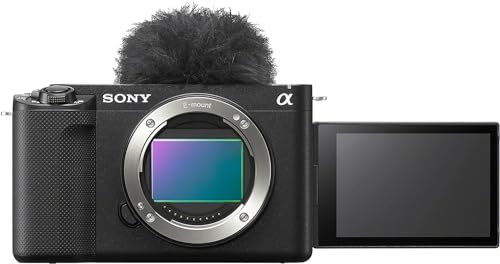
- Best for: Established creators filming cinematic vlogs, interviews, and low-light content who already own or will buy E-mount lenses.
- 12.1 MP full-frame Exmor R CMOS sensor
- 4K recording up to 120p; 15+ stops of latitude per listing
- AI-based autofocus with eye tracking
- 3-inch screen
Established creators filming cinematic vlogs, interviews, and low-light content who already own or will buy E-mount lenses.
This is a body-only listing, so no lens is included, and the 12.1 MP stills resolution leaves little room for heavy photo cropping.
The ZV-E1 is the step-up option for vloggers who film in available light and want the full-frame look. Its listing describes a 12.1 MP full-frame Exmor R sensor optimised for 4K, with more than 15 stops of latitude and AI-based autofocus, in a body that stays compact for a full-frame camera. Recording reaches 4K 120p for slow-motion B-roll, and the sensor’s low-light performance means evening and indoor footage holds together without heavy lighting. Because this listing is body only, it fits creators who already own Sony E-mount lenses or plan to choose a specific prime for their style of video.
Which One Fits Your Situation
You film product reviews at a desk
Choose the Sony ZV-E10 II. Its autofocus shifts between your face and an item you hold toward the lens, the directional three-capsule microphone favours your voice from the front, and the headphone jack lets you confirm levels before a long take. The included power zoom lens covers close product shots and wider desk framing without a lens swap mid-session.
You are buying your first real camera
Start with the Canon EOS R50 kit. It arrives ready to film with a lens in the box, its automatic modes are forgiving while you learn, and the viewfinder helps when you take the camera outdoors for photos. You give up some advanced video formats, but for a first year of weekly uploads, simplicity and reliable face tracking matter more.
You post short vertical clips as often as long videos
Look at the FUJIFILM X-M5 or the ZV-E10 II. Both are built around quick, social-ready workflows: the X-M5 adds Film Simulation colour and three built-in microphones for run-and-gun clips, while the Sony’s vari-angle screen rotates its interface for vertical framing. Pick the Fujifilm if colour style is your signature; pick the Sony if product showcase focus behaviour matters more.
You film at night or in moody indoor light
The Sony ZV-E1 earns its place here. The full-frame sensor and wide latitude keep skin tones and shadows usable in cafés, evening streets, and dim rooms where the APS-C models start to struggle. Pair it with a fast prime lens and you can keep filming in places where the other three would need added lighting.
Common Mistakes
- Buying on maximum resolution alone, then discovering the camera lacks a microphone input or a screen that faces forward.
- Assuming every kit lens suits a small room; a 15mm or 16mm starting focal length frames a desk setup far more easily than longer kit zooms.
- Ignoring stabilisation type — digital-only or lens-based correction crops the frame and still cannot match a tripod for static talking-head shots.
- Forgetting the extras in the budget: a body-only camera still needs a lens, and every model here needs fast memory cards for its higher video modes.
- Mounting a shotgun microphone in the hot shoe without checking whether it blocks a tilt-up screen or the flip screen’s rotation.
Frequently Asked Questions
Do I need 4K for a video blog?
No, but it helps. Filming in 4K lets you crop to a tighter framing in editing without obvious quality loss, which is useful when you shoot alone and cannot reframe mid-take. All four cameras here record 4K. If your workflow is fast and storage is limited, their Full HD modes remain perfectly publishable for talking-head content.
Is a flip screen really necessary for vlogging?
For solo filming, effectively yes. Without a forward-facing screen you cannot confirm framing, focus, or whether you are even recording until you walk around the camera. Every camera in this guide uses a side-flip vari-angle screen, which also avoids the problem of a top-mounted microphone blocking a tilt-up display.
APS-C or full-frame for a new channel?
APS-C is the sensible default. The ZV-E10 II, R50, and X-M5 are smaller, their lenses are more affordable, and their image quality is well beyond what a new channel needs. Full-frame, as in the ZV-E1, pays off when you regularly film in low light or want stronger background separation, not as a first purchase.
Can these cameras livestream or work as webcams?
Yes, within limits. These models support USB connectivity and clean HDMI output per their listings, so they can feed a computer for streaming or calls with far better quality than a built-in webcam. Check the listing for your chosen model, and plan on a dummy battery or USB power for sessions longer than a typical recording.
Related guides
More from Amazon
Programs that pair well with the guide above. Offers and eligibility are set by Amazon and may change.
Free shipping on eligible items, Prime Video and more. Eligible new members can start with a free trial.
Start a Prime free trialAudiobooks and podcasts to listen to on the go. Eligible new members can start with a free trial.
Try Audible freeAd-free music streaming. Eligible new subscribers can start with a free trial.
Try Music Unlimited freeA free business account with business pricing and bulk-buying tools for work, shop or home office.
Create a business accountAs an Amazon Associate we earn from qualifying purchases.










Write Your Review
No reviews yet. Be the first to share your experience!