
Our Short List of 3

- Best for: New espresso owners who also brew filter coffee and want one grinder for both.
- Burrs: 40mm conical steel burrs (M2), manufactured in Europe, from the listing
- Grind settings: 40 total, split between an espresso-fine micro range (1-20) and a brew macro range (21-40)
- Hopper capacity: 300g (10.6 oz), from the listing
- Grounds bin capacity: 120g (4.2 oz), from the listing
- Best for: A dedicated home espresso bar where small grind changes are a daily habit.
- Burrs: conical burr set, with the outer ring burr rotating around a stationary cone burr, from the listing
- Grind settings: 270, from 30 macro steps plus 9 micro settings
- Dosing: 3 programmable dosing buttons, accurate to within a 10th of a second; digital panel settings within 0.01 second
- Grind speed: up to 5g per second, with minimal retention in the straight-thru grind mechanism

- Best for: Drinkers who weigh every dose and split their brewing between espresso and filter methods.
- Burrs: conical burr, from the product title on the listing
- Grind settings: 41 settings, for espresso, drip, French press, and cold brew, from the title
- Loading style: single dose loading, from the listing
- Hopper capacity: 110 grams, from the listing copy
All 4 Picks at a Glance
| Product | Specs | Action |
|---|---|---|
| Baratza Encore ESP Coffee Grinder |
| Check price on Amazon |
| Baratza Sette 270 Conical Burr Coffee Grinder |
| Check price on Amazon |
| Fellow Opus Conical Burr Coffee Grinder |
| Check price on Amazon |
 Breville Smart Grinder Pro BCG820BSS |
| Check price on Amazon |
Key takeaways
- The best conical burr espresso grinders overall, covering dial-in range, dosing style and hopper size, with every specification taken from its Amazon listing.
What's inside
As an Amazon Associate I earn from qualifying purchases. This post may contain affiliate links at no extra cost to you.
Buying a conical burr espresso grinder comes down to one practical question: can this machine make the small, repeatable grind changes that espresso demands, day after day, without fighting you? Espresso punishes coarse adjustment steps, because a single notch can turn a balanced shot sour or bitter, and it punishes vague dosing, because the same setting with a different amount of coffee is a different drink. Burr shape alone settles nothing. What separates the models below is adjustment resolution, dosing method, and how the daily routine actually flows.
This overview is for first-time espresso buyers choosing a grinder that will not hold their machine back, and for owners of a basic grinder whose shots swing from fast to choked with no setting in between. The shortlist was built from product names and specifications on Amazon listing pages, keeping only models whose own listing states conical burrs and espresso use. The four that remain cover the main buying shapes: a dual-range all-rounder, a high-resolution dial-in specialist, a single-dose all-purpose model, and a timed hopper grinder.
Quick Picks
As an Amazon Associate we earn from qualifying purchases.
| Product | Best for | Key spec from title |
|---|---|---|
| Baratza Encore ESP Coffee Grinder | A first espresso grinder that also brews filter coffee | 40 grind settings with an espresso micro range |
| Baratza Sette 270 Conical Burr Coffee Grinder | Fine dial-in control for a dedicated espresso bar | 270 grind settings |
| Fellow Opus Conical Burr Coffee Grinder | Single-dose grinding across every brew method | Espresso grinder with 41 settings |
| Breville Smart Grinder Pro BCG820BSS | Timed dosing from a large hopper | 60 precise grind settings |
How to Choose
Adjustment resolution matters more than the headline count
A big settings number only helps if the steps near espresso fineness are small. Espresso lives in a narrow band, and the useful question is how finely the adjustment is spaced inside that band. One approach splits the dial into two ranges, with closely spaced steps reserved for espresso and wider steps for brewing. Another stacks hundreds of macro and micro combinations over the same burrs. Either can work. What fails is a dial where one click jumps from a fast shot to a choked basket, leaving the right grind sitting between two steps.
Pick a dosing style you will repeat happily
Listings describe three broad dosing styles, and each shapes your mornings differently. Programmable timed buttons store a dose duration and repeat it at a touch, which suits a household making the same drink repeatedly. A precision timer adjusted in small increments does similar work with a single setting rather than stored presets. Single-dose loading skips timers entirely: you weigh beans in, and the same weight comes out. None is universally better, but a style you find fiddly will quietly degrade into guesswork, so choose the routine you can picture doing half awake.
Match hopper size to how you buy coffee
Hopper capacity in these listings ranges from a small load-and-go chamber to a full 18 ounce supply. A large hopper rewards buying one bag and working through it, and a locking hopper that lifts off cleanly makes the eventual changeover tidier. A small chamber suits weighed doses and keeps beans in the bag, where they stay fresher, at the cost of reloading for every drink. Consider also where grounds land: a portafilter cradle or dosing cup sized for 54mm and 58mm baskets keeps the transfer short and reduces the scatter that a loose bin invites.
Check the burr description on the listing itself
Conical burr is a claim worth verifying on the exact model you are buying, because brands sell sibling grinders with flat burrs under similar names. The listings used here state the burr type in their own wording, along with details such as 40mm conical steel burrs or stainless steel conical burrs. Burr size and material are worth noting, but treat them as context rather than a score: adjustment quality and dosing consistency shape your shots more directly than a few millimetres of burr diameter, and no listing figure predicts how a grinder will taste with your beans.
The 4 Best Options
Baratza Encore ESP Coffee Grinder
- Best for: New espresso owners who also brew filter coffee and want one grinder for both.
- Burrs: 40mm conical steel burrs (M2), manufactured in Europe, from the listing
- Grind settings: 40 total, split between an espresso-fine micro range (1-20) and a brew macro range (21-40)
- Hopper capacity: 300g (10.6 oz), from the listing
- Grounds bin capacity: 120g (4.2 oz), from the listing
New espresso owners who also brew filter coffee and want one grinder for both.
The espresso range has twenty steps, so a very fussy machine and bean pairing may leave you wishing for adjustment between two steps.
The Encore ESP is the balanced starting point of this group. Baratza’s listing calls it a go-to entry-level home coffee grinder, optimized for espresso, and the design backs that positioning: settings 1 to 20 sit in a finely spaced micro range built for dialling in shots, while settings 21 to 40 open out for brewing up to cold brew. You get a grounds bin for batch brewing and an espresso dosing cup for portafilter work, so one machine covers a household that pulls shots on weekdays and brews a pot on Sundays.
Baratza Sette 270 Conical Burr Coffee Grinder
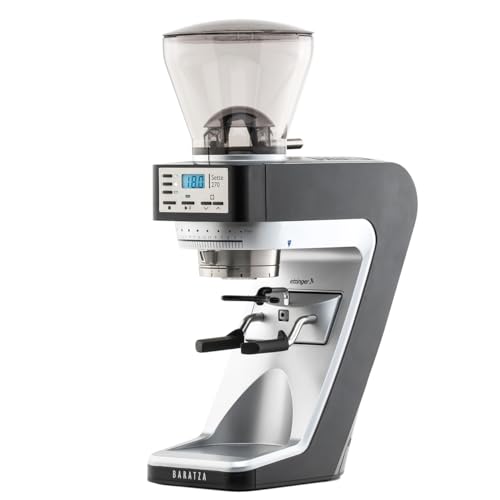
- Best for: A dedicated home espresso bar where small grind changes are a daily habit.
- Burrs: conical burr set, with the outer ring burr rotating around a stationary cone burr, from the listing
- Grind settings: 270, from 30 macro steps plus 9 micro settings
- Dosing: 3 programmable dosing buttons, accurate to within a 10th of a second; digital panel settings within 0.01 second
- Grind speed: up to 5g per second, with minimal retention in the straight-thru grind mechanism
A dedicated home espresso bar where small grind changes are a daily habit.
Speed and resolution come with a busier routine of programming buttons and tracking micro settings, which casual drinkers may never use.
Where the Encore ESP splits its range in two, the Sette 270 multiplies it. Thirty macro steps combined with nine micro settings produce the 270 grind settings in its name, and the listing ties that range to precise dial-in for espresso styles from dense, syrupy shots to high-yield, tea-like extractions. Dosing is programmable across three buttons, accurate to within a 10th of a second, and the straight-through mechanism drops grounds directly into a portafilter or bin at up to 5g per second, which keeps a morning queue of drinks moving.
Fellow Opus Conical Burr Coffee Grinder
- Best for: Drinkers who weigh every dose and split their brewing between espresso and filter methods.
- Burrs: conical burr, from the product title on the listing
- Grind settings: 41 settings, for espresso, drip, French press, and cold brew, from the title
- Loading style: single dose loading, from the listing
- Hopper capacity: 110 grams, from the listing copy
Drinkers who weigh every dose and split their brewing between espresso and filter methods.
Back-to-back drinks for guests mean weighing and loading each dose separately, which is slower than grinding from a full hopper.
Fellow takes the opposite route to the big-hopper models: the Opus is built around single dose loading, so the dose you weigh is the dose you grind. Its Amazon title identifies it as a conical burr coffee grinder and an espresso grinder with 41 settings, and the stated range runs from espresso through drip and French press to cold brew. For a buyer whose espresso machine shares counter space with a pour-over setup, that breadth means one grinder, one dial to learn, and no standing hopper of beans going stale between uses.
Breville Smart Grinder Pro BCG820BSS
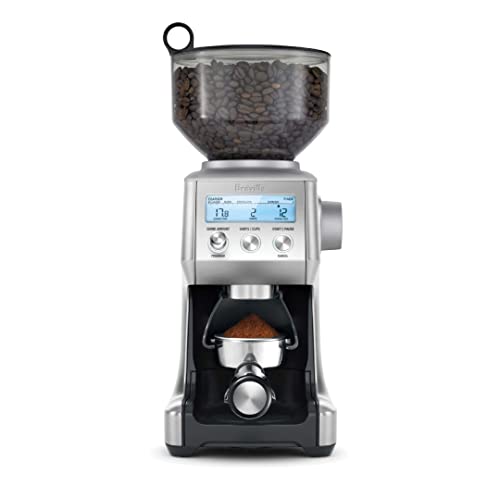
- Best for: Households that want timed, repeatable doses from a large hopper with a clear display.
- Burrs: stainless steel conical burrs, designed to minimize grinding heat, from the listing
- Grind settings: 60 precise grind settings, from the finest espresso to the coarsest French press grind
- Timer: precision electronic timer, adjustable in 0.2 second increments
- Hopper: 18 ounce coffee bean capacity with a locking system for easy removal, storage, and transfer
Households that want timed, repeatable doses from a large hopper with a clear display.
Timed dosing drifts as beans age and settings change, so the timer supports consistency rather than replacing an occasional weighed check.
Breville’s model is the appliance-style option in this group, organised around an LCD display and timed dosing. The listing promises 60 precise grind settings from the finest espresso to the coarsest French press grind, with a precision electronic timer that adjusts in 0.2 second increments for a consistent dose. An 18 ounce hopper with a locking system feeds the stainless steel conical burrs, and the box approach extends to grinding directly into a portafilter, the grinds container, a gold tone filter basket, or paper filter, depending on what you are brewing.
Which One Fits Your Situation
You are buying your first espresso grinder
Start with the Baratza Encore ESP. The split range puts a clear boundary around the espresso settings, so learning to dial in feels structured instead of open-ended, and the same machine still brews filter coffee well enough that you are not buying twice. The dosing cup keeps the early, messy weeks tidier while you build a routine.
You already dial in by taste and want finer control
Move to the Baratza Sette 270. Its macro and micro stacking gives you somewhere to go when a shot sits between two ordinary steps, and the programmable buttons store doses for the drinks you make most. This is the pick for an owner who adjusts grind as beans age and notices the difference a small change makes.
Your counter hosts several brew methods
Choose the Fellow Opus. Espresso in the morning, pour-over at lunch, and cold brew steeping for tomorrow can all come from its 41 settings, and single-dosing means none of those drinks starts with beans that have sat in a hopper all week. It rewards a weigh-everything habit across every method, not just espresso.
Your household drinks the same coffee every morning
Take the Breville Smart Grinder Pro. A large locking hopper, a timer you can nudge in small increments, and a display that shows where you are make the weekday routine nearly automatic. It is the least fussy fit for a home where the goal is a reliable drink before work rather than an ongoing dial-in project.
Common Mistakes
- Choosing by total setting count without checking how finely the steps are spaced at espresso fineness.
- Pairing a capable espresso machine with a grinder whose steps jump over the right grind, then blaming the machine for sour shots.
- Storing a full hopper of beans for weeks and expecting the first and last shots from the bag to behave the same way.
- Changing dose and grind setting in the same step, which hides which adjustment fixed or broke the shot.
- Ignoring basket size when comparing dosing accessories, then finding the included cup or cradle does not fit your portafilter.
Frequently Asked Questions
Why choose a conical burr grinder for espresso?
Conical burr models dominate the home espresso shelves used for this guide, and their listings emphasise fine, closely spaced adjustment at espresso settings along with compact counter footprints. The practical reason to choose one is the combination of that adjustment style and the dosing routines built around it. Burr shape by itself does not guarantee a good shot, so judge each model on its settings, dosing, and workflow rather than the label alone.
How many grind settings does an espresso grinder need?
Enough that the steps near espresso fineness are small, which is not the same as a large total. A grinder with a dedicated, finely spaced espresso range can dial in well with fewer overall settings than a wide-range model whose steps stay coarse throughout. Use the listings as your guide: look for an espresso or micro range described in the manufacturer’s own wording, not just a big number in the product name.
Should I dose by time or by weight?
Timed dosing repeats a duration, and it works well once a bean is dialled in, especially with stored presets or a timer adjustable in small increments. Weighing each dose, as single-dose loading encourages, controls the amount directly and copes better when you change beans often. Many home baristas combine both: weigh while dialling in a new bag, then let the timer repeat the dose once the setting settles.
Can one of these grinders also handle filter coffee?
Yes, and the listings say so in their own terms. Models here describe ranges running from espresso to French press or cold brew, with brew or macro ranges separated from the espresso settings on some and a single wide dial on others. Expect to move the setting a long way between methods and to purge a small amount when returning to espresso fineness, so the first shot after a filter session is not carrying coarse leftovers.
Related guides
More from Amazon
Programs that pair well with the guide above. Offers and eligibility are set by Amazon and may change.
Free shipping on eligible items, Prime Video and more. Eligible new members can start with a free trial.
Start a Prime free trialAudiobooks and podcasts to listen to on the go. Eligible new members can start with a free trial.
Try Audible freeAd-free music streaming. Eligible new subscribers can start with a free trial.
Try Music Unlimited freeA free business account with business pricing and bulk-buying tools for work, shop or home office.
Create a business accountAs an Amazon Associate we earn from qualifying purchases.










Write Your Review
No reviews yet. Be the first to share your experience!