
Our Short List of 3
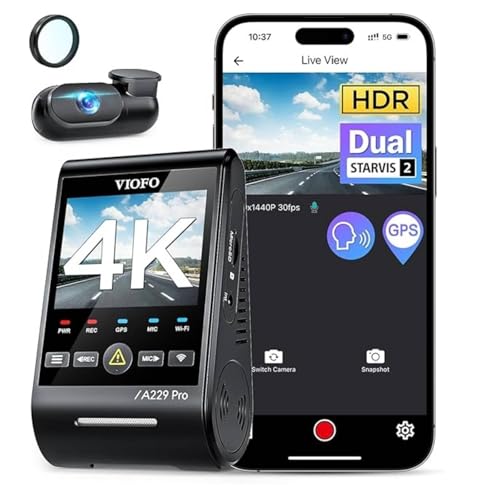
- Best for: Drivers who cover motorway miles and want rear plates readable at night.
- Front recording: 4K (2160p); rear recording: 2K (1440p)
- Sensors: Sony STARVIS 2 IMX678 front and IMX675 rear
- HDR recording with Night Vision 2.0
- Display: 2.4-inch LCD screen

- Best for: Drivers who park on the street and want buffered parking evidence without paying for a 2K rear channel.
- Front recording: 4K (3840 x 2160); rear recording: 1080p
- Sensor: Sony 8MP, f/1.6 aperture
- Buffered parking mode with G-sensor and motion detection
- 5GHz Wi-Fi for video downloading
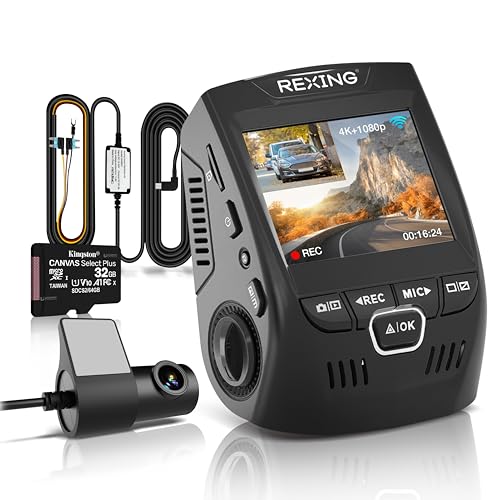
- Best for: Drivers in very hot or cold regions who want the widest possible front view.
- Dual-channel recording: 4K front and 1080p rear
- Lens: 170-degree wide angle with WDR
- Display: 2.4-inch LCD screen
- Built-in Wi-Fi with mobile app control
All 3 Picks at a Glance
| Product | Specs | Action |
|---|---|---|
| VIOFO A229 Pro 2CH |
| Check price on Amazon |
| VIOFO A129 Pro Duo |
| Check price on Amazon |
| RexingUSA V1P 4K |
| Check price on Amazon |
Key takeaways
- Compare the best front and rear dash cams with 4K front recording, HDR night vision, GPS and parking mode, plus the checks to make before you buy a dual system.
What's inside
As an Amazon Associate I earn from qualifying purchases. This post may contain affiliate links at no extra cost to you.
A front-only dash cam tells half the story of the most disputed kind of crash: the rear-end shunt in traffic, where each driver blames the other. Adding a rear camera settles who was following too closely and whether you were pushed into the car ahead, so the real decision is not whether to buy two channels but how much rear detail, night clarity and parked coverage you actually need. Paying for a sharper front sensor while accepting a weak rear feed is the mistake most buyers make.
This guide is for daily commuters, parents sharing one family car, and drivers who park on the street and want evidence while the car is unattended. Every system below is a true front-and-rear package with the rear camera included in the listing, chosen from the specifications and box contents published on its Amazon product page. The three picks split into a high-detail option, a value option with buffered parking recording, and a wide-angle option built for hot climates.
Quick Picks
As an Amazon Associate we earn from qualifying purchases.
| Product | Best for | Key spec from title |
|---|---|---|
| VIOFO A229 Pro 2CH | Drivers who want the clearest rear footage | 4K front + 2K rear, Dual STARVIS 2 |
| VIOFO A129 Pro Duo | Street parking with buffered event capture | 4K front + 1080P rear, Buffered Parking Mode |
| RexingUSA V1P 4K | Hot climates and the widest view | 4K + 1080p dual channel, 170° wide angle |
How to Choose
Rear Resolution Is the Real Dividing Line
Front cameras in this class nearly all record 4K, so the specification that actually separates dual systems is the rear channel. A 1080p rear camera reads plates at low speed and in good light, but at night or on a fast road its footage can soften exactly when you need a registration number. A 2K rear camera keeps more detail at distance and after dark. Decide by where you drive: mostly daylight city trips forgive a 1080p rear unit, while regular motorway miles or unlit rural roads argue for the higher-resolution rear sensor every time.
Night Sensors and HDR Matter More Than the Front Badge
Low-light performance comes from the sensor and dynamic range, not from the resolution printed on the box. Sony STARVIS and STARVIS 2 sensors are built to gather more light per pixel, and HDR recording balances a dark road against bright oncoming headlights so plates stay readable instead of blowing out white. Compare the sensor names on both channels, because some systems pair a strong front sensor with a basic rear one. If your driving is mostly after dark, treat rear HDR as a requirement rather than a bonus feature.
Parking Mode Is a Power Decision, Not a Menu Setting
Every parking mode in this roundup needs a constant power source, which in practice means a hardwire kit connected to the fuse box, and that kit is usually sold separately. Buffered recording is the premium version: the camera keeps a rolling buffer and saves footage from before the impact as well as after it, which shows what led up to a hit-and-run. Also check the power source inside the camera itself. A supercapacitor tolerates a hot windshield far better than a lithium battery, which can swell and shorten the camera’s life in a sun-baked car.
Card Size, Wi-Fi and GPS Decide Daily Usability
Two channels recording for hours each day fill memory cards quickly, and dual footage also wears cheap cards out. Check the maximum card size each camera accepts and budget for a high-endurance card in that capacity. Wi-Fi with an app saves you pulling the card to reach a clip, and 5GHz Wi-Fi transfers noticeably faster than 2.4GHz. GPS logging stamps speed and route into your evidence, but on some models the GPS lives in the mount while on others it is a separate add-on, so confirm what is actually inside the box before ordering.
The 3 Best Options
VIOFO A229 Pro 2CH
- Best for: Drivers who cover motorway miles and want rear plates readable at night.
- Front recording: 4K (2160p); rear recording: 2K (1440p)
- Sensors: Sony STARVIS 2 IMX678 front and IMX675 rear
- HDR recording with Night Vision 2.0
- Display: 2.4-inch LCD screen
Drivers who cover motorway miles and want rear plates readable at night.
The HK4 hardwire kit is a separate purchase, so factor it in if you want parking mode from day one.
The A229 Pro 2CH is the pick when rear footage quality is the priority, because it pairs a 4K front camera with a 2K rear camera instead of the usual 1080p rear unit. Both channels use Sony STARVIS 2 sensors with HDR, so night footage front and back holds plate detail better than older dual systems. Voice control keeps your hands on the wheel, the 5GHz Wi-Fi moves clips to a phone quickly, and a polarizing filter is already in the box to cut windshield glare during the day.
VIOFO A129 Pro Duo
- Best for: Drivers who park on the street and want buffered parking evidence without paying for a 2K rear channel.
- Front recording: 4K (3840 x 2160); rear recording: 1080p
- Sensor: Sony 8MP, f/1.6 aperture
- Buffered parking mode with G-sensor and motion detection
- 5GHz Wi-Fi for video downloading
Drivers who park on the street and want buffered parking evidence without paying for a 2K rear channel.
Parking mode needs the VIOFO HK3 hardwire cable kit, which is sold separately.
The A129 Pro Duo has been a default dual-channel recommendation for years because it gets the fundamentals right: genuine 4K up front, a 1080p rear camera in the box, and a buffered parking mode that saves the seconds before an impact as well as after it. Its supercapacitor design suits cars that sit in the sun, the GPS module is included rather than sold separately, and dual-band Wi-Fi makes pulling a clip to your phone painless. It gives up rear resolution to the newer A229 Pro, but for mixed town driving it covers the evidence bases well.
RexingUSA V1P 4K
- Best for: Drivers in very hot or cold regions who want the widest possible front view.
- Dual-channel recording: 4K front and 1080p rear
- Lens: 170-degree wide angle with WDR
- Display: 2.4-inch LCD screen
- Built-in Wi-Fi with mobile app control
Drivers in very hot or cold regions who want the widest possible front view.
GPS is not built into this listing, so add the separate GPS logger if you need speed and route data in your footage.
The RexingUSA V1P 4K takes a different approach: instead of chasing rear resolution, it spreads a 170-degree lens across the front view so neighbouring lanes and junctions are inside the frame. The rear camera records 1080p, Wi-Fi and the mobile app handle clip transfers, and the supercapacitor is rated for a much wider temperature range than most, which matters in cars parked through desert summers or cold winters. GPS logging is the compromise here, since the logger is an optional extra rather than part of this listing.
Which One Fits Your Situation
You Were Rear-Ended Once and Want Proof Next Time
Choose the VIOFO A229 Pro 2CH. A rear-end claim usually turns on the following driver’s behaviour in the seconds before impact, and this system’s 2K rear camera with a STARVIS 2 sensor keeps plates and brake lights clear in more conditions than a 1080p rear unit. The front 4K channel also records whether you had anywhere to go, which completes the picture an insurer actually needs.
Your Car Sleeps on the Street Every Night
Choose the VIOFO A129 Pro Duo and budget for its hardwire kit. Its buffered parking mode saves footage from before a bump as well as after, which is the difference between seeing a car reverse into yours and seeing only the aftermath. The supercapacitor also tolerates the temperature swings of a car that never sees a garage, and the included GPS module means one less accessory to buy.
You Park in Serious Heat or Bitter Cold
Choose the RexingUSA V1P 4K. Its supercapacitor is rated to operate from well below freezing to temperatures that would stress a battery-based camera left on a summer windshield, and supercapacitors do not swell with age the way lithium cells can. The wide 170-degree lens also helps in the tight parking lots and junctions where low-speed bumps in extreme-weather driving tend to happen.
You Want the Simplest First Dual-Channel Install
Choose the VIOFO A129 Pro Duo if you are fitting a dash cam for the first time. Everything essential is in the box, including the GPS module and a trim removal tool for tucking the rear cable along the headlining. The menu and screen are straightforward, and because the model has been sold for years, installation guides for almost every common car are easy to find before you start.
Common Mistakes
- Buying on front resolution alone and ignoring the rear channel, which is the footage a rear-end claim depends on.
- Assuming parking mode works from the box, when most systems need a hardwire kit that is sold separately.
- Fitting a bargain memory card that cannot sustain two channels of continuous recording and corrupts clips.
- Mounting the rear camera before checking the cable length against the route through your specific car.
- Choosing a battery-powered camera for a car that parks in direct sun, where heat shortens battery life.
Frequently Asked Questions
Do the front and rear cameras record at the same time?
Yes. Every system in this guide records both channels simultaneously to the same memory card, so a single incident produces matching front and rear files with the same timestamp. That pairing is the whole point of a dual system: an insurer can watch what happened ahead of you and behind you as one continuous event rather than two unrelated clips.
Do I need a hardwire kit for parking mode?
In most cases, yes. Parking modes need power while the engine is off, and the 12V socket in most cars switches off with the ignition. A hardwire kit connects the camera to the fuse box and usually adds low-voltage protection for the car battery. All three systems here treat that kit as a separate accessory, so check the listing for your chosen model before ordering.
What size memory card should I buy for a dual dash cam?
Buy the largest high-endurance card the camera supports if you drive daily, because two channels fill space quickly and loop recording constantly rewrites the card. The VIOFO models here accept up to 512GB, while the RexingUSA V1P accepts up to 256GB. Whatever the capacity, choose a card rated for continuous dash cam or surveillance use rather than a standard phone card.
Can I watch and download footage on my phone?
Yes, all three systems have Wi-Fi and a companion app for live view, playback and downloads. The two VIOFO models use 5GHz Wi-Fi, which transfers large 4K clips noticeably faster than older 2.4GHz connections. For a quick check at the roadside the app is ideal, but for reviewing a long trip the memory card in a computer is still the faster route.
Related guides
More from Amazon
Programs that pair well with the guide above. Offers and eligibility are set by Amazon and may change.
Free shipping on eligible items, Prime Video and more. Eligible new members can start with a free trial.
Start a Prime free trialAudiobooks and podcasts to listen to on the go. Eligible new members can start with a free trial.
Try Audible freeAd-free music streaming. Eligible new subscribers can start with a free trial.
Try Music Unlimited freeA free business account with business pricing and bulk-buying tools for work, shop or home office.
Create a business accountAs an Amazon Associate we earn from qualifying purchases.










Write Your Review
No reviews yet. Be the first to share your experience!