
Our Short List of 3

- Best for: Landowners who need two viewpoints covered immediately, such as an entrance gate plus an equipment shed.
- Photo resolution: 36MP, including on-demand captures
- Video resolution: 1080p with HD audio
- Trigger speed: 0.40 seconds
- Detection and flash range: 100 ft
- Best for: A first camera on new or unfamiliar land, where automatic carrier switching removes the coverage gamble.
- Photo resolution: 8MP true resolution, up to 3264 x 2448
- Video resolution: 1080p with sound (cellular transmission up to 1024p)
- Detection range: 80 ft PIR
- Flash range: 60 ft, invisible blackout IR LED
- Best for: Wildlife research and close identification work, where 40MP stills, QHD video and live viewing justify a more capable camera.
- Photo resolution: 40MP, selectable between 4MP, 8MP, 16MP and 40MP
- Video resolution: 1440p QHD with audio
- Trigger speed: 0.3 seconds
- Detection and flash range: 100 ft
All 3 Picks at a Glance
| Product | Specs | Action |
|---|---|---|
| Moultrie Edge 2 Cellular Trail Camera (2-Pack) |
| Check price on Amazon |
| Spartan Camera GoCam2 Cellular (Multi-Carrier) |
| Check price on Amazon |
| Stealth Cam Deceptor Max 2.0 |
| Check price on Amazon |
Key takeaways
- Compare the best cellular trail cameras for remote land, research plots and property checks, with carrier options, detection ranges and real Amazon specs.
What's inside
As an Amazon Associate I earn from qualifying purchases. This post may contain affiliate links at no extra cost to you.
A cellular trail camera is two purchases in one: the camera itself, and the carrier connection that decides whether a photo ever reaches your phone. On remote land, the second purchase matters more. A camera mounted where its carrier has no usable signal is just an ordinary trail camera with an antenna, and you may not learn it failed until you drive out to check. The real decision is matching the camera’s network approach, detection range and power setup to the ground it has to watch, unattended, for weeks at a time.
This guide is for landowners checking gates, fences and outbuildings, wildlife researchers running remote study plots, and hunters who scout without leaving scent on a site. Every pick is a cellular model sold on Amazon US, chosen from the specifications on its product page: a two-camera pack that connects to the strongest network automatically, a multi-carrier camera for places where coverage is a guess, and a dual-SIM model with the sharpest capture of the three.
Quick Picks
As an Amazon Associate we earn from qualifying purchases.
| Product | Best for | Key spec from title |
|---|---|---|
| Moultrie Edge 2 Cellular Trail Camera (2-Pack) | Watching two gates or crossings on one property from day one | 36MP photo and 100 ft detection range |
| Spartan Camera GoCam2 Cellular (Multi-Carrier) | New land where you do not know which carrier reaches the site | 8MP photo and 80 ft detection range |
| Stealth Cam Deceptor Max 2.0 | Research plots where image detail decides what you can identify | 40MP photo and 1440p QHD video |
How to Choose
Carrier Coverage at the Exact Mounting Site
Cellular cameras are not interchangeable on networks. Some are locked to one carrier, some carry SIMs for AT&T and Verizon, and auto-connect or multi-carrier models pick the strongest signal where they are mounted. Signal at the farmhouse tells you nothing about signal at a back fence line or a creek crossing, so check coverage at the tree you actually plan to use. If you manage several properties in different counties, a camera that switches carriers saves you from stocking two different models and swapping hardware when a site changes hands or a lease moves.
Photo Resolution Versus What Actually Transmits
The megapixel figure on the box describes what the sensor saves, not always what arrives on your phone. Cellular plans typically send a smaller preview first, with full-resolution files available on request or by download. For land checks, a clear preview is usually enough to see a vehicle at a gate. For research, where you may need to read a collar, tag or subtle marking, on-demand photo and video requests and high-resolution downloads matter far more than the headline number. Compare the transmitted and on-demand options on each product page before you assume two cameras with similar megapixels deliver similar evidence.
Detection Range, Trigger Speed and Flash Type
A camera that detects at 100 feet but triggers slowly will photograph tails instead of animals and empty frames instead of vehicles. Match detection range to the width of the trail, road or clearing you are covering, and prefer a trigger speed under half a second for anything that moves at speed. Flash choice is the other half of night work: low-glow LEDs emit a faint red light that most subjects ignore, while no-glo blackout flash is invisible and suits security-minded placements near buildings, where a visible glow would announce the camera to the very people you hope to record.
Power and Memory for Long Unattended Deployments
Every trip to swap batteries is a trip the cellular camera was supposed to save you, so power capacity is a core specification, not an accessory question. Compare how many AA batteries each model holds, whether it accepts an external 12V battery box or solar panel, and how it stores images. Built-in memory removes SD card failures and card theft from the equation, while a card slot gives you a physical backup to pull during site visits. Finally, remember the running cost: each camera needs its own active data plan for as long as it is deployed.
The 3 Best Options
Moultrie Edge 2 Cellular Trail Camera (2-Pack)
- Best for: Landowners who need two viewpoints covered immediately, such as an entrance gate plus an equipment shed.
- Photo resolution: 36MP, including on-demand captures
- Video resolution: 1080p with HD audio
- Trigger speed: 0.40 seconds
- Detection and flash range: 100 ft
Landowners who need two viewpoints covered immediately, such as an entrance gate plus an equipment shed.
Confirm the listing configuration before ordering, because Edge 2 is sold in several pack sizes and this ASIN is the two-camera pack.
This listing is a two-camera pack, which changes the maths for property monitoring: one purchase covers a gate and a feeder, or both ends of a fence line, on the same app and plan structure. The Edge 2 connects automatically to the strongest nationwide 4G LTE network at each site, so the two cameras do not need identical coverage to both work. On-demand photo and video requests from the Moultrie app suit land checks, where you often want a fresh look at a water tank or a locked barn right now rather than the next scheduled trigger.
Spartan Camera GoCam2 Cellular (Multi-Carrier)
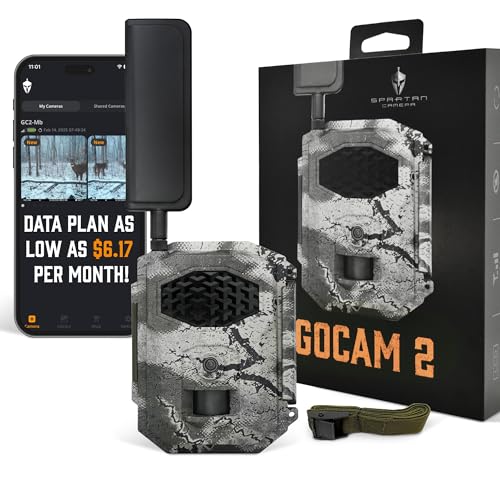
- Best for: A first camera on new or unfamiliar land, where automatic carrier switching removes the coverage gamble.
- Photo resolution: 8MP true resolution, up to 3264 x 2448
- Video resolution: 1080p with sound (cellular transmission up to 1024p)
- Detection range: 80 ft PIR
- Flash range: 60 ft, invisible blackout IR LED
A first camera on new or unfamiliar land, where automatic carrier switching removes the coverage gamble.
An SD card is required and not the same as built-in memory, so budget for a Class 10 card and remember the full-resolution files live on it.
The GoCam2 in this multi-carrier version is built for the commonest problem in remote monitoring: you simply do not know which network works at the site. It switches automatically between Verizon and AT&T 4G LTE to hold the best available connection, which makes it a sensible first camera for a new lease or a research plot you have not visited with a signal meter. Its blackout flash is fully invisible at night, and the maker rates battery life about thirty percent longer than the previous GoCam, with a 12V DC input for external power on long deployments.
Stealth Cam Deceptor Max 2.0
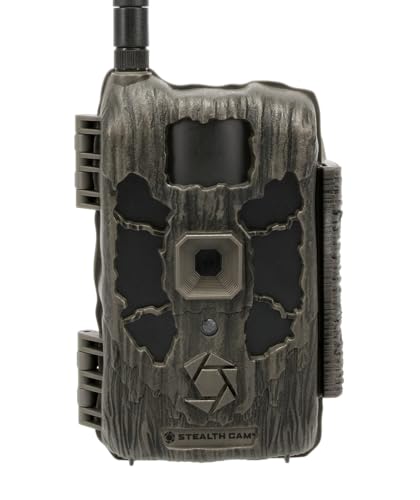
- Best for: Wildlife research and close identification work, where 40MP stills, QHD video and live viewing justify a more capable camera.
- Photo resolution: 40MP, selectable between 4MP, 8MP, 16MP and 40MP
- Video resolution: 1440p QHD with audio
- Trigger speed: 0.3 seconds
- Detection and flash range: 100 ft
Wildlife research and close identification work, where 40MP stills, QHD video and live viewing justify a more capable camera.
The 16 AA batteries are not included, and the larger battery tray makes this a bigger unit to hide, at 7.48 x 5.51 x 3.15 inches.
The Deceptor Max 2.0 is the detail specialist of this group. Its dual-core processor captures and uploads at the same time, so a burst sequence does not pause transmission, and its on-demand live streaming through the Command Pro app lets a researcher look at a plot in real time instead of waiting for the next trigger. Two pre-installed SIM cards with automatic network selection cover AT&T and Verizon, built-in GPS supports location tracking across a fleet of cameras, and the selectable photo resolutions let you trade file size against the fine detail needed to tell individual animals apart.
Which One Fits Your Situation
A Gate and a Feeder on the Same Property
Start with the Moultrie Edge 2 two-pack. Two cameras on one purchase cover the two places activity actually happens, auto-connect handles the reality that signal strength differs between a roadside gate and a sheltered feeder, and on-demand captures let you check either spot from home. Add more packs later and every camera stays in the same app.
A Research Plot Hours From Any Town
Choose the Stealth Cam Deceptor Max 2.0. When a site visit costs half a day, the camera has to answer questions remotely: live streaming for a look right now, 40MP stills for identification, GPS for fleet management, and a 16-battery tray plus 12V input for long gaps between visits. Its internal memory also keeps data on the camera if a card would be a theft or failure risk.
New Land Where Coverage Is Unknown
Take the Spartan GoCam2 multi-carrier. Automatic switching between Verizon and AT&T turns an unknown into a non-issue, and the invisible blackout flash keeps the camera discreet while you learn how the land is used. Its 2-inch screen also makes first setup at an unfamiliar site simpler, because aiming and settings can be checked on the camera itself.
Watching a Cabin, Barn or Equipment Shed
Any of the three works, but flash type should drive the choice. The GoCam2 and the Deceptor Max 2.0 both use invisible no-glo flash, so night images do not advertise the camera’s position to a passerby. Mount either one high, angle it across the approach rather than straight at a door, and use on-demand or live features to confirm what a trigger actually caught.
Common Mistakes
- Buying the camera before checking which carriers actually have signal at the mounting tree, not at the house.
- Assuming the photo that arrives on your phone is the camera’s full resolution, when plans often send a smaller preview first.
- Mounting too high and angled down, which shrinks the detection zone and produces cropped, hard-to-identify images.
- Forgetting that every cellular camera needs its own active data plan for as long as it stays in the field.
- Aiming the sensor across a sunlit clearing or at moving brush, then blaming the camera for hundreds of empty triggers.
Frequently Asked Questions
Do cellular trail cameras require a subscription?
Yes. Every cellular trail camera needs an active data plan with its maker’s service to transmit photos and videos, and each camera generally needs its own plan. Plans are usually month to month and can often be paused between seasons. Factor that ongoing cost into any comparison, because a camera that sits deactivated sends nothing no matter how strong its specifications look on the box.
Will a cellular trail camera work where my phone has no signal?
Generally no. These cameras use the same AT&T and Verizon LTE networks as your phone, so a complete dead zone defeats them. Dual-SIM, auto-connect and multi-carrier models improve your odds by choosing the stronger of two networks at the site, which is a real advantage in patchy country. In a true dead zone, a standard SD card camera is the honest answer until coverage improves.
What is the difference between low-glow and no-glo flash?
Low-glow infrared LEDs produce a faint red glow that is visible if you look directly at the camera at night; most animals ignore it, and it usually gives strong illumination. No-glo, or blackout, flash uses higher-wavelength LEDs that the human eye cannot see at all. Choose no-glo for security placements and wary subjects, and low-glow when maximum night clarity matters more than total invisibility.
Can I use a cellular trail camera for property security instead of hunting?
Yes, and many landowners do exactly that for gates, barns, cabins and equipment storage. The same features apply: motion triggers, phone alerts and night flash. Just remember a trail camera is a monitoring tool, not an alarm system. It records and reports activity after detecting it, works only where it has cellular coverage, and should be mounted discreetly and high enough that it cannot simply be taken down.
Related guides
More from Amazon
Programs that pair well with the guide above. Offers and eligibility are set by Amazon and may change.
Free shipping on eligible items, Prime Video and more. Eligible new members can start with a free trial.
Start a Prime free trialAudiobooks and podcasts to listen to on the go. Eligible new members can start with a free trial.
Try Audible freeAd-free music streaming. Eligible new subscribers can start with a free trial.
Try Music Unlimited freeA free business account with business pricing and bulk-buying tools for work, shop or home office.
Create a business accountAs an Amazon Associate we earn from qualifying purchases.










Write Your Review
No reviews yet. Be the first to share your experience!