
Our Short List of 3

- Best for: A first wired camera over a driveway, garden or side path, recorded to a Reolink NVR or card.
- Video: 2560 x 1920 (5 MP) at 30 fps, 1/2.7-inch CMOS sensor
- Lens: 4.0 mm fixed, f/2.0; 80-degree horizontal field of view
- Night vision: infrared up to 100 ft
- Person, vehicle and pet detection; time-lapse mode
- Best for: Shop fronts, car parks and tills where recorded detail has to identify people and vehicles.
- Video: 3840 x 2160 (8 MP) at 25 fps, 1/2.49-inch CMOS sensor
- Lens: 4.0 mm fixed, f/2.0; 87-degree horizontal field of view
- Night vision: infrared up to 100 ft (30 m)
- Human and vehicle detection; audio recording

- Best for: A wide yard corner, garage or small shop where one camera must cover the whole space with sound.
- Video: 5 MP (2592 x 1944) at 20 fps, Starlight 1/2.7-inch CMOS sensor
- Lens: 2.8 mm fixed; 103-degree viewing angle
- Night vision: up to 98 ft
- Built-in microphone for one-way audio
All 4 Picks at a Glance
| Product | Specs | Action |
|---|---|---|
| Reolink RLC-510A |
| Check price on Amazon |
| Reolink RLC-820A |
| Check price on Amazon |
| Amcrest IP5M-T1179EW-AI-V3 |
| Check price on Amazon |
 Reolink RLC-510WA |
| Check price on Amazon |
Key takeaways
- Four IP cameras compared on Amazon US: Reolink's 5MP and 4K PoE models, an Amcrest AI turret and a dual-band Wi-Fi Reolink, by recording, detection and install.
What's inside
As an Amazon Associate I earn from qualifying purchases. This post may contain affiliate links at no extra cost to you.
An IP camera purchase is really a network decision wearing a camera’s clothes. The camera itself is the easy part; what shapes the next five years is how it connects, where the footage lands and which recorder or app you are locked into afterwards. A PoE camera on a cable run behaves like infrastructure, while a Wi-Fi model trades that stability for a faster install. Decide the recording plan first (recorder, card or server) and the right camera usually picks itself.
This guide is for homeowners wiring a first PoE camera, small businesses covering a shop front or car park, and renters who need a camera without new cable runs. The four picks were chosen from their Amazon product pages: the Reolink RLC-510A, the Reolink RLC-820A, the Amcrest IP5M-T1179EW-AI-V3 and the Reolink RLC-510WA, spanning wired 5MP, wired 4K, an AI turret and a dual-band Wi-Fi option.
Quick Picks
As an Amazon Associate we earn from qualifying purchases.
| Product | Best for | Key spec from title |
|---|---|---|
| Reolink RLC-510A | A first wired camera for a driveway or garden | 5MP PoE with person, vehicle and pet detection |
| Reolink RLC-820A | A shop front or car park where detail matters | 4K 8MP PoE dome with 100 ft IR night vision |
| Amcrest IP5M-T1179EW-AI-V3 | A wide corner view with sound | 5MP turret with 98 ft night vision and built-in mic |
| Reolink RLC-510WA | A spot you cannot reach with Ethernet cable | 5MP dual-band Wi-Fi with night vision, IP67 |
How to Choose
PoE cabling versus Wi-Fi
Power over Ethernet sends video and power down one cable, so a PoE camera keeps recording through Wi-Fi congestion, router reboots and weak signal at the far end of a garden. The cost is the cable run itself and a PoE switch or injector, which none of these cameras bundle. Wi-Fi models like the RLC-510WA skip the data cable but still need a power outlet, and their stream is only as steady as the signal at the mounting point. Run cable where you can; reserve Wi-Fi for the positions cable genuinely cannot reach.
Resolution and lens coverage
Five megapixels is the working standard here, and the step to the RLC-820A’s 4K sensor buys cropping room rather than a different picture: you can zoom into recorded footage and still read a face or a number plate. Lens angle matters as much as pixel count. The Amcrest’s 103-degree view covers a wide corner from one mount, while the Reolink bullets sit near 80 to 100 degrees and suit defined lanes such as driveways and paths. Match the angle to the choke point you actually need to identify people at, not to the whole yard.
Where the footage is recorded
Every camera here can record to a microSD card in the camera, but card-only recording has a weakness: steal the camera and the evidence goes with it. An NVR on the network fixes that and holds weeks of continuous footage, though brand matters, because the RLC-510A’s listing states plainly that third-party NVRs are not supported. FTP and NAS options on the Amcrest and Reolink Wi-Fi model suit homes that already run a server. Choose the destination before the camera, then check the listing’s own compatibility notes rather than assuming any recorder works with any camera.
Detection that filters false alerts
Plain motion detection fires on shadows, rain and headlights, and a camera that cries wolf gets muted within a month. The listings here all sort movement into people, vehicles and, on the Reolink models, pets, so alerts can be limited to what matters. The Amcrest adds a built-in microphone, which gives recordings context a silent camera lacks. Check which detection types a listing actually names before buying, and plan to tune sensitivity and zones after install, because out-of-the-box settings rarely match a real driveway.
The 4 Best Options
Reolink RLC-510A
- Best for: A first wired camera over a driveway, garden or side path, recorded to a Reolink NVR or card.
- Video: 2560 x 1920 (5 MP) at 30 fps, 1/2.7-inch CMOS sensor
- Lens: 4.0 mm fixed, f/2.0; 80-degree horizontal field of view
- Night vision: infrared up to 100 ft
- Person, vehicle and pet detection; time-lapse mode
A first wired camera over a driveway, garden or side path, recorded to a Reolink NVR or card.
The listing states third-party NVRs are not supported, and neither a PoE switch nor a power adapter is in the box.
The RLC-510A is the straightforward starting point for a wired home system. Its 5MP sensor records at 30 frames per second, it separates people, vehicles and pets in its alerts, and a single Ethernet cable carries both power and video up to a few hundred feet. Recording can live on a microSD card, a Reolink NVR or an FTP server, and the time-lapse mode is a genuine extra for watching a build or a garden project unfold. The metal bullet housing is IP67 rated, so it shrugs off exposed mounting positions in poor weather.
Reolink RLC-820A
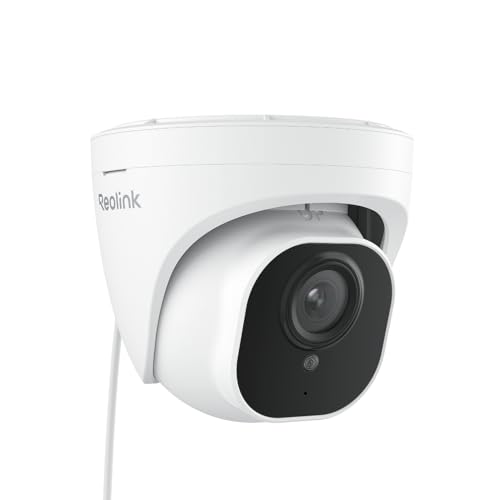
- Best for: Shop fronts, car parks and tills where recorded detail has to identify people and vehicles.
- Video: 3840 x 2160 (8 MP) at 25 fps, 1/2.49-inch CMOS sensor
- Lens: 4.0 mm fixed, f/2.0; 87-degree horizontal field of view
- Night vision: infrared up to 100 ft (30 m)
- Human and vehicle detection; audio recording
Shop fronts, car parks and tills where recorded detail has to identify people and vehicles.
A PoE switch or injector is not included, and the dome needs a ceiling or soffit mounting position.
Step up to the RLC-820A when the footage has to stand up to scrutiny. The 4K sensor records at 25 frames per second, which leaves enough detail to crop into a driveway or till area during playback, and the dome housing sits discreetly under a soffit where a bullet would invite tampering. Human and vehicle detection trims the alert noise, audio recording adds context, and H.265 compression keeps the larger files manageable on a card or NVR. It is wired-only by design, so it suits fixed positions you never plan to move.
Amcrest IP5M-T1179EW-AI-V3
- Best for: A wide yard corner, garage or small shop where one camera must cover the whole space with sound.
- Video: 5 MP (2592 x 1944) at 20 fps, Starlight 1/2.7-inch CMOS sensor
- Lens: 2.8 mm fixed; 103-degree viewing angle
- Night vision: up to 98 ft
- Built-in microphone for one-way audio
A wide yard corner, garage or small shop where one camera must cover the whole space with sound.
The listing notes the product may contain components that are not NDAA compliant, which matters for regulated or government sites.
The Amcrest turret covers the widest single view in this group, a 103-degree angle from its 2.8 mm lens, which makes it the natural choice for a yard corner or a room-sized retail space. Its Starlight sensor is built for low light, the built-in microphone records one-way audio alongside the video, and the storage list is the most open here: microSD, Amcrest NVR, NAS, FTP or Blue Iris. The trade is frame rate, at 20 frames per second, and a turret body that must be aimed by hand at install and then left alone.
Reolink RLC-510WA
- Best for: Garages, barns and garden buildings where power exists but running Ethernet is impractical.
- Video: 5 MP (2560 x 1920) at 30 fps
- Dual-band Wi-Fi (2.4 GHz and 5 GHz); plug-in powered, DC 12 V adapter included
- Night vision: infrared up to 100 ft, 18 IR LEDs
- Person, vehicle and animal detection; time-lapse mode
Garages, barns and garden buildings where power exists but running Ethernet is impractical.
It has a built-in microphone only, with no two-way talk, and performance depends on Wi-Fi signal at the mount.
The RLC-510WA is the answer when the right mounting point has power but no Ethernet. It keeps the same 5MP resolution and 100-foot infrared night vision as its wired sibling, connects over dual-band Wi-Fi, and still records to a microSD card, an FTP server or a Reolink NVR, so it can join a wired system later. Person, vehicle and animal detection carries over too. What you give up is the cable’s certainty: the stream depends on Wi-Fi strength at the wall, so check signal at the exact mounting spot before drilling anything.
Which One Fits Your Situation
You are wiring your first home system
Start with the RLC-510A and a small PoE switch. One cable per camera, recording to the camera’s card or a Reolink NVR, and detection that already separates people from pets keeps the first install simple. Add the RLC-820A later over the driveway if you find you need 4K detail for identification.
You run a shop or small business
Cover the entrance and till with the RLC-820A. Its 4K footage holds up when you crop into an incident, the dome housing is discreet under a soffit, and continuous recording to an NVR keeps a full trading day on file. Use the Amcrest turret for a wide stockroom corner where its microphone adds context.
You need to watch an outbuilding
If the barn or garage already has power, the RLC-510WA avoids trenching a data cable across the yard. Check the Wi-Fi signal at the mounting wall first; a strong 5 GHz or 2.4 GHz reading means the 5MP stream will hold. Where the building also needs sound, the wired Amcrest is the better long-term answer.
You already run a NAS or home server
The Amcrest IP5M-T1179EW-AI-V3 and the RLC-510WA both list FTP among their recording destinations, and both name third-party software options, so either can fold into a server-based setup. Keep the RLC-510A and RLC-820A for systems built around a Reolink NVR instead, because the RLC-510A’s listing rules out third-party NVRs for recording entirely.
Common Mistakes
- Ordering cameras before choosing the recorder, then finding the NVR and camera brands do not support each other.
- Forgetting that PoE switches, injectors and microSD cards are sold separately from every camera here.
- Mounting a wide-angle camera high and far away, then expecting faces to be identifiable in playback.
- Trusting a Wi-Fi camera at a mounting point where a phone barely holds one bar of signal.
- Leaving default detection sensitivity untouched and drowning in alerts from trees, rain and passing headlights.
Frequently Asked Questions
Do IP cameras need an NVR to record?
No. Every camera in this guide can record to a microSD card inside the camera, and several can send footage to an FTP server. An NVR earns its place when you run several cameras, want weeks of continuous recording in one box, or want the footage kept somewhere a stolen camera cannot take it.
Can an IP camera keep recording if the internet goes down?
Yes, as long as the local network stays up. PoE and Wi-Fi cameras here record to their cards, an NVR or a local server without needing the internet; what you lose during an outage is remote viewing and push alerts. Recording schedules and detection keep running on the camera and recorder themselves.
Is PoE or Wi-Fi better for a home IP camera?
PoE is the steadier choice wherever a cable can reach: one run delivers power and video, immune to Wi-Fi congestion and dead spots. Wi-Fi wins on install effort for a single awkward position, such as an outbuilding with power but no data cable. Many homes end up mixed, wired for the main approaches and wireless for the leftovers.
Can I watch these cameras on my phone from away from home?
Yes. Each brand’s app offers live view and playback remotely, and the Reolink models support up to 12 simultaneous users across devices, which suits families and small teams sharing access. Remote viewing needs the camera’s network to have internet access, and playback of card footage is slower than footage held on an NVR.
Related guides
More from Amazon
Programs that pair well with the guide above. Offers and eligibility are set by Amazon and may change.
Free shipping on eligible items, Prime Video and more. Eligible new members can start with a free trial.
Start a Prime free trialAudiobooks and podcasts to listen to on the go. Eligible new members can start with a free trial.
Try Audible freeAd-free music streaming. Eligible new subscribers can start with a free trial.
Try Music Unlimited freeA free business account with business pricing and bulk-buying tools for work, shop or home office.
Create a business accountAs an Amazon Associate we earn from qualifying purchases.










Write Your Review
No reviews yet. Be the first to share your experience!