
Our Short List of 3

- Flash type: 940nm no-glow infrared
- Night range: 100 ft
- Trigger speed: 0.1 seconds
- Photo resolution: up to 48MP

- Flash type: no-glow infrared
- Night range: 120 ft (manufacturer figure)
- Trigger speed: 0.15 seconds
- Photo resolution: up to 32MP

- Flash type: low-glow infrared
- Detection and flash range: 100 ft
- Photo resolution: 36MP
- Video resolution: 1080p with HD audio
All 5 Picks at a Glance
| Product | Specs | Action |
|---|---|---|
| 1. GardePro A3 — no-glow flash built around a low-light sensor |
| Check price on Amazon |
| 2. Bushnell Core DS-4K No Glow — a dedicated sensor for night work |
| Check price on Amazon |
| 3. Moultrie Edge 2 — low-glow cellular delivery in a two-camera pack |
| Check price on Amazon |
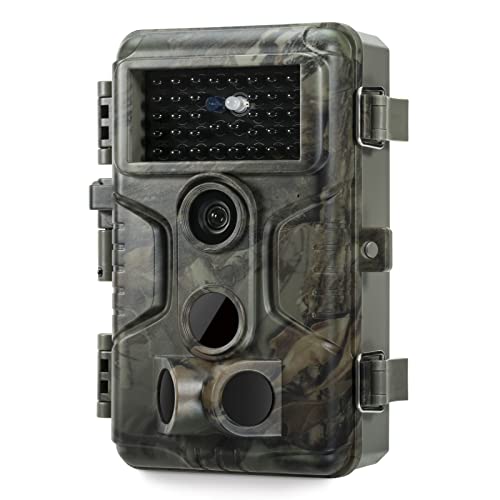 4. GardePro A3S — the higher-resolution step up in the same line |
| Check price on Amazon |
 5. Stealth Cam Deceptor — no-glo cellular with dual-network coverage |
| Check price on Amazon |
Key takeaways
- Compare the best night vision trail cameras by flash type, night range, trigger speed and video quality, with five picks for clear images after dark.
What's inside
- What decides night picture quality
- 1. GardePro A3 — no-glow flash built around a low-light sensor
- 2. Bushnell Core DS-4K No Glow — a dedicated sensor for night work
- 3. Moultrie Edge 2 — low-glow cellular delivery in a two-camera pack
- 4. GardePro A3S — the higher-resolution step up in the same line
- 5. Stealth Cam Deceptor — no-glo cellular with dual-network coverage
- Getting better pictures after dark
- Frequently asked questions
As an Amazon Associate I earn from qualifying purchases. This post may contain affiliate links at no extra cost to you.
Most of the action on a game trail happens between dusk and dawn, and that is exactly when an ordinary trail camera is at its weakest. A camera can carry an impressive megapixel figure and still produce washed-out, blurry or empty frames after dark if its infrared flash is weak, its trigger is slow or its sensor struggles in low light. Choosing among the best night vision trail cameras means looking past daytime headline numbers and comparing the parts that decide what a picture looks like at 2 a.m.: the type of infrared flash, how far that flash reaches, how quickly the camera fires, and how the sensor handles a scene lit only by infrared light.
Disclosure: As an Amazon Associate, we earn from qualifying purchases made through links on this page, at no extra cost to you.
This guide compares five trail cameras chosen specifically for their published night specifications. Three use no-glow infrared flash that stays invisible to animals and people, one pairs a low-glow flash with cellular delivery, and one adds dual-network cellular coverage to a no-glo array. Every specification below comes from the manufacturer or the product listing, so the figures can be compared model to model.
What decides night picture quality
Flash type. Trail cameras light a night scene with infrared LEDs. Low-glow emitters, usually around 850nm, produce a faint red glow that is visible if you look straight at the camera, but they tend to throw light a little farther. No-glow emitters, usually 940nm, are effectively invisible when they fire, which suits wary game and discreet placement, though they often give up a small amount of reach. Neither type uses a white flash, so night images are monochrome.
Flash range versus detection range. These are two different numbers. Detection range is how far away the passive infrared sensor can pick up heat and movement and wake the camera. Flash range is how far the infrared light carries well enough to expose a picture. A camera that detects movement at 100 feet but only lights 60 feet will hand you dark frames of animals it sensed but could not illuminate, so the two figures should be read together.
Trigger speed. Trigger speed is the delay between the sensor detecting movement and the camera recording. At night this matters more than during the day, because an animal crossing a narrow trail may only be inside the lit zone for a moment. Figures in this guide run from 0.1 to 0.3 seconds, and the faster cameras are more likely to catch the animal centred rather than leaving the frame.
Sensor and lens. Low-light sensors with large apertures gather more of the infrared light that is available, which is why some models in this guide highlight a dedicated night sensor or a low-light imaging chip rather than relying on one sensor for both day and night work.
1. GardePro A3 — no-glow flash built around a low-light sensor
- Flash type: 940nm no-glow infrared
- Night range: 100 ft
- Trigger speed: 0.1 seconds
- Photo resolution: up to 48MP
The GardePro A3 was designed with night work as the priority. It uses a Sony Starvis sensor with a large-aperture lens and the maker’s smart illumination tuning, a combination GardePro says is aimed at the two classic night faults of trail cameras: subjects blown out white when they stand close, and frames that fall too dark when they stand far away. Its 940nm no-glow infrared array is rated to 100 feet, and because the emitters produce no visible glow, the camera can sit on a trail used by shy animals without announcing itself each time it fires.
The trigger speed is listed at 0.1 seconds, the joint fastest in this guide, which helps when animals cross the frame rather than feeding in front of it. Still images are recorded at up to 48MP and video at 1296p in the H.264 format, which keeps file sizes manageable on the card. The A3 is a conventional card-based camera with no cellular or Wi-Fi link, so pictures are collected by swapping the SD card, which supports cards up to 512GB. It runs on eight AA batteries.
2. Bushnell Core DS-4K No Glow — a dedicated sensor for night work
- Flash type: no-glow infrared
- Night range: 120 ft (manufacturer figure)
- Trigger speed: 0.15 seconds
- Photo resolution: up to 32MP
Bushnell’s Core DS-4K takes a different approach to the same problem: instead of asking one sensor to do everything, it carries two, with one sensor optimised for daylight and a second dedicated to night capture. The no-glow infrared flash is rated by Bushnell at a 120-foot night range, the longest reach in this guide, and the trigger speed is listed at 0.15 seconds. That pairing of a long flash throw and a fast trigger suits open settings such as field edges and food plots, where animals are often first lit at a distance.
Photo resolution runs to 32MP and video is recorded in 4K at 30 frames per second, the highest video figure here, and a 1.5-inch colour screen inside the housing makes it easier to aim the camera and check framing at the tree. The camera runs on six AA batteries, accepts SD cards up to 512GB and offers photo, video and hybrid capture modes with multi-shot bursts of up to six images per trigger. For a set that will be checked in person and judged mainly on the strength of its night frames, the dual-sensor layout is the headline feature.
3. Moultrie Edge 2 — low-glow cellular delivery in a two-camera pack
- Flash type: low-glow infrared
- Detection and flash range: 100 ft
- Photo resolution: 36MP
- Video resolution: 1080p with HD audio
The Moultrie Edge 2 is the low-glow entry in this guide, and the listing covered here is a two-camera pack, which makes it a practical way to cover two crossings or a trail and a feeder at once. Its low-glow infrared flash supports a 100-foot detection and flash range, and each camera records 36MP photos and 1080p video with audio. Low-glow emitters can show a faint red tint at the source when they fire, so this is the pick for places where a slight glow is acceptable in exchange for cellular convenience.
That convenience is the real story. The Edge 2 connects automatically to the strongest available nationwide 4G LTE signal and sends images to the Moultrie Mobile app, with on-demand photo and video requests from the phone. There is no SD card to manage because memory is built in, and the app handles settings changes remotely, which means a camera hung in October can be adjusted without a trip back to the tree. A paid cellular plan is required for transmission, and coverage at the exact mounting spot decides how quickly pictures arrive.
4. GardePro A3S — the higher-resolution step up in the same line
- Flash type: 940nm no-glow infrared
- Night range: 100 ft
- Trigger speed: 0.1 seconds
- Photo resolution: up to 64MP
The GardePro A3S keeps the night formula of the A3 and raises the output figures. It uses the same Sony Starvis low-light sensor family with no-glow infrared illumination rated to 100 feet and the same 0.1-second trigger speed, but still images rise to 64MP while video stays at 1296p with sound. For a card-based camera that will be checked on foot, that extra resolution gives more room to crop into a frame when an animal stands at the far edge of the flash range, which is where night pictures most often need help.
Like the A3, the A3S is a standalone camera with no cellular radio and no Wi-Fi, so there is no plan to maintain and no signal requirement at the tree; the trade is that nothing is visible until the card is collected. It runs on eight AA batteries and accepts SD cards up to 512GB. Between the two GardePro models, the A3 covers the core night specification, while the A3S is the version to pick when the larger still images will actually be used for identification at distance rather than quick scouting checks.
5. Stealth Cam Deceptor — no-glo cellular with dual-network coverage
- Flash type: 36 940nm no-glo LEDs
- Detection and flash range: 80 ft
- Trigger speed: 0.3 seconds
- Photo resolution: up to 40MP
The Stealth Cam Deceptor brings the no-glo approach to a cellular camera. Its array of 36 940nm no-glo LEDs gives an 80-foot detection and flash range with no visible light when it fires, and the trigger speed is listed at 0.3 seconds. Still images reach 40MP and video is recorded in 1440p QHD with audio, both delivered through the Command Pro app, which also supports on-demand photo and video capture when you want a fresh look at a site without waiting for movement.
The Deceptor’s coverage arrangement is its distinguishing feature: it works across both AT&T and Verizon and connects automatically to the stronger signal, which reduces the guesswork of matching a camera to a carrier before knowing how a property sits between towers. Burst mode records one to three images per trigger, and the camera runs on eight AA batteries with a 12V external power jack for accessory power. The 80-foot flash range is the shortest in this guide, so it fits tighter setups — a scrape, a crossing or a feeder — better than wide open ground.
Getting better pictures after dark
Specifications set the ceiling, but placement decides how close a camera gets to it. A few habits make a visible difference to night frames:
- Aim along the trail, not across it. An animal walking toward or away from the camera stays inside the lit zone far longer than one crossing the frame at right angles, which gives a fast trigger less work to do and keeps the subject inside the flash range.
- Keep the background in mind. Infrared light reflects strongly off close brush, trunks and grass, and the camera exposes for the brightest part of the scene. Clearing vegetation from the first few feet in front of the lens and avoiding a trunk squarely behind the target area reduces blown-out foregrounds and dark subjects.
- Match the mode to the goal. Video shows behaviour and direction of travel, while a burst of stills usually gives the clearest frame for identification. Hybrid modes that take a photo and then video offer both, at the expense of card space and battery life.
- Use lithium batteries in cold weather. Night work is the heaviest load a trail camera carries, because the flash fires on every trigger, and output from alkaline cells falls away in low temperatures. Lithium cells hold their voltage better through a cold night.
- Check the first nights, then leave it alone. A short first deployment confirms aim, flash reach and sensitivity settings. Repeated visits after that add scent and disturbance around the set, which works against the discreet flash you chose the camera for.
Frequently asked questions
What is the difference between no-glow and low-glow trail cameras?
Both light a scene with infrared LEDs rather than a visible white flash. Low-glow emitters, usually around 850nm, can show a faint red glow at the camera when they fire and tend to reach slightly farther. No-glow emitters, usually 940nm, produce no visible light, which suits wary game and discreet placement, sometimes with a modest reduction in range.
How far can a trail camera see at night?
Two figures matter: the detection range, which is how far away the sensor can wake the camera, and the flash range, which is how far the infrared light carries well enough to expose a picture. In this guide the published flash ranges run from 80 to 120 feet, and a subject beyond the flash range will appear dark even if the camera detected it.
Does trigger speed matter for night photos?
Yes. Trigger speed is the delay between detection and capture, and at night an animal may only be inside the illuminated area briefly. A camera listed at 0.1 seconds is more likely to catch the subject near the centre of the frame than one listed at 0.3 seconds, especially on a crossing trail rather than at a feeder.
Do cellular trail cameras take better night pictures?
Not by themselves. Cellular delivery changes how pictures reach you, not how they are captured; night quality still depends on the flash type, flash range, sensor and trigger speed. A cellular model such as the Moultrie Edge 2 or Stealth Cam Deceptor earns its place when remote delivery and on-demand captures matter as much as the images themselves.
Related guides
More from Amazon
Programs that pair well with the guide above. Offers and eligibility are set by Amazon and may change.
Free shipping on eligible items, Prime Video and more. Eligible new members can start with a free trial.
Start a Prime free trialAudiobooks and podcasts to listen to on the go. Eligible new members can start with a free trial.
Try Audible freeAd-free music streaming. Eligible new subscribers can start with a free trial.
Try Music Unlimited freeA free business account with business pricing and bulk-buying tools for work, shop or home office.
Create a business accountAs an Amazon Associate we earn from qualifying purchases.










Write Your Review
No reviews yet. Be the first to share your experience!