
Key takeaways
- Compare running watches for Strava by sync reliability, GPS accuracy for segments, battery life and app quality across Garmin, COROS, Suunto and Apple.
As an Amazon Associate I earn from qualifying purchases. This post may contain affiliate links at no extra cost to you.
If your running life lives on Strava, your watch has one job above all: record an accurate run and have it appear in your feed, on your segments and in your club challenges without you touching a thing. The good news is that every major running watch brand now syncs with Strava automatically. The differences that remain are GPS accuracy, which decides whether your segment efforts register fairly, and how much of the experience happens on the watch itself.
This guide compares five watches that pair well with a Strava-centred life, from dedicated sports brands with one-tap account linking to the Apple Watch, which runs a native Strava app on the wrist. All five upload automatically once linked, so the comparison focuses on tracking quality and day-to-day smoothness.
As an Amazon Associate, we earn from qualifying purchases.
Quick Picks
| Product | Best for | Key point |
|---|---|---|
| Garmin Forerunner 265S (Whitestone and Neo Tropic) | Runners with smaller wrists who want a full training watch, not a cut-down one | One-time Garmin Connect link, then fully automatic uploads |
| COROS PACE 3 (Black, Nylon Band) | Runners who want dual-frequency GPS and huge battery life at an entry-level position in the range | Dual-frequency GPS for cleaner segment traces |
| SUUNTO Run (All Black) | Runners who want a light AMOLED watch with dual-band GPS from outside the Garmin ecosystem | Suunto app syncs to Strava and 90-plus partner services |
| Polar Pacer Pro | Data-focused runners who value running power, sleep tracking and fuelling tools over smartwatch features | Polar Flow uploads with detailed lap and power data |
| Apple Watch SE (2nd Gen), GPS + Cellular, 40 mm (Midnight) | iPhone owners who want running tracking inside the Apple ecosystem, with a native Strava app on the wrist | Native Strava app records directly on the watch |
How to Choose
How sync actually works. For Garmin, COROS, Suunto and Polar, you link accounts once inside the brand’s app or web platform, and every recorded run then uploads to Strava automatically when the watch syncs to your phone. On Apple Watch, the native Strava app can record the run itself, or the Workout app can feed Strava through Apple Health. Both routes are reliable; the brand-app route keeps richer data in the maker’s platform too.
GPS accuracy decides segment fairness. Segments compare your trace against a defined stretch of road or trail. Single-band GPS is fine in open areas, but dual-frequency receivers, like the COROS and Suunto here, hold a cleaner line between buildings and under trees, which means fewer missed or wrongly matched segments on city routes.
What data reaches Strava. Distance, pace, heart rate, cadence and elevation upload from all five. Running power and advanced dynamics depend on the platform and how you view them. If you analyse deeply, record with the brand known for the metric you care about and let Strava be the social layer on top.
Battery for long segment hunts. Chasing segments on long weekend runs needs GPS hours in reserve. The COROS leads here with up to 38 hours of full GPS recording, while the Apple Watch needs daily charging and suits shorter, sharper sessions. Match the watch to your longest typical run.
Best Options
Garmin Forerunner 265S (Whitestone and Neo Tropic)

The Forerunner 265S is the small-case version of Garmin’s core race watch, sized for wrists roughly 115 to 178 mm around, and it gives up almost nothing to the bigger model. Training readiness, HRV status, a morning report and race-adaptive daily suggested workouts are all here, driven by the same Elevate heart rate sensor and satellite mix. The AMOLED screen is bright enough for midday summer runs and the five-button layout still works with gloves and sweaty fingers.
Battery life is the quiet headline: up to 15 days between charges in smartwatch mode means a full marathon block does not revolve around a charging cable. Onboard music storage is included, so phone-free runs with downloaded playlists are covered without stepping up to the flagship tier.
Specs
- Case 42 mm; 1.1-inch AMOLED touchscreen at 360 x 360 pixels; battery up to 15 days in smartwatch mode and up to 24 hours in GPS mode; onboard music storage with downloads from Spotify, Deezer and Amazon Music; weight 39 g; water rating 5 ATM; GPS, GLONASS, Galileo and QZSS positioning; wrist heart rate, Pulse Ox, barometric altimeter and compass
Best for: Runners with smaller wrists who want a full training watch, not a cut-down one
Watch out for: The 42 mm screen shows fewer data fields per page than the 46 mm Forerunner 265, and there are no onboard maps at this level of the range
COROS PACE 3 (Black, Nylon Band)

The PACE 3 is COROS’s core running watch: a 30 g nylon-band watch with dual-frequency GNSS, up to 38 hours of full GPS recording and a training platform that covers structured workouts, race predictions and recovery advice. It syncs cleanly to the major training platforms and records running power from the wrist.
What it skips is smartwatch gloss. There is no speaker, no voice assistant and no app store, and music is limited to MP3 files you copy across yourself. Runners who see those as clutter rather than loss get flagship-grade tracking hardware for the entry point of the COROS line.
Specs
- Case 41.9 mm; 1.2-inch memory-in-pixel touchscreen at 240 x 240 pixels; battery up to 17 days of daily use and up to 38 hours in full GPS mode; weight 30 g with the nylon band; dual-frequency GNSS; offline music via MP3 files held on the watch; breadcrumb navigation; water rating 5 ATM
Best for: Runners who want dual-frequency GPS and huge battery life at an entry-level position in the range
Watch out for: The screen looks muted beside AMOLED rivals, and the ecosystem of third-party apps is far smaller than Garmin’s or Apple’s
SUUNTO Run (All Black)

The Suunto Run is the Finnish brand’s dedicated running watch, built around three ideas: low weight, a bright AMOLED screen and dual-band GPS accuracy. At 36 g with a textile strap it sits lightly on the wrist, and the crown button makes scrolling through laps and menus easy with gloves on.
Music is handled with 4 GB of storage for your own files, played to Bluetooth headphones with no phone involved. Training analysis lives in the Suunto app, which tracks load, recovery and progress with a cleaner, less crowded layout than most rivals. Two straps in the box is a small touch that saves an early accessory purchase.
Specs
- 1.32-inch AMOLED touchscreen with a crown button; weight 36 g; dual-band GPS; battery up to 12 days in daily mode and up to 20 hours with dual-band GPS recording; 4 GB of offline music storage; two textile straps included in the box; structured training analysis in the Suunto app
Best for: Runners who want a light AMOLED watch with dual-band GPS from outside the Garmin ecosystem
Watch out for: The Suunto app ecosystem is smaller than Garmin Connect, and there is no contactless payment on this model
Polar Pacer Pro
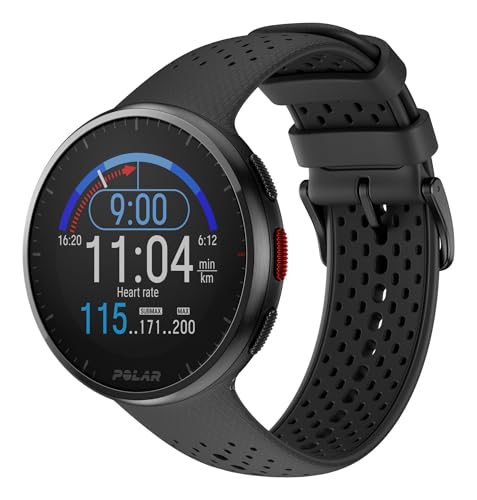
Polar builds watches around physiology, and the Pacer Pro shows it: wrist-based running power, detailed sleep and recovery tracking through Nightly Recharge, and FuelWise reminders that prompt you to take on carbs during long runs. Hill Splitter breaks climbs and descents into segments automatically.
The hardware is deliberately plain: a light 41 g case, a sunlight-readable display and buttons only. There is no music and no app store. For runners who treat the watch as a measuring instrument and do their listening on a phone, that focus is exactly the appeal, and Polar Flow remains one of the clearest training platforms to learn from.
Specs
- Weight 41 g; 1.2-inch memory-in-pixel display at 240 x 240 pixels; battery up to 35 hours of GPS training and up to 7 days in watch mode; wrist-based running power; Hill Splitter and FuelWise fuelling reminders; barometric altimeter; no onboard music; water resistant to 50 metres
Best for: Data-focused runners who value running power, sleep tracking and fuelling tools over smartwatch features
Watch out for: No music storage, no touchscreen and a monochrome-leaning display that feels plain next to AMOLED rivals
Apple Watch SE (2nd Gen), GPS + Cellular, 40 mm (Midnight)

For iPhone owners, the Apple Watch SE is the connected option: the Workout app covers running with heart rate zones and custom workouts, and dedicated running apps, including a native Strava app, run directly on the watch. The cellular model takes calls, messages and music streaming with no phone in your pocket.
The compromise is endurance. Battery life of up to 18 hours means daily charging, and multi-day GPS adventures are off the table. As a daily smartwatch that also trains, though, nothing else in this guide integrates with an iPhone as completely.
Specs
- Case 40 mm aluminium; Retina LTPO OLED display; S8 chip running watchOS; battery up to 18 hours; music through Apple Music with downloads or streaming on the cellular model; water resistant to 50 metres; Workout app plus third-party running apps; requires an iPhone
Best for: iPhone owners who want running tracking inside the Apple ecosystem, with a native Strava app on the wrist
Watch out for: Battery life is measured in hours rather than days, and there is no Android compatibility at all
Which One Fits
- Choose the Garmin Forerunner 265S if you want the most popular and proven Strava pipeline, with deep training data behind the social layer.
- Choose the COROS PACE 3 if segment accuracy and battery life top your list, especially for city and trail routes.
- Choose the SUUNTO Run if you like Suunto’s app and want dual-band GPS with clean automatic uploads.
- Choose the Polar Pacer Pro if you want running power and detailed laps feeding your Strava activities.
- Choose the Apple Watch SE if you prefer recording directly in the Strava app on your wrist and live in the Apple ecosystem.
Common Mistakes
Recording in two apps at once. Running the Strava phone app and your watch together creates duplicate activities and confused data. Pick one recorder, ideally the watch, and let sync do the rest.
Linking accounts in the wrong place. Sync is set up in the watch brand’s app or website, not inside Strava alone. If uploads stop, check the connection on the brand’s side first, then confirm Strava still lists the service as connected.
Blaming the watch for every missed segment. Segments fail for mundane reasons: privacy zones hiding the relevant stretch, a segment defined on a path your GPS trace drifted from, or the activity set to private. Check those settings before doubting the hardware.
Ignoring privacy zones. Strava hides the parts of activities near addresses you set, which can clip segments near home. That is the feature working as designed; adjust your expectations for segments inside the zone.
FAQ
Do Garmin watches upload to Strava automatically?
Yes. Link Garmin Connect and Strava once, and every run uploads as soon as the watch syncs with your phone. The same one-time linking applies to COROS, Suunto and Polar through their apps.
Which watch is most accurate for Strava segments?
Dual-frequency GPS models hold the cleanest traces in difficult areas. In this guide that means the COROS PACE 3 and the SUUNTO Run, which resist the signal bounce that causes missed segment matches in cities.
Can I record with the Strava app on a watch?
On Apple Watch, yes: the native Strava app records runs on the wrist with heart rate. On Garmin, COROS, Suunto and Polar you record in the watch’s own system and Strava receives the upload, which preserves the richer brand data as well.
Why did my run not appear on Strava?
The usual causes are an expired account link, the activity being set to private, or the watch not having synced to the phone yet. Reconnect the accounts in the brand app, confirm the activity is visible there, and the upload normally follows within minutes.
Final Verdict
For a Strava-centred runner, the COROS PACE 3 is the accuracy-and-battery pick, the Forerunner 265S the safest all-round pipeline, and the Apple Watch SE the choice if you want Strava itself on your wrist. Every watch here uploads automatically once linked, so choose by GPS quality and the app you enjoy opening after the run.
Related guides
More from Amazon
Programs that pair well with the guide above. Offers and eligibility are set by Amazon and may change.
Free shipping on eligible items, Prime Video and more. Eligible new members can start with a free trial.
Start a Prime free trialAudiobooks and podcasts to listen to on the go. Eligible new members can start with a free trial.
Try Audible freeAd-free music streaming. Eligible new subscribers can start with a free trial.
Try Music Unlimited freeA free business account with business pricing and bulk-buying tools for work, shop or home office.
Create a business accountAs an Amazon Associate we earn from qualifying purchases.
Write Your Review
No reviews yet. Be the first to share your experience!