
Our Short List of 3

- Best for: Larger homes running three or more cameras in different directions from the router.
- WiFi standard: WiFi 6 (802.11ax), dual band
- Speed: AX3000, up to 3 Gbps total
- Coverage: up to 2,400 sq. ft.
- Device capacity: up to 64 devices

- Best for: Cameras on outbuildings, gates, or yards where an indoor signal cannot reach.
- WiFi standard: WiFi 6 (802.11ax), dual band
- Speed: AX1800, 574 Mbps on 2.4 GHz plus 1,201 Mbps on 5 GHz
- Weather rating: IP67 weatherproof housing
- Antennas: 4 x 8dBi omnidirectional

- Best for: One or two cameras on the opposite side of a small or medium home from the router.
- WiFi standard: WiFi 6 (802.11ax), dual band
- Speed: AX1800, up to 1.8 Gbps (600 Mbps plus 1,200 Mbps)
- Added coverage: up to 1,500 sq. ft.
- Device capacity: 20+ devices
All 5 Picks at a Glance
| Product | Specs | Action |
|---|---|---|
| TP-Link RE715X |
| Check price on Amazon |
| WAVLINK AX1800 Outdoor (WN573HX1) |
| Check price on Amazon |
| NETGEAR EAX15 |
| Check price on Amazon |
 Linksys RE7350 |
| Check price on Amazon |
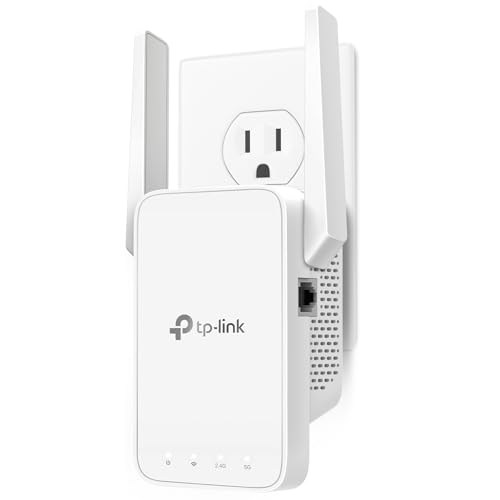 TP-Link RE315 |
| Check price on Amazon |
Key takeaways
- Keep outdoor security cameras online with the right WiFi extender. Compare coverage, dual-band speeds, Ethernet ports and an IP67 outdoor option.
What's inside
As an Amazon Associate I earn from qualifying purchases. This post may contain affiliate links at no extra cost to you.
A security camera is only useful while it stays connected, and the usual reason one drops offline is distance: the router sits deep inside the house while the camera is mounted on a garage, gate, or far exterior wall, with brick, siding, and insulation weakening the signal on the way out. The real decision is not raw speed but reach — which extender can push a stable 2.4 GHz signal through your walls to the exact spot where the camera hangs, and keep it there through weather and busy evenings.
This guide is for homeowners with one stubborn camera that keeps disconnecting, and for households running several cameras around a larger property. Every pick below is a WiFi range extender chosen from the specifications on its Amazon product page — coverage ratings, WiFi standard, bands, and ports — with an outdoor-rated model included for cameras that sit beyond the house walls entirely.
Quick Picks
As an Amazon Associate we earn from qualifying purchases
| Product | Best for | Key spec from title |
|---|---|---|
| TP-Link RE715X | Several cameras spread around a larger home | AX3000 WiFi 6, up to 2,400 sq. ft. |
| WAVLINK AX1800 Outdoor (WN573HX1) | Cameras on a detached garage, barn, or gate | AX1800 WiFi 6, IP67 weatherproof |
| NETGEAR EAX15 | One or two cameras on the far side of the house | AX1800 WiFi 6, up to 1,500 sq. ft. |
| Linksys RE7350 | Buyers who want a wired port near the cameras | AX1800 WiFi 6, up to 2,000 sq. ft. |
| TP-Link RE315 | A single nearby camera on a tight budget | AC1200 dual band, up to 1,500 sq. ft. |
How to Choose
Place the extender where it still hears the router
An extender can only rebroadcast the signal it receives, so its own position matters more than the camera’s. The reliable spot is roughly halfway between the router and the camera, in a place where the router’s signal is still strong — for a camera on the front wall, that usually means an outlet in a front room rather than one beside the camera itself. If the extender sits in the same dead zone as the camera, it faithfully repeats a weak, unstable signal and the dropouts continue. Models with a signal-strength indicator light make finding that halfway point much easier.
Treat the coverage rating as a best case
The square-foot figure on the box is measured in open space, and exterior walls cut real-world reach sharply. Brick, stucco with metal mesh, foil-backed insulation, and metal garage doors are especially hard on WiFi. If your camera is 40 feet from the router but behind two exterior walls, shop as if the distance were far greater and pick an extender rated well above your home’s size. For a camera mounted outside the building envelope altogether — on a detached garage, fence, or barn — an outdoor-rated extender mounted on the exterior wall removes the wall problem instead of fighting through it.
Check the 2.4 GHz band first, not the headline speed
Most security cameras connect on 2.4 GHz only, because that band travels farther and passes walls better than 5 GHz. A dual-band extender is still the right buy: the 5 GHz band gives the extender a faster link back to the router and keeps phones and laptops off the camera’s band. What matters for the camera itself is a strong, stable 2.4 GHz signal, so compare the 2.4 GHz figures in the listing rather than the combined AX number in the product name. Also confirm whether the extender can keep one network name, so the camera does not need re-pairing to a separate network.
Decide whether you need the Ethernet port or PoE
An Ethernet port on an extender opens two useful options. In access point mode, a cable run from the router turns the extender into a wired-fed access point, which is far more stable than a wireless hop — worth doing if you can route a cable toward the camera side of the house. The port also lets a nearby wired device, such as a camera hub or recorder, plug in directly. Outdoor extenders take this further with Power over Ethernet: one cable carries both data and power to a unit mounted outside, though the injector itself has to stay indoors.
The 5 Best Options
TP-Link RE715X
- Best for: Larger homes running three or more cameras in different directions from the router.
- WiFi standard: WiFi 6 (802.11ax), dual band
- Speed: AX3000, up to 3 Gbps total
- Coverage: up to 2,400 sq. ft.
- Device capacity: up to 64 devices
Larger homes running three or more cameras in different directions from the router.
It is an indoor wall-plug unit with no weather rating, so it must live inside on the wall nearest the cameras; it also is not compatible with TP-Link Deco mesh systems.
For a home with cameras at several corners, the RE715X brings the most headroom in this group. Its AX3000 WiFi 6 rating and coverage claim of up to 2,400 square feet give it the best chance of holding a 2.4 GHz link to cameras on opposite sides of the house from a single unit, and the listing rates it for up to 64 connected devices, so a full set of cameras, bulbs, and phones will not crowd it out. It also works as an access point through its gigabit Ethernet port if you can run a cable partway toward the cameras.
WAVLINK AX1800 Outdoor (WN573HX1)
- Best for: Cameras on outbuildings, gates, or yards where an indoor signal cannot reach.
- WiFi standard: WiFi 6 (802.11ax), dual band
- Speed: AX1800, 574 Mbps on 2.4 GHz plus 1,201 Mbps on 5 GHz
- Weather rating: IP67 weatherproof housing
- Antennas: 4 x 8dBi omnidirectional
Cameras on outbuildings, gates, or yards where an indoor signal cannot reach.
The PoE converter is not waterproof and must be installed indoors, and the listing specifies CAT5E or better cable no longer than 100 m for the run to the unit.
When the camera sits on a detached garage, a barn, or a gate post, no indoor extender is well placed to serve it, and this is the one pick built for exactly that layout. The WN573HX1 mounts outside in an IP67 weatherproof housing rated for temperatures from -20°C to 50°C, with four 8dBi antennas pushing WiFi 6 coverage outward from the building instead of through its walls. It is powered over Ethernet, so a single cable run handles both power and data, and its listing rates it for up to 128 connected devices across a yard or smallholding.
NETGEAR EAX15
- Best for: One or two cameras on the opposite side of a small or medium home from the router.
- WiFi standard: WiFi 6 (802.11ax), dual band
- Speed: AX1800, up to 1.8 Gbps (600 Mbps plus 1,200 Mbps)
- Added coverage: up to 1,500 sq. ft.
- Device capacity: 20+ devices
One or two cameras on the opposite side of a small or medium home from the router.
The 1,500 sq. ft. added coverage is the smallest figure here, so measure honestly — a camera behind a brick exterior wall at the edge of that range may still struggle.
The EAX15 suits the common case of one or two cameras mounted on the far side of the house from the router. It is a compact wall-plug extender rated to add up to 1,500 square feet of coverage, with WiFi 6 and four streams so a camera feed does not stall when the household is streaming in the evening. NETGEAR sells it as a mesh extender that keeps one network name, which matters for cameras: they stay on the same network they were paired to instead of needing setup again against an extender-specific name.
Linksys RE7350
- Best for: Homes where a cable run partway to the cameras is possible, or where placement help is welcome.
- WiFi standard: WiFi 6 (802.11ax), dual band
- Speed: up to 1.8 Gbps
- Coverage: up to 2,000 sq. ft.
- Ethernet: 1 gigabit port
Homes where a cable run partway to the cameras is possible, or where placement help is welcome.
This model also circulates in renewed form, so check on the listing whether the unit offered is new or refurbished before ordering, since the warranty differs.
The RE7350 is the pick for buyers who want flexibility in how the extended network is built. Its listing claims up to 2,000 square feet of added coverage with AX1800 WiFi 6, and it includes a gigabit Ethernet port plus an access point mode, so it can either repeat the router’s signal wirelessly or broadcast from a wired connection if you run cable toward the camera side of the property. Linksys’s Spot Finder technology is designed to help you place it where the router’s signal is still strong, which is the placement decision that makes or breaks camera stability.
TP-Link RE315
- Best for: A single camera or doorbell one room beyond the router’s comfortable reach.
- WiFi standard: WiFi 5 (802.11ac), dual band
- Speed: AC1200, 867 Mbps on 5 GHz plus 300 Mbps on 2.4 GHz
- Coverage: up to 1,500 sq. ft.
- Device capacity: up to 30 devices
A single camera or doorbell one room beyond the router’s comfortable reach.
The listing’s own text is inconsistent — the title says up to 1,500 sq. ft. while the description mentions 1,600 — so plan around the lower figure; its Ethernet port is also 100 Mbps rather than gigabit.
The RE315 covers the simplest version of the problem: one camera, one weak room between it and the router, and no need for WiFi 6 capacity. It is an AC1200 dual-band extender rated for up to 1,500 square feet and 30 devices, with two adjustable external antennas you can angle toward the camera’s side of the house. A camera stream asks very little bandwidth, so its 300 Mbps 2.4 GHz band is not the limitation it might be for other uses. Setup runs through the TP-Link Tether app, and it can join an EasyMesh network later if your setup grows.
Which One Fits Your Situation
Your camera is on a detached garage or barn
Choose the WAVLINK AX1800 Outdoor. Once a camera leaves the house, an indoor extender is fighting through the exterior wall of the home and often the wall of the outbuilding too. A weatherproof unit mounted outside, fed by a single Ethernet cable, starts its coverage where the cameras actually are and avoids both walls entirely.
One camera at the front of the house keeps dropping
Start with the TP-Link RE315 if the camera is a room or two beyond the router, or step up to the NETGEAR EAX15 if the household also streams heavily in the evening. Place either unit in the front room nearest the camera, confirm the camera reconnects on the extended signal, and only then consider whether a stronger model is needed.
You have cameras on several sides of a bigger home
The TP-Link RE715X is the sensible single-unit answer, thanks to its 2,400 sq. ft. rating and 64-device capacity. Position it centrally rather than near any one camera. If the property is large enough that opposite corners still fade, its EasyMesh support lets it work alongside a compatible router instead of leaving you to start over with a different system.
You can run an Ethernet cable toward the cameras
Use that cable. Either the Linksys RE7350 or the RE715X in access point mode turns a wired feed into a full-strength signal on the camera side of the house, removing the wireless hop that causes most dropouts. For a camera outside the walls, the WAVLINK’s PoE design achieves the same wired stability with the unit itself mounted outdoors.
Common Mistakes
- Placing the extender next to the camera, inside the same dead zone, so it repeats a weak signal instead of a strong one.
- Judging extenders by the combined speed in the product name while the camera only uses the 2.4 GHz band.
- Trusting the square-foot rating without accounting for brick, stucco, or metal exterior walls between the extender and the camera.
- Setting up a separate extender network name and then wondering why the camera, paired to the original network, never reconnects.
- Mounting an indoor-rated extender in a porch, garage, or eave where moisture and temperature swings will shorten its life.
Frequently Asked Questions
Will an extender force my camera onto a new network name?
It depends on the model and mode. Mesh-style extenders such as the EAX15 and EasyMesh models keep your existing network name, so the camera reconnects on its own. A basic repeater setup may create a second name with its own suffix, and the camera then has to be paired to that new network before it will record again.
Do security cameras need a 5 GHz connection?
Almost all of them use 2.4 GHz, and that is deliberate: the band reaches farther and handles walls better, which suits a camera fixed to an exterior wall. A dual-band extender still helps, because its 5 GHz radio can carry the link back to the router while leaving the 2.4 GHz band clearer for the cameras themselves.
Where exactly should I put the extender for an outdoor camera?
Inside, on the wall closest to the camera, at a spot where the router’s signal is still solid — often a front or side room rather than a hallway by the door. Use the extender’s signal indicator if it has one. If no indoor spot keeps a strong router link, that is the case for an outdoor-rated unit instead.
Can I use an indoor extender outside under a porch roof?
It is a poor idea even when the spot looks sheltered. Indoor extenders carry no weather rating, and condensation, insects, and temperature swings work on them through the seasons. The listing for the outdoor WAVLINK unit rates it IP67 and for -20°C to 50°C operation; if the extender must live outside, buy one specified for it.
Related guides
More from Amazon
Programs that pair well with the guide above. Offers and eligibility are set by Amazon and may change.
Free shipping on eligible items, Prime Video and more. Eligible new members can start with a free trial.
Start a Prime free trialAudiobooks and podcasts to listen to on the go. Eligible new members can start with a free trial.
Try Audible freeAd-free music streaming. Eligible new subscribers can start with a free trial.
Try Music Unlimited freeA free business account with business pricing and bulk-buying tools for work, shop or home office.
Create a business accountAs an Amazon Associate we earn from qualifying purchases.










Write Your Review
No reviews yet. Be the first to share your experience!