
Key takeaways
- Compare running watches in the under 200 dollar bracket by GPS quality, coaching, battery life and screens, with Garmin, COROS, Fitbit and Amazfit picks.
As an Amazon Associate I earn from qualifying purchases. This post may contain affiliate links at no extra cost to you.
The under 200 dollar bracket is the sweet spot of the running watch market. This is the level where built-in GPS becomes standard, screens get bright, coaching tools appear, and battery life stays generous because the hardware is not feeding a giant display. For most runners, a watch from this bracket covers everything from a first 10K to a marathon build without feeling like a compromise.
This guide compares four watches positioned in this bracket by their makers. Between them they cover the main philosophies: Garmin’s adaptive coaching, COROS’s lightweight endurance hardware, Fitbit’s friendly health platform and Amazfit’s feature-dense value. As with every price-bracket guide, the focus is what you get at this level, and what still sits one tier above.
As an Amazon Associate, we earn from qualifying purchases.
Quick Picks
| Product | Best for | Key point |
|---|---|---|
| Garmin Forerunner 55 (Black) | Newer runners who want guidance and long battery life without smartwatch clutter | Adaptive daily workouts and the Garmin platform |
| COROS PACE 3 (Black, Nylon Band) | Runners who want dual-frequency GPS and huge battery life at an entry-level position in the range | Dual-frequency GPS and 38 hours of GPS battery |
| Fitbit Versa 4 (Black and Graphite) | Runners who want built-in GPS inside the Fitbit app experience, with smartwatch touches | Built-in GPS inside the friendly Fitbit experience |
| Amazfit Active 2 Premium (44 mm) | Runners who want maps and an AMOLED screen without paying flagship running-watch money | AMOLED screen, sapphire glass and offline maps |
How to Choose
What this bracket adds over the cheapest tier. Expect standard built-in GPS, colour screens, structured workout support, race time predictions on the sports brands, and apps with real training load analysis. This is also where satellite accuracy improves: the COROS here adds dual-frequency positioning, which cleans up traces in cities and woods.
Coaching is the real divider. Hardware converges at this level, so choose by guidance. Garmin suggests workouts daily and adapts them to your recovery. COROS builds structured plans around your training load. Fitbit scores your readiness each morning in plain language. Amazfit tracks the data and leaves planning mostly to you. The best coach is the one whose style you will follow.
Battery versus screen, again. The AMOLED models here look superb and still manage around 10 days, while the memory-in-pixel COROS runs for weeks. If your training includes long trail days, GPS hours matter more than standby days: check both figures against your longest week, not your average one.
What still lives above this bracket. Onboard full-colour maps on Garmin, multi-band GPS on more models, music downloads from streaming services, contactless payments and metal-bezel flagships. If none of those are daily needs, this bracket is where value peaks.
Comfort and strap quality count double here. At this level the hardware finally feels finished: softer straps, better buckles and cases that sit flatter than the cheapest tier. You will wear this watch all day and sleep in it for recovery scores, so try the strap mentally against your whole routine, not just your runs. Every model here accepts standard replacement bands, which keeps a good watch fresh for years.
Best Options
Garmin Forerunner 55 (Black)

The Forerunner 55 is Garmin’s entry running watch, and its simplicity is the point. It tracks pace, distance and heart rate, then turns that data into daily suggested workouts that adapt to your recovery and recent load. PacePro helps you hold a plan on race day, and the race predictor gives a honest read on what your current fitness points to.
There is no touchscreen and no app store, which many runners end up preferring: five buttons, a display that is readable in hard sunlight, and up to two weeks of battery. It is the watch to buy when the goal is to run more consistently, not to manage notifications from your wrist.
Specs
- Case 42 mm; 1.04-inch memory-in-pixel display at 208 x 208 pixels; battery up to 2 weeks in smartwatch mode and up to 20 hours in GPS mode; weight 37 g; no onboard music storage; daily suggested workouts, PacePro pacing strategies and a race predictor; water rating 5 ATM
Best for: Newer runners who want guidance and long battery life without smartwatch clutter
Watch out for: The screen is small and monochrome-leaning, there is no touchscreen, and music stays on your phone
COROS PACE 3 (Black, Nylon Band)

The PACE 3 is COROS’s core running watch: a 30 g nylon-band watch with dual-frequency GNSS, up to 38 hours of full GPS recording and a training platform that covers structured workouts, race predictions and recovery advice. It syncs cleanly to the major training platforms and records running power from the wrist.
What it skips is smartwatch gloss. There is no speaker, no voice assistant and no app store, and music is limited to MP3 files you copy across yourself. Runners who see those as clutter rather than loss get flagship-grade tracking hardware for the entry point of the COROS line.
Specs
- Case 41.9 mm; 1.2-inch memory-in-pixel touchscreen at 240 x 240 pixels; battery up to 17 days of daily use and up to 38 hours in full GPS mode; weight 30 g with the nylon band; dual-frequency GNSS; offline music via MP3 files held on the watch; breadcrumb navigation; water rating 5 ATM
Best for: Runners who want dual-frequency GPS and huge battery life at an entry-level position in the range
Watch out for: The screen looks muted beside AMOLED rivals, and the ecosystem of third-party apps is far smaller than Garmin’s or Apple’s
Fitbit Versa 4 (Black and Graphite)
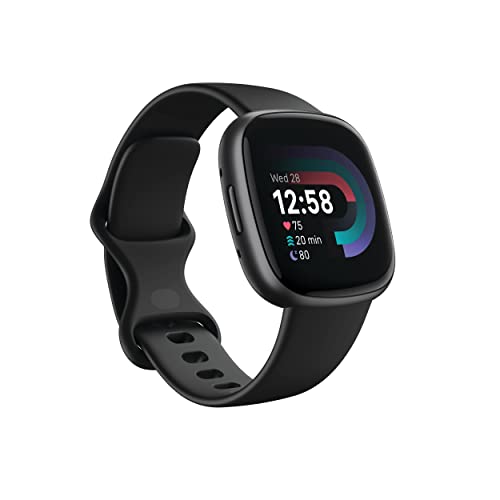
The Versa 4 is Fitbit’s full smartwatch shape with built-in GPS, so runs record pace and route with no phone. It keeps the friendly Fitbit layer on top: a Daily Readiness Score each morning, Active Zone Minutes through the week and sleep tracking that is simple to read.
Battery life of 6-plus days is strong for a bright-screen smartwatch, and Bluetooth calls plus Alexa cover daily convenience. What it does not do is deep training analysis or music storage, so it fits runners who train by feel and consistency rather than by structured plans.
Specs
- Built-in GPS and GLONASS; battery of 6-plus days, and up to 12 hours with continuous GPS; more than 40 exercise modes; Daily Readiness Score and Active Zone Minutes; display resolution 348 x 442 pixels; water resistant to 50 metres; Bluetooth calls and Amazon Alexa built in
Best for: Runners who want built-in GPS inside the Fitbit app experience, with smartwatch touches
Watch out for: No music storage and no third-party apps; some readiness features need Fitbit Premium
Amazfit Active 2 Premium (44 mm)

The Active 2 Premium is the surprise of the value tier: a sapphire-glass AMOLED screen, five-system satellite positioning and downloadable offline maps with turn directions, a set of features that usually lives on watches positioned far above it. Battery life reaches up to 10 days, and the Zepp app carries no mandatory subscription.
For runners, the run tracking is accurate and the screen is excellent in sunlight. The limits show in coaching depth: structured plans and recovery analysis are present but simpler than the dedicated running brands. As hardware per unit of money, very little on this page competes with it.
Specs
- Case 44 mm; 1.32-inch AMOLED display at 466 x 466 pixels under sapphire glass; five satellite positioning systems; free downloadable offline maps with turn directions; battery up to 10 days; more than 160 sport modes; case weight about 30 g; Zepp app with no mandatory subscription
Best for: Runners who want maps and an AMOLED screen without paying flagship running-watch money
Watch out for: Running-specific analysis such as race prediction is thinner than on Garmin or COROS watches
Which One Fits
- Choose the Garmin Forerunner 55 if you want a coach on your wrist: daily suggested workouts, pacing strategies and race predictions inside the Garmin platform.
- Choose the COROS PACE 3 if accuracy and endurance lead your list, with dual-frequency GPS and the longest battery in this guide.
- Choose the Fitbit Versa 4 if you like Fitbit’s friendly readiness and sleep tools and want built-in GPS without leaving that app.
- Choose the Amazfit Active 2 Premium if screen quality and offline maps excite you more than coaching depth.
Common Mistakes
Assuming the bracket guarantees every feature. Under 200 dollars buys a lot, but not everything. Music storage, payments and full maps are scattered unevenly across these models, so verify your one must-have feature on the exact model rather than assuming the tier includes it.
Choosing by screen alone. The prettiest screen here belongs to the watch with the shallowest coaching. Runners training for a goal usually get more from guidance than from pixels, so rank your priorities before comparing displays.
Ignoring GPS mode battery figures. Standby days make headlines, but GPS hours decide whether the watch survives your longest run with charge to spare. Compare the GPS figure against your peak training week.
Forgetting platform lock-in. Your history builds inside one app. All four platforms here export to Strava, which softens the lock-in, but plans and scores do not transfer. Pick the app you can live with for years.
FAQ
Is this bracket enough for marathon training?
Comfortably. All four watches record accurate GPS and heart rate, last through long runs with ease and offer pacing or planning tools. Many marathoners train their whole build on watches at this level and never miss the flagship features.
Which of these has the best GPS?
The COROS PACE 3, thanks to dual-frequency positioning that resists signal bounce in cities and forests. The others use single-band receivers that are accurate in open conditions and only show their limits among tall buildings or dense canopy.
Do watches in this bracket store music?
Mostly no. This tier generally offers music control of your phone rather than storage, with downloads from streaming services sitting one level up. If phone-free music is essential, look at dedicated Music models in the Garmin range.
How do these compare with a phone app for running?
A watch wins on heart rate, battery, convenience and not carrying a phone. If you already run with a phone and only need pace and distance, an app is free; the moment you want wrist heart rate and phone-free runs, this bracket is the entry point.
Final Verdict
For most runners, this bracket is the smart buy, and the COROS PACE 3 is its standout for pure running: dual-frequency GPS, a 30 g body and weeks of battery. The Forerunner 55 remains the coaching pick, the Versa 4 the friendly all-rounder, and the Active 2 Premium the hardware showpiece. Decide whether you want a coach, a recorder or a companion, and the choice makes itself.
Related guides
More from Amazon
Programs that pair well with the guide above. Offers and eligibility are set by Amazon and may change.
Free shipping on eligible items, Prime Video and more. Eligible new members can start with a free trial.
Start a Prime free trialAudiobooks and podcasts to listen to on the go. Eligible new members can start with a free trial.
Try Audible freeAd-free music streaming. Eligible new subscribers can start with a free trial.
Try Music Unlimited freeA free business account with business pricing and bulk-buying tools for work, shop or home office.
Create a business accountAs an Amazon Associate we earn from qualifying purchases.









Write Your Review
No reviews yet. Be the first to share your experience!