
Key takeaways
- Compare the best superzoom cameras for wildlife, travel and moon shots. Check zoom range, sensor size, 4K video and stabilisation before you pick one.
What's inside
As an Amazon Associate I earn from qualifying purchases. This post may contain affiliate links at no extra cost to you.
A superzoom camera asks you to trade one thing for another. You gain a lens that stretches from a wide landscape view to a bird perched far across a field, and you give up the larger sensor and interchangeable lenses that help a bigger camera after sunset. The right pick depends on how far your subjects sit, how much weight you will carry, and whether most of your shooting happens in bright daylight or morning light. Settle those answers before comparing zoom numbers, because the longest reach on the box is not always the camera you will enjoy using.

This guide is written for birdwatchers, travellers, parents filming school matches from the sidelines, and anyone who has tried to photograph the moon with a phone and come away with a pale dot. Each camera below was picked from the name and specifications on its Amazon product page, so the zoom range, sensor size and video format you see here match what the listing itself states.
Quick Picks
As an Amazon Associate we earn from qualifying purchases.
| Product | Best for | Key spec from title |
|---|---|---|
| Nikon Coolpix P950 | Birding at very long range | 83x optical zoom, 24-2000mm lens |
| Canon PowerShot SX70 HS | Travel with one light camera | 65x optical zoom, 21-1365mm lens |
| Sony Cyber-shot DSC-RX10 IV | Fast action in dimmer light | 25x optical zoom, 24-600mm Zeiss lens |
| Panasonic Lumix FZ80D | First superzoom for everyday shooting | 60x optical zoom, 20-1200mm lens |
How to Choose
Zoom Range and What It Costs You
Zoom range is the headline figure on every superzoom box, and it is also the figure most likely to mislead. A lens that reaches 2000mm lets you fill the frame with a heron across a lake, yet the same lens narrows to a small maximum aperture at full stretch, which lets in less light and makes a tripod or monopod almost essential. Shorter superzooms, such as a 25x lens ending at 600mm, keep a wider aperture and stay handholdable for longer. Ask how often your subjects sit beyond 100 metres. If the answer is rarely, a mid-range zoom will feel lighter, focus faster, and produce cleaner files than a record-breaking lens you seldom extend.
Sensor Size and Light Behaviour
Most superzoom cameras use a 1/2.3-inch sensor, which is small beside the 1-inch sensor in the Sony RX10 IV. That size gap shows up as soon as the light fades. The smaller sensor keeps the camera and lens compact and affordable, and it performs well in sunshine, at the beach, and on bright winter mornings. The larger 1-inch sensor gathers more light per pixel, so dusk wildlife, indoor sports halls, and shaded woodland come out with less grain and more detail in the shadows. If your shooting day ends at sunset rather than beginning at dawn, sensor size deserves as much attention as the zoom number on the front of the lens.
Autofocus and Burst Speed
A distant bird rarely waits for the camera to catch up, so autofocus speed and burst rate decide how many keepers you bring home. Look for phase-detection autofocus, which locks onto moving subjects more surely than contrast detection alone, and for a burst rate that holds focus between frames rather than firing blindly. The Sony in this guide pairs 315 phase-detection points with a very fast burst, which suits swallows, dogs, and children on a football pitch. The other cameras track well enough for perched birds and slow-moving animals. Check the listing for the autofocus system by name, and remember that long lenses magnify every small focus error.
Handling, Weight and Battery Life
Superzoom cameras look compact beside a camera with a separate telephoto lens, yet the longest models still weigh well over a kilogram and balance nose-heavy once the barrel extends. Try to picture a full morning carrying one on a strap: a deep grip, a bright electronic viewfinder, and a tilting screen matter more after two hours than they do in a shop. Battery life is the other quiet limit, because a full day of birding can drain a single charge before lunch. Carry a spare battery, a fast memory card with room for 4K clips, and a neck strap you trust, and check the listing for the battery model so the spare you buy fits.
The 4 Best Options
Nikon Coolpix P950
The P950 is the camera to look at when distance is the whole point of the purchase. Its 83x lens runs from 24mm to 2000mm, which brings a bird on a far fence post close enough to identify, and its Dual Detect Optical Vibration Reduction steadies the view while you frame at full stretch. RAW files give you room to lift shadows later, and the vari-angle screen helps when you shoot from a low hide or above a crowd. It is a big, deliberate camera rather than a pocket companion, and it rewards a monopod, patience, and bright conditions more than hurried grab shots.
Specs
- 83x optical zoom, 24-2000mm equivalent NIKKOR lens
- 16 megapixel 1/2.3-inch BSI CMOS sensor
- 4K UHD video recording
- RAW file support
- Dual Detect Optical Vibration Reduction
- 3.2-inch vari-angle LCD monitor
- Built-in Wi-Fi and Bluetooth
Best for: Birdwatchers and wildlife watchers who need the longest reach in a single fixed lens.
Watch out for: The small sensor shows grain sooner in dim light, so check your expectations for dawn and dusk shooting before buying.
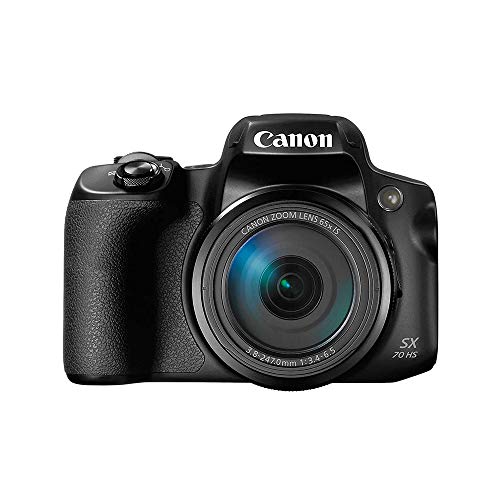
Canon PowerShot SX70 HS
The SX70 HS suits travellers who want one camera for a whole holiday without carrying extra lenses. Its 65x lens covers 21mm at the wide end, which is broader than most rivals and handy for streets and interiors, and stretches to 1365mm for distant landmarks and animals. The DIGIC 8 processor keeps the camera responsive, 4K video records family moments in fine detail, and the vari-angle screen folds out for low shots and self-recording. It is lighter than the Nikon models here, so it hangs comfortably from a shoulder all day, and its Wi-Fi and Bluetooth links move pictures to a phone for sharing on the move.
Specs
- 65x optical zoom, 21-1365mm equivalent lens
- 20.3 megapixel 1/2.3-inch CMOS sensor
- DIGIC 8 image processor
- 4K video recording
- 3.0-inch vari-angle LCD monitor
- Built-in Wi-Fi and Bluetooth
- 10 frames per second continuous shooting
Best for: Travellers who want wide-angle views and very long reach in one light body.
Watch out for: The lens narrows to a small aperture at full zoom, so bright daylight gives the cleanest results at the long end.
Sony Cyber-shot DSC-RX10 IV
The RX10 IV is the most capable camera in this group, and the one that behaves most like a serious photographic tool. Its 1-inch sensor is much larger than the sensors in the other three cameras, which shows in cleaner low-light files and softer backgrounds. The 25x Zeiss lens stops at 600mm, so it gives up extreme reach, yet its 0.03-second autofocus and 315 phase-detection points lock onto moving subjects with a confidence the others cannot match. It also records 4K video with strong detail and a tilting touchscreen. Buyers who photograph sport, dogs, or birds in flight will notice the difference every time the subject moves.
Specs
- 25x optical zoom, 24-600mm Zeiss Vario-Sonnar T* lens
- 20.1 megapixel 1-inch Exmor RS CMOS sensor
- 0.03-second autofocus with 315 phase-detection points
- 24 frames per second continuous shooting with AF/AE tracking
- 4K video recording
- 3.0-inch tilting touchscreen LCD
- Built-in Wi-Fi, Bluetooth and NFC
Best for: Action, sport and wildlife in flight, where autofocus speed and low-light quality matter most.
Watch out for: The 600mm maximum reach is far shorter than the other cameras here, so check that it covers the distances you actually shoot at.
Panasonic Lumix FZ80D
The FZ80D is the simplest way into superzoom photography, and it covers the basics with surprising completeness. Its 60x lens runs from 20mm to 1200mm, which is wide enough for landscapes and long enough for the moon, while 4K Photo mode lets you pull a still frame from a video clip when timing is tricky. Power O.I.S. steadies handheld shots at long focal lengths, the touchscreen makes focus point selection quick, and the electronic viewfinder helps on sunny days when a rear screen washes out. It is a friendly first superzoom, and a useful second camera for anyone who already owns a larger system.
Specs
- 60x optical zoom, 20-1200mm equivalent lens
- 18.1 megapixel 1/2.3-inch MOS sensor
- 4K video recording and 4K Photo mode
- Power O.I.S. image stabilisation
- 3.0-inch touchscreen LCD monitor
- 2,360k-dot electronic viewfinder
- Built-in Wi-Fi connectivity
Best for: Beginners and casual shooters who want a wide zoom range in a straightforward camera.
Watch out for: The small sensor and slower lens at full zoom mean dim indoor scenes will look softer than outdoor daylight shots.
Which One Fits Your Situation
Birding From a Hide or a Distant Shore
Choose the Nikon Coolpix P950. Its 2000mm reach fills the frame with birds far beyond the range of the other cameras, and its vibration reduction helps you hold the composition steady while you wait. The vari-angle screen suits low hides, and RAW files let you recover detail from feathers in tricky light. Accept the weight and carry a monopod, because the reach that makes this camera special also makes it hardest to handhold at full stretch.
One Camera for a Whole Holiday
Choose the Canon PowerShot SX70 HS. Its 21mm wide end handles streets, rooms, and landscapes, and the 65x zoom still reaches distant animals and landmarks when the moment appears. It is the lightest camera in this group, its battery lasts well through a day of sightseeing, and Wi-Fi moves pictures to a phone for sharing the same evening. If your bag has room for one camera and no extra lenses, this is the most flexible shape of superzoom.
Fast Subjects and Fading Light
Choose the Sony Cyber-shot DSC-RX10 IV. Its larger 1-inch sensor keeps files cleaner as the light drops, and its autofocus locks onto running dogs, flying birds, and players mid-sprint faster than any other camera here. The 24 frames per second burst with tracking means more of those moments land in focus. You trade away the longest reach, so this pick suits buyers whose subjects come within a few dozen metres rather than sitting on a far horizon.
Learning Superzoom Photography
Choose the Panasonic Lumix FZ80D. Its controls are direct, its touchscreen makes focusing intuitive, and its 20mm wide end forgives framing mistakes that a narrower lens would punish. The 4K Photo mode is a kind teacher, letting you extract the exact frame where a bird takes off or a child jumps. It is also the most approachable camera in this group to carry and to learn on, which matters more in the first months than any single specification.
Common Mistakes
- Buying for the biggest zoom number alone, without checking sensor size, aperture at full zoom, and autofocus behaviour.
- Shooting handheld at maximum zoom and expecting sharp pictures, when a monopod or a faster shutter speed would have saved the shot.
- Forgetting a spare battery and a fast memory card, then running out of power or storage halfway through a day outdoors.
- Expecting a small-sensor superzoom to match a larger camera in dim light, and blaming the lens for grain that comes from the sensor.
- Leaving the camera on full automatic for wildlife, instead of learning the focus-area and burst settings that keep moving subjects sharp.
Frequently Asked Questions
What is a superzoom camera?
A superzoom camera is a fixed-lens bridge camera with a very long optical zoom range, usually from around 20mm at the wide end to 600mm or far beyond. The lens cannot be removed, so one body covers landscapes, portraits, and distant wildlife. Most models use a small sensor to keep the lens compact, though the Sony RX10 IV uses a larger 1-inch sensor for cleaner low-light results.
Can a superzoom camera photograph the moon?
Yes, and this is a popular use for the category. A lens reaching 1200mm or 2000mm fills the frame with the moon and shows craters a phone or a short lens cannot resolve. Use a tripod or steady surface, switch off digital zoom, and set a fast shutter speed to avoid blur. The Nikon P950 is the strongest choice, since its 2000mm reach shows lunar detail without cropping.
Do superzoom cameras work well in low light?
They work best in bright light, because the sensors in most models gather less light than a larger sensor. Dusk and indoor shots show more grain, and the lens aperture narrows at full zoom, which worsens the problem. The Sony RX10 IV handles dim conditions best here thanks to its 1-inch sensor and brighter lens. For the others, shoot in daylight, raise the ISO only when needed, and brace it.
Is a superzoom camera better than a phone with digital zoom?
For distant subjects, yes. A superzoom uses true optical magnification, so a bird at 100 metres stays detailed, while a phone crops and enlarges a small part of its image, softening feathers and fur. Phones still win for convenience, night modes, and instant sharing, and suit everyday scenes. A superzoom earns its place when your subject sits too far away for a phone to reach without heavy cropping.
Related guides
More from Amazon
Programs that pair well with the guide above. Offers and eligibility are set by Amazon and may change.
Free shipping on eligible items, Prime Video and more. Eligible new members can start with a free trial.
Start a Prime free trialAudiobooks and podcasts to listen to on the go. Eligible new members can start with a free trial.
Try Audible freeAd-free music streaming. Eligible new subscribers can start with a free trial.
Try Music Unlimited freeA free business account with business pricing and bulk-buying tools for work, shop or home office.
Create a business accountAs an Amazon Associate we earn from qualifying purchases.










Write Your Review
No reviews yet. Be the first to share your experience!