
Our Short List of 3

- Best for: photographers who want maximum full-frame detail plus subject-aware autofocus for mixed subjects.
- Mount: Sony E
- Sensor: 61.0 MP full-frame back-illuminated Exmor R CMOS
- Processor: BIONZ XR with dedicated AI processing unit
- Autofocus: Real-time Recognition AF with deep learning
- Best for: stills photographers who mostly shoot static subjects but want speed in reserve.
- Mount: Canon RF
- Sensor: 45 MP full-frame CMOS
- Processor: DIGIC X
- ISO range: 100-51200

- Best for: landscape and portrait photographers who shoot deliberately and value dynamic range over burst speed.
- Mount: Nikon Z
- Sensor: 45.7 MP full-frame
- Processors: dual EXPEED 6
- Autofocus: 493-point phase-detect AF system with Eye-Detect AF
All 4 Picks at a Glance
| Product | Specs | Action |
|---|---|---|
| Sony a7R V |
| Check price on Amazon |
| Canon EOS R5 |
| Check price on Amazon |
| Nikon Z7 II |
| Check price on Amazon |
 Fujifilm GFX100 II |
| Check price on Amazon |
Key takeaways
- Four stills-first cameras verified on Amazon US, from 45MP full-frame bodies to a 102MP medium format flagship, compared on detail, dynamic range and colour.
What's inside
As an Amazon Associate I earn from qualifying purchases. This post may contain affiliate links at no extra cost to you.
A camera bought purely for photography is judged differently from a hybrid. Video menus and recording limits stop mattering; what counts is how much detail the sensor holds, how gracefully it handles shadow and highlight, how the viewfinder helps you compose, and whether the colour makes you want to keep shooting. The mistake is chasing the biggest megapixel number without asking where those files will end up.
This roundup is for stills photographers: landscape shooters who print, portrait and studio workers, and enthusiasts upgrading to a body they plan to keep for years. The four cameras below were selected from the specifications on their Amazon US pages: the Sony a7R V, Canon EOS R5, Nikon Z7 II and Fujifilm GFX100 II, spanning high-resolution full frame and medium format.
Quick Picks
As an Amazon Associate we earn from qualifying purchases.
| Product | Best for | Key spec from title |
|---|---|---|
| Sony a7R V | Resolution plus intelligent autofocus | 61.0 MP full-frame BSI Exmor R sensor |
| Canon EOS R5 | Stills with fast bursts when needed | 45 MP full-frame CMOS sensor, DIGIC X |
| Nikon Z7 II | Slow, deliberate landscape photography | 45.7 MP full-frame sensor, dual EXPEED 6 |
| Fujifilm GFX100 II | Maximum detail for prints and studio | 102 MP medium format sensor, X-Processor 5 |
How to Choose
Resolution you will actually use
Megapixels only help if your output needs them. A 61 MP or 102 MP file rewards large prints, gallery work and aggressive cropping, but it also fills cards and hard drives quickly and punishes sloppy technique. Photographers who mainly share images online or print at moderate sizes will not see the full benefit of the biggest sensors here. Be honest about your end use: choose the resolution that matches your prints, not the largest number on the box, and budget for the storage and computing power big files demand.
Dynamic range and low-ISO quality
For stills, what happens at base ISO matters more than headline high-ISO figures. Landscape and studio photographers live at low sensitivities, where clean shadows let you lift exposure in editing without noise falling apart. Back-illuminated sensors, like the ones in the Sony and Nikon bodies here, are designed to help exactly there. Check the native ISO range on each listing and think about how much you recover shadow detail in your current editing workflow, because that is where these cameras separate.
The viewfinder and screen shape your compositions
You compose every photograph through the finder, so its clarity is a daily quality, not a spec-sheet footnote. The Fujifilm GFX100 II lists a 9.44-million-dot EVF, the sharpest here, while the Canon EOS R5’s manufacturer comparison on its page lists a 5.76-million-dot finder. Tilting screens matter too for low tripod work and waist-level framing. If you shoot slowly and deliberately, finder quality is worth prioritising over burst speed you will rarely touch. Try to handle shortlisted bodies if you can, because finder size, eye relief and control layout are personal, and a camera that feels awkward will quietly discourage you from taking it out.
Colour: film character or neutral files
Stills photographers divide into two camps. Some want neutral RAW files and full control in editing; others want JPEGs with character straight from the camera. Fujifilm builds its reputation on film-inspired colour, and its listing highlights RAW, JPEG and HEIF capture with its colour science. Canon, Nikon and Sony take a more neutral starting point that suits heavy grading. Neither approach is wrong, but picking the one that matches how you actually finish images saves hours every month. Download sample files from each system before you buy; ten minutes comparing skin tones and foliage will tell you more than any specification table.
The 4 Best Options
Sony a7R V
- Best for: photographers who want maximum full-frame detail plus subject-aware autofocus for mixed subjects.
- Mount: Sony E
- Sensor: 61.0 MP full-frame back-illuminated Exmor R CMOS
- Processor: BIONZ XR with dedicated AI processing unit
- Autofocus: Real-time Recognition AF with deep learning
photographers who want maximum full-frame detail plus subject-aware autofocus for mixed subjects.
61 MP files are large, so confirm your cards, storage and computer can keep up before committing.
The a7R V pairs the highest full-frame resolution here with autofocus intelligence that stills shooters genuinely use. Its dedicated AI processing unit drives Real-time Recognition AF, which helps when the photograph includes people, animals or vehicles, while the 61.0 MP back-illuminated sensor delivers the cropping freedom landscape and studio photographers want. Sensor-shift stabilisation supports handheld work, continuous shooting reaches 10 fps for a stills body that can react when a scene moves, and two card slots protect a day’s work. It is the most versatile pure-photography body in this group.
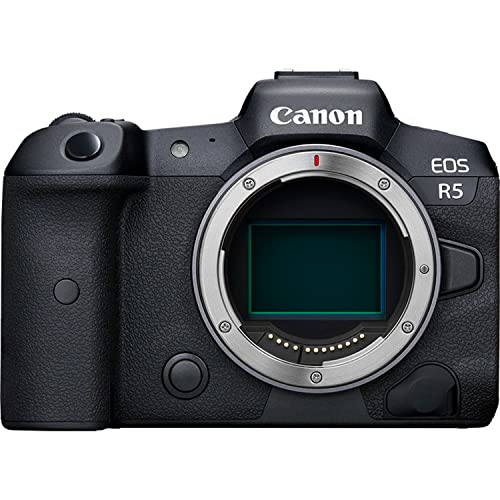
Canon EOS R5
- Best for: stills photographers who mostly shoot static subjects but want speed in reserve.
- Mount: Canon RF
- Sensor: 45 MP full-frame CMOS
- Processor: DIGIC X
- ISO range: 100-51200
stills photographers who mostly shoot static subjects but want speed in reserve.
the two slots take different card formats, so check which cards you already own before pricing the switch.
The EOS R5 is the stills all-rounder of this group: a 45 MP sensor that resolves plenty for large prints, paired with burst speeds that cover the occasional moving subject without turning the camera into a sports body. Canon’s page highlights Dual Pixel CMOS AF II across roughly the whole frame with 1,053 AF areas, in-body stabilisation rated up to eight stops, and a 5.76-million-dot viewfinder in its comparison table. The magnesium alloy body and dual slots, one CFexpress Type B and one SD UHS-II, suit photographers who work outdoors and cannot reshoot a missed moment.
Nikon Z7 II
- Best for: landscape and portrait photographers who shoot deliberately and value dynamic range over burst speed.
- Mount: Nikon Z
- Sensor: 45.7 MP full-frame
- Processors: dual EXPEED 6
- Autofocus: 493-point phase-detect AF system with Eye-Detect AF
landscape and portrait photographers who shoot deliberately and value dynamic range over burst speed.
one slot uses CFexpress or XQD media rather than SD, so factor a new card into the total cost.
The Z7 II is built around a slower, more deliberate way of working, and its listing says so plainly: an ultra-high resolution 45.7 MP sensor with, in Nikon’s words, brilliant dynamic range. Dual EXPEED 6 processors keep the camera responsive and deepen the buffer, the 493-point autofocus system includes Eye-Detect modes for portraits, and 5-axis in-body stabilisation steadies handheld frames. Two card slots accept CFexpress or XQD in one and SD in the other. For landscape photographers who compose on a tripod and expose carefully, this feature set is aimed precisely at them.
Fujifilm GFX100 II
- Best for: studio, landscape and fine-art photographers whose prints and clients justify medium format.
- Mount: Fujifilm G
- Sensor: 102 MP medium format CMOS II HS, 43.8 x 32.9 mm
- Processor: X-Processor 5
- Maximum image size: 11648 x 8736 pixels
studio, landscape and fine-art photographers whose prints and clients justify medium format.
GF lenses and the body itself are a separate, costlier system, so price at least one lens before deciding.
Medium format is the step beyond full frame, and the GFX100 II is its current flagship expression. The 102 MP sensor measures 43.8 by 32.9 millimetres, about 1.7 times the area of full frame according to the listing, which is what produces the depth and tonal gradation studio and landscape photographers chase. Fujifilm pairs it with the X-Processor 5, subject-detection autofocus unusual in this class, up to eight stops of in-body stabilisation, and a 9.44-million-dot EVF. It even shoots stills at up to 8 fps, brisk for medium format, and pixel shift multi-shot builds 400 MP files for reproduction work.
Which One Fits Your Situation
You print large for walls, galleries or clients
Print size is where resolution stops being a luxury. The Fujifilm GFX100 II offers the most headroom, with 102 MP and pixel shift for extreme detail. If medium format stretches the budget too far, the Sony a7R V’s 61 MP full-frame files still print very large with careful technique, and its lens system costs less to build out over time.
You shoot landscapes slowly from a tripod
Deliberate work rewards dynamic range and a clear finder more than frame rates. The Nikon Z7 II is shaped for exactly this: high resolution, dual processors for a responsive feel, and stabilisation for the moments the tripod stays folded. The Canon EOS R5 is the alternative if your landscape trips also include wildlife or people, where its autofocus coverage and burst speeds help.
Portraits and studio work pay your bills
Skin tones, tethering workflows and dependable autofocus decide studio cameras. The Sony a7R V’s recognition autofocus keeps eyes sharp at wide apertures, while the GFX100 II gives portraitists the medium format rendering clients notice in large prints. The EOS R5 sits between them, with Eye Control AF on its listing that lets you place focus by looking at the subject.
You want one body to keep for many years
Longevity favours deep lens systems and robust bodies. The Sony, Canon and Nikon bodies here all sit in mature full-frame systems with wide lens choice, so any of them can anchor a kit for a decade. Choose by the lenses you want next rather than the body alone, because you will replace the body long before you replace good glass.
Common Mistakes
- Choosing a camera by megapixels alone, then discovering your computer and storage cannot handle the files comfortably.
- Ignoring lens system costs, especially with medium format, where one GF lens can rival a full-frame body.
- Assuming a stills-first camera needs flagship burst speeds, and paying for performance your subjects never require.
- Overlooking card formats when switching systems, since CFexpress media adds real cost on top of the body.
- Judging colour from spec sheets instead of sample files, when colour rendering is one of the main reasons to pick a system.
Frequently Asked Questions
How many megapixels does a photo camera really need?
For prints up to moderate sizes and online use, even 24 MP is plenty. The 45 to 61 MP bodies here earn their place when you print large, crop significantly, or sell work where clients zoom into detail. The 102 MP GFX100 II serves reproduction and gallery-scale output. Match resolution to your largest realistic print, not to the biggest number available.
Is medium format worth it over full frame for stills?
It can be, for the right work. The larger sensor in the GFX100 II delivers finer tonal gradation and detail that shows in big prints and demanding studio jobs. The trade-offs are cost, size and a smaller lens range. Photographers who print modestly or shoot varied subjects usually get better value from the high-resolution full-frame bodies in this guide.
Does in-body stabilisation matter for photography?
Yes, mainly for handheld stills in low light: slower shutter speeds stay usable, which keeps ISO down and files cleaner. All four cameras here include sensor-shift stabilisation, rated up to eight stops on the Canon and Fujifilm listings. On a locked-off tripod it matters less, and most landscape shooters switch it off there, but for walk-around photography it is a genuine advantage.
Should stills photographers care about video specs at all?
Only lightly. Every camera here records capable video, but if you shoot photographs exclusively, those features should not drive the decision or the budget. Sensor quality, dynamic range, viewfinder clarity and lens choice shape your results every day. Treat video as a bonus for the occasional clip rather than a reason to pick one of these bodies over another.
Related guides
More from Amazon
Programs that pair well with the guide above. Offers and eligibility are set by Amazon and may change.
Free shipping on eligible items, Prime Video and more. Eligible new members can start with a free trial.
Start a Prime free trialAudiobooks and podcasts to listen to on the go. Eligible new members can start with a free trial.
Try Audible freeAd-free music streaming. Eligible new subscribers can start with a free trial.
Try Music Unlimited freeA free business account with business pricing and bulk-buying tools for work, shop or home office.
Create a business accountAs an Amazon Associate we earn from qualifying purchases.










Write Your Review
No reviews yet. Be the first to share your experience!